Following the American Civil War Sesquicentennial with day by day writings of the time, currently 1863.

Thursday, June 6, 2013

Sunday, June 7.—Have had quite a number of men die to-day. I have not been very well for some days, and hence have not visited the sick. Mrs. W. has been paying them all attention. She has told me about two, whom she has been attending in the room near ours. One was a Mr. Allison from Louisiana, between sixty and seventy years of age. He was a substitute; and has left eight children, the most of whom are in the service. The other one, Mr. Johnson, in the next bunk to him, was in his seventeenth year. About the same time the spirits of the aged pilgrim and youthful martyr were wafted to realms on high, where I trust they are now at rest in the “balm-breathing presence of God.”

We have a very nice lady, Mrs. Ellis, wife of one of the officers, in the hospital, who takes charge of the linen department, and is of great assistance.

A chaplain preached this afternoon in one of our wards; his text was, “Seek ye first the kingdom of heaven.” The sermon was a very impressive one. The men listened to it with the most profound attention. I have observed that soldiers generally are very attentive listeners during divine service. I should have enjoyed the sermon much better if my attention had not been drawn to the extravagant dress of the Speaker. I could not but think, if he had worn a gown to hide it, that it would have been much more in keeping with his priestly office. His uniform was one of the most showy I have ever seen worn by any of our officers since the war; it was of the finest black broadcloth, cut “a la militaire,” with the usual amount of gilt buttons. As I gazed at him, I thought, with Cowper,


“A heavenly mind

May be indifferent to her house of clay,

And slight the hovel as beneath her care;

But how a body so fantastic, trim,

And quaint in its deportment and attire

Can lodge a heavenly mind, demands a doubt.”


I am told he is much beloved in the army, and has been the means of doing a great deal of good. His clothes were presented to him by his brigade, for his kindness to the men; but I do wish he would not wear them, especially at this time, when such clothes are certain to be the subject of remark, worn by any one, but much more by an embassador of the lowly Jesus. I often wish I was not quite so prejudiced against these things. Affectation in dress I dislike, as much as in manners.


“In man or woman, but most in man,

And most of all in man that ministers

And serves the altar, in my soul I loath

All affectation; ’tis my perfect scorn.”
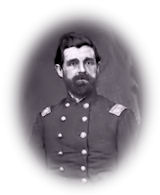
Colonel Lyons.

Fort Donelson, June 6, 1863.—The cavalry started today—Major Bond’s expedition also, and it is very quiet here. I have been beset today by women whose husbands are in the guard-house—citizens. One complained that she had eight small children and nothing to eat. Her husband was caught taking a load of whisky South some time since. I promised to investigate the cases soon.

You recollect a Court-Martial at Fort Henry last winter, of which Lieutenant Warren was a member. They sentenced a private in Flood’s Battery to be shot. The sentence has just come back approved, with a direction to Colonel Lowe to execute it. As Colonel Lowe is named in the order I do not like to shoot the fellow without further orders. He is the worst desperado I ever saw. He is the fellow that used to break his fetters so often last winter, and once he escaped. He has slipped his handcuffs twenty-seven times and proposes to make it a round thirty before he gets through.

Saturday, 6th—Lieut. Black took all men able for duty and started to Sligo this morning. To-night the Company got in from G.

JUNE 6TH.—Still banging away. I took a horseback ride around the line to the left in the rear of McClernand’s corps. Everywhere I went I was met with the familiar zip, zip, of rebel bullets flying promiscuously through the air. I read a northern rebel paper, received by a member of the 96th Ohio, filled with false statements about the soldiers around Vicksburg. It said a great many of Grant’s soldiers were deserting. This is of course false, for I have heard of but two deserting their flag in time of need. Those two will never be able to look their old comrades in the face, for if they escape the penalty of death, disgrace and ignominy will not only follow them through life, but stamp their memories and lineage with infamy. The scorn of every loyal soldier will follow these cowards who have deserted in the face of the foe. No true-hearted mother or father can welcome the return of such recreants, who not only disgrace themselves but all their kindred. This paper also stated that the soldiers around Vicksburg are dying off like flies. This is another falsehood, for the army is in good health and spirits, and looking forward to victory with assurance.

June 6. — Got up at 3.30 A.M., but all to no purpose, as we did not move to-day. In the afternoon, I went with General Reynolds down to the signal station near the Fitzhugh house. Could see two guns in position on the Bowling Green Road, and the enemy behind their rifle-pits. On the way back, General Reynolds sent me to General Sedgwick. Found his headquarters on the bluff, just opposite the bridges. He was very kind indeed, and spoke of receiving a letter from Miss Kate Sedgwick, in which she spoke about me. As I left General S. the rain began to pour down, and before I reached camp we had quite a heavy thunder shower which was extremely welcome. Introduced myself to General Wright[1] this afternoon. He remembered me and was quite pleasant.


[1] General Horatio G. Wright was the officer with whom I served at Port Royal as volunteer aide. He afterwards commanded the Sixth Corps.

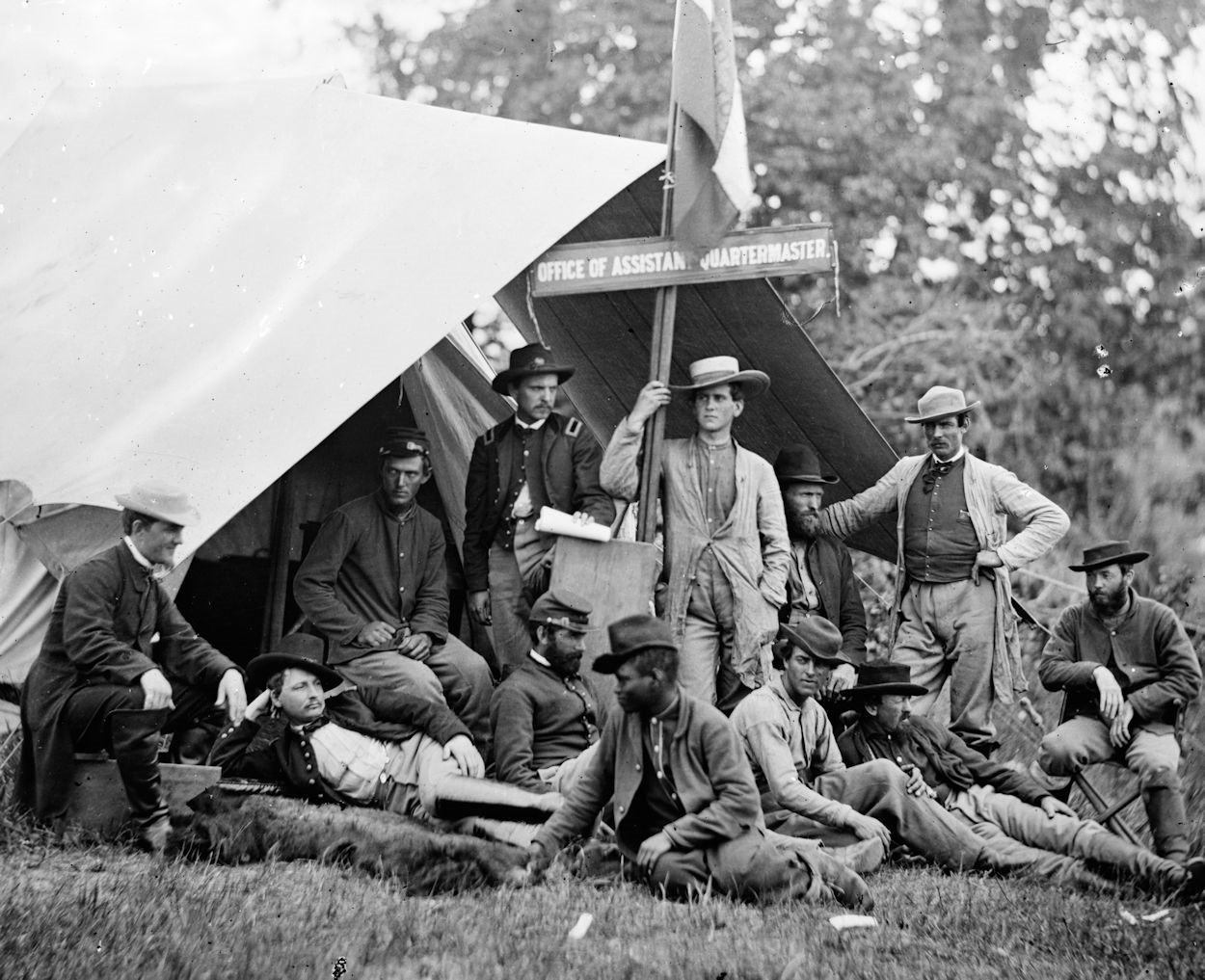
Fairfax Courthouse, Virginia. Capt. J.B. Howard, Office of Assistant Quartermaster, Army of the Potomac

Fairfax Courthouse, Virginia. Capt. J.B. Howard and group, Office of Assistant Quartermaster, Army of the Potomac; June 1863; photo by Timothy H. O’Sullivan.

Library of Congress image.

__________

digital file from original neg.Note – This image has been digitally adjusted for one or more of the following:

  • fade correction,
  • color, contrast, and/or saturation enhancement
  • selected spot removal.

Saturday, 6th—Several companies from our brigade were detailed to go out last night and work as sappers and miners on the rifle pits. Our forces are working their way closer to the rebels’ works every day, and Vicksburg is now almost completely surrounded. The rebels are running short of provisions, it is said, and are anxious for reinforcements to break the siege. They made attacks today on our outside lines at four or five different points, driving in our pickets.

June 6 — This afternoon our battalion was ordered to move toward the Rappahannock. We marched to within one mile of the river, on the Beverly Ford road, and camped in the south edge of a woods on the west side of the Beverly Ford road. However, this is more of a bivouac than a camp, as we are not allowed to unload our baggage, as we are within one mile of the Yankee line, which is on the north bank of the Rappahannock, and nothing between us and the enemy but a cavalry picket line. Hood’s division of infantry passed us this evening, moving down the river.

6th June (Saturday).—Arrived at Atlanta at 3 A.M., and took three hours’ sleep at the Trouthouse hotel. After breakfasting, I started again for Augusta at 7 A.M. (174 miles); but the train had not proceeded ten miles before it was brought up by an obstruction, in the shape of a broken-down freight train, one of whose cars was completely smashed. This delayed us for about an hour, but we made up for it afterwards, and arrived at Augusta at 5.15 P.M.

The country through Georgia is undulating, well cultivated, and moderately covered with trees; and this part of the Confederacy has as yet suffered but little from the war. At some of the stations provisions for the soldiers were brought into the cars by ladies, and distributed gratis. When I refused on the ground of not being a soldier, these ladies looked at me with great suspicion, mingled with contempt, and as their looks evidently expressed the words, “Then why are you not a soldier?” I was obliged to explain to them who I was, and show them General Bragg’s pass, which astonished them not a little. I was told that Georgia was the only state in which soldiers were still so liberally treated—they have become so very common everywhere else. On reaching Augusta, I put up at the Planter’s-house hotel, which seemed very luxurious to me after so many hours of the cars. But the Augusta climate is evidently much hotter than Tennessee.

June 6, Saturday. Am unhappy over our affairs. The Army of the Potomac is doing but little; I do not learn that much is expected or intended. The failure at Chancellorsville has never been satisfactorily explained. Perhaps it cannot be. Some of the officers say if there had been no whiskey in the army after crossing the Rappahannock we should have had complete success. But the President and Halleck are silent on this subject.

How far Halleck is sustaining Grant at Vicksburg I do not learn. He seems heavy and uncertain in regard to matters there. A further failure at V. will find no justification. To-day he talks of withdrawing a portion of the small force at Port Royal. I am not, however, as anxious as some for an immediate demonstration on Charleston. There are, I think, strong reasons for deferring action for a time, unless the army is confident of success by approaches on Morris Island. Halleck is confident the place can be so taken. But while he expresses this belief, he is not earnest in carrying it into effect. He has suddenly broken out with zeal for Vicksburg, and is ready to withdraw most of the small force at Port Royal and send it to the Mississippi. Before they could reach Grant, the fate of Vicksburg will be decided. If such a movement is necessary now, it was weeks ago, while we were in consultation for army work in South Carolina and Georgia.

Halleck inspires no zeal in the army or among our soldiers. Stanton is actually hated by many officers, and is more intimate with certain extreme partisans in Congress — the Committee on the Conduct of War and others —than with the Executive Administration and military men. The Irish element is dissatisfied with the service, and there is an unconquerable prejudice on the part of many whites against black soldiers. But all our increased military strength now comes from the negroes. Partyism is stronger with many in the Free States than patriotism. Every coward and niggardly miser opposes the War. The former from fear, lest he should be drafted; the latter to avoid taxes.

The examination at the Naval School has closed, and the practice ship, the Macedonian, sails to-day. The report of the board is highly commendatory of the school. I have, amidst multiplied duties, tried to make the school useful, and have met with opposition and obstruction when I should have had support.