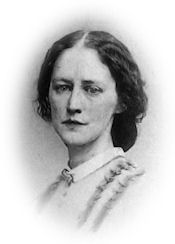
Georgeanna Woolsey to Francis Bacon.
Fishkill, Aug. 6, ’63.
Mother and I were in Gettysburg when your letter came, having hurried on immediately after the battle, under the impression, due to a mistake in telegraphing, that Charley was hurt; and, being on hand, were fastened upon by Mr. Olmsted, to take charge of a feeding station and lodge for the wounded men. So there we were, looking after other people’s boys, since our own was safe, for three weeks, coming as near the actual battle field as I should ever wish to. You know all about that fighting, how desperate it was on both sides; what loss, and what misery; the communications cut, no supplies on hand, no surgeons, or so few that they were driven to despair from the sight of wretchedness they could not help,—20,000 badly wounded soldiers and only one miserable, unsafe line of railroad to bring supplies and carry men away. We were twenty-four hours in getting from Baltimore to Gettysburg, when in ordinary times we should have been four. This was the only excuse I could think of to give the wretched rebels who, two weeks after the battle, lay in the mud under shelter tents, and had their food handed them in newspapers: “I am sorry, my man; we are all distressed at it; but you have cut our communications and nothing arrives.”
Never say anything against the Army of the Potomac again, when so few of our men, after their marching and fasting, overtook and overcame Lee’s fatted twice-their-number. I saw but very few who were slightly hurt among the wounded, and we fed all the 16,000 who went away from Gettysburg. So brave as they were too, and so pleased with all that was done for them—even the rebels. We had our station with tents for a hundred, with kitchen, surgeon and “delegation,” right on the railroad line between Gettysburg and Baltimore, and twice a day the trains left with soldiers,—long trains of ambulances always arriving just too late for the cars, and no provision being made to shelter and feed them except by the Sanitary Commission. We had the full storehouse of the Commission to draw upon, and took real satisfaction in dressing and comforting all our men. No man of the 16,000 went away without a good hot meal, and none from our tents without the fresh clothes they needed. Mother put great spirit into it all, listened to all their stories, petted them, fed them, and distributed clothes, including handkerchiefs with cologne, and got herself called “Mother,”—”This way, Mother,” “Here’s the bucket, Mother,” and “Isn’t she a glorious old woman?”—while the most that I ever heard was, “She knows how; why, it would have taken our steward two hours to get round; but then she’s used to it, you see;” which, when you consider that I was distributing hot grog, and must have been taken for a barmaid, was not so complimentary! Then those rebels too, miserable fellows; we hated them so much when they were away from us, and couldn’t help being so good to them when they were in our hands. I am, or should be, angry with myself in that I felt worse when Lieutenant Rhout of the 14th South Carolina died on my hands, singing the Lutheran chants he had sung in his father’s church before they made a soldier of him, than when E. C. writes me that “Amos” was their oldest son, and that she and his father were over sixty. . . . I am glad we helped those rebels. They had just as much good hot soup, when our procession of cans and cups and soft bread and general refreshment went round from car to car, as they wanted; and I even filled the silver pap‑cup that a pretty boy from North Carolina had round his neck, though he was an officer and showed no intention to become a Unionist. “Yes, it was his baby-cup,” and “his mother gave it to him;” and he lay on the floor of the baggage car, wounded, with this most domestic and peaceful of all little relics tied round his neck. We had lovely things for the men to eat —as many potatoes and turnips as they wanted, and almost “too much cabbages”; and custard pudding, and codfish hash, and jelly an inch high on their bread, and their bread buttered” buttered on both sides,” as the men discovered, greatly to their amusement one night, considering that the final touch had been given when this followed the clean clothes and cologne,—”cologne worth a penny a sniff.” “I smell it up here,” a soldier called to me, poking his head out of the second story window, while I and my bottle stood at the door of his hospital.
If at any time you would like to swear, call your enemy a Dutch farmer—nothing can be worse, or, if he is a man of decency, make him feel more indignant. The D— farmers of Gettysburg have made themselves a name and a fame to the latest day, by charging our poor men, who crawled out of the barns and woods where they hid themselves after they were wounded, three and four dollars each for bringing all that was left of their poor bodies, after defending the contemptible D— firesides, down to the railroad. We found this out, and had a detail from the Provost Marshal to arrest the next farmer who did it, and oblige him to refund or go to prison. The day before we came away a sleepy-looking, utterly stupid Dutchman walked into camp, having heard we had “some rebels.” He lived five miles from the city and had “never seen one,” and came mooning in to stare at them, and stood with his mouth open, while the rebels and ourselves were shouting with laughter, he “pledging his word” that “he never saw a rebel afore.” “And why didn’t you take your gun and help drive them out of your town?” Mother said. “Why, a feller might a got hit;” at which the rebels, lying in double rows in the tent, shook themselves almost to pieces.
It was a satisfaction to be in Gettysburg, though I confess to a longing to shut out the sight of it all, sometimes. The dear fellows were so badly hurt, and it was so hard to bear their perfect patience; men with a right arm gone, and children at home, and no word or look of discontent.
The authorities want us to go back again, and look after the special diet in the new and fine General Hospital for 3000 men, too sick to be moved. We can’t do so, though, as Jane and I have promised to spend the winter at Point Lookout in the Hammond Hospital. Look with respect upon your correspondent; she is at the head of the Protestant half of the women’s department of that hospital. The Sisters run half the wards, and I expect to have fun with their Lady Superior and to wheedle her out of all her secrets, and get myself invited out to tea. Why shouldn’t she and I compare notes on the proper way to make soup? I will call her “Sister,” and agree to eat oysters on Friday,—(they are particularly fine on the Maryland shore).
It will be rather jolly down there, particularly as the surgeon in charge is delighted to have us come, and we shall ride over him just as much as your dear old women, black and white, do over their particular conquest. As for gardens of oranges, and flowers—well, we shall have beds of oysters, and, as it is a military station, there will be a band there to keep up our spirits; which reminds me to give the Baltimore fireman his due, who, being one of our friends at Gettysburg, secured two bands before we came away and marched them down to camp to serenade us, which they did standing at the mouth of the long tent and refreshing themselves afterwards with gingerbread and punch, unmindful of the fact that the jolly Canandaigua “delegation,” finding its fingers inconvenienced by the sugar on them, just dipped their hands in the claret and water without saying anything! It will be a long time before Gettysburg will forget the Army of the Potomac. Their houses are battered, some of them with great holes through and through them. Their streets are filled with old caps, pieces of muskets, haversacks, scraps of war everywhere, and even the children fling stones across the streets, and call to each other, “Here, you rebel, don’t you hear that shell?” and one babe of four years I found sitting on the pavement with a hammer peacefully cracking percussion caps from the little cupful he had. . . .
What a good thing the public burying of the colored Captain has been, down where you are in New Orleans. Send me some more accounts of your hospital.