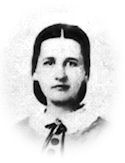
November 1st, 1866.—My dear little friend, my confidential friend of many years, I am telling you goodbye. Whatever the future may bring me of weal or woe will not he recorded. This is MY DAY, my wedding day.
“Happy is the bride that the sun shines on” and from dawn until the evening hour the sun has shone forth in all his splendor. Soon the man of God will come and with him will come “My Soldier in Gray,” and
“I’ll love him more, more,
Than wife e’er did before
Be the clays dark or bright.”
October 28th, 1866.—It has been said “the course of true love never does run smooth,” but our marriage seems to have met with the approval of all concerned. I am glad it is so. Both families are perfectly satisfied, no one comes to the front with objections as is often the case. We will live here with Father and Mother and I fail to see what more I could ask of life.
October 16th, 1866.—Father has given me a beautiful little book to read, “The Ribbon of Blue.” It tells of the necessity of love and forbearance in the married state and is full of selections from poets, who have written on that subject. And yet, after all, there is no advice better than was given to us by an old negro preacher, when we met him on the road.
He stopped us and said, “I done hear dat you chilluns is gwine ter git marri’d.”
“That is so,” said my Soldier. “What do you think of it, Uncle Caesar?”
“I thinks well of it, but I got suppin’. fur ter tell de bofe of you, Trus’ in de Lord, dat is needful, but dere’s anurer thing: don’t you nebber, de two er you, git mad at de same time.”
Now, if that is not matrimonial wisdom I cannot see where you will find it.
October 5th, 1866.—My dress has been bought and Mrs. Kinnebrough says she will have all my things ready; the dress is of plain white silk, to be trimmed with pearl bandings and illusion. With it I am to wear Sister Mag’s lovely set of pearls. I like time-honored customs, so have ordered a wreath and corsage bouquet of orange blossoms from Paris. They will come on the next steamer. There is one time-honored custom, however, which will not be observed. There is to be nothing intoxicating served to the guests at my wedding. No wife nor mother shall look back with mortification to my wedding night. Another custom also has been prohibited by Mother’s orders: She has let all our friends know that “no wedding presents must be sent.” She says the South is impoverished, there are few who can afford to give a handsome gift and yet almost every one will spend that which they can ill-afford, rather than be outdone in generous giving. I am well satisfied with this arrangement. I would not like to think our friends had deprived themselves to give to us. Mother is quite right.
We have company most of the time these days, coming and going, day by day. Sometimes I think I would like the quiet home life just now.
September 25th, 1866.—Nearly a month since I have opened my diary, but I am busy these fall days. There are so many stitches to take, so many plans to make and remake; visitors coming and going; rides with my Soldier in Gray; long talks with Father in the twilight and helping Mother with the housekeeping, for she has not felt quite well of late. All this keeps me busy but I am happy. One of Father’s favorite sayings is “Happiness is a road-side flower growing on the highway of usefulness.”
Mrs. Kinnebrough is making some dresses for me. She is a good dressmaker and a pleasant lady; a real lady, the daughter of an English clergyman, she is quite pretty, too. It is time to be deciding just what my wedding dress is to be. Sister Mart will soon come home from Tennessee and she will help me to plan.
August 27th, 1866.—The grapes are a little late in ripening this year, they are at their best now and today we have had a couple of dozen friends to feast on them. They brought baskets and took home a goodly share. It is very pleasant to share what we have.
When we were children Mother used to read us stories from “A Father’s Tales to His Daughter,” a lovely little book, now out of print. It was printed in the last century and my copy is worn and old. What I remember best is this, “The Bunch of Cherries,” and the lesson taught (every story in those days had a moral) was “what you possess becomes doubly valuable when you are so fortunate as to share it with another.” A kindly thought, is it not?
August 26th, 1866.—We have to look ahead and plan for the fall wedding which My Soldier pleads for. He was born on All Saints’ Day and he is asking for a birthday gift. It is almost two months off and I have been talking with Mother this morning. I do not want a grand wedding such as my sisters had; circumstances are so different now. Father’s fortune has been swept away by the results of the war. It is true, he still has his land but that is almost valueless at present and it may never bring in anything again as land without labor is a poor proposition.
Father has aged since the surrender and he will never be able to recoup his losses. All this show and expense is wholly unnecessary. What I would like would be a pretty wedding dress, every girl wants that, but I want a quiet wedding with my family and his family present and some of his friends and some of my friends for attendants. Beautiful flowers from Mother’s garden, some of Hattie’s lovely japonicas, simple refreshments and NO WINE.
The Rev. William Esten Eppes, whom both families love, is our choice of a minister. Mother listened to all I had to say and then she said, “I will talk to Mag and Martha about it,” and I knew my cause was lost. Even so it was and I can do no more. Something less grand would suit us better for we are beginning life with “stout hearts an’ willin’ hands but nae siller.”
August 25th, 1866.—This is Father’s birthday and Mother always makes a “Red-letter Day” of it, with the delicacies of which he is most fond. Each of us had a present, selected with reference to his taste. He is sixty-eight today and so handsome.
August 20th, 1866.—This is a quiet neighborhood just now, so many of our number are away for the summer. Uncle Richard and Father do not feel the need of other company, they are so devoted to each other but I am sure Mother feels a little lonely sometimes.
Jordan has gone long ago and she has no regular carriage driver. She misses her drives around the country and the visits to the neighbors. She misses the large force of servants she used to manage so skilfully. Like the rich man in the Bible, she could “say to one go and he goeth and to another come, and he cometh,” and now all is different. The few servants we have are no longer cheerful and willing, they are given to grumpy spells, when they go around muttering to themselves and looking as cross as two sticks. Then, too, we never know at night if we will find any servants at all the next morning; all this is very trying to a housekeeper of the ancient regime.
August 4th, 1866.—I have not made a success of training Frances. She was taught the Ten Commandments. She committed them to memory, each one was carefully explained, but in spite of this I do believe she has broken them all save the sixth, she has not yet been guilty of murder, though I am afraid the will to do it is not lacking.
Mother keeps in her wardrobe a bottle of chloroform, she is very careful of this dangerous medicine and it is used for Mattie when she is suffering with the toothache. Mother locks the door of the wardrobe and usually puts the key under her pillow, but we have not yet become accustomed to the need for a lock and a key and sometimes it is forgotten.
This morning, just before day, Mother was awakened by the strong and penetrating fumes of chloroform. She opened her eyes and there stood Frances pouring the drug out on her pillow. Mother was so drowsy she could not move but by a mighty effort she screamed, this aroused Father and Frances ran, but he was too quick for her and locked the door by which she had entered the house.
She fell on her knees and implored forgiveness; said she was looking for money; said she did not intend to hurt “Miss Patsy,” but when daylight came her mother and her grandparents were summoned and the case laid before them. The result is that they have sent her to an uncle who lives in Tallahassee, with orders never to come here again. I am sure I would be glad to be rid of her, for she has given me more trouble than words can tell.