Following the American Civil War Sesquicentennial with day by day writings of the time, currently 1863.

February 2009

February.—Anna has been teasing me all the morning about a verse which John Albert Granger Barker wrote in my album. He has a most fascinating lisp when he talks, so she says this is the way the verse reads :

“Beauty of perthon, ith thertainly chawming

Beauty of feachure, by no meanth alawming

But give me in pwefrence, beauty of mind,

Or give me Cawwie, with all thwee combined.”

It takes Anna to find “amuthement” in ” evewy thing.”

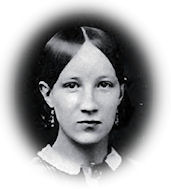
Mary Wheeler came over and pierced my ears to-day, so I can wear my new earrings that Uncle Edward sent me. She pinched my ear until it was numb and then pulled a needle through, threaded with silk. Anna would not stay in the room. She wants her’s done but does not dare. It is all the fashion for girls to cut off their hair and friz it. Anna and I have cut off ours and Bessie Seymour got me to cut off her lovely long hair to-day. It won’t be very comfortable for us to sleep with curl papers all over our heads, but we must do it now. I wanted my new dress waist which Miss Rosewarne is making, to hook up in front, but Grandmother said I would have to wear it that way all the rest of my life so I had better be content to hook it in the back a little longer. She said when Aunt Glorianna was married, in 1848, it was the fashion for grown up women to have their waists fastened in the back, so the bride had hers made that way but she thought it was a very foolish and inconvenient fashion. It is nice, though, to dress in style and look like other people. I have a Garibaldi waist and a Zouave jacket and a balmoral skirt.

Sunday.—I asked Grandmother if I could write a letter to Father to-day, and she said I could begin it and tell him that I went to church and what Mr Daggett’s text was and then finish it to-morrow. I did so, but I wish I could do it all after I began. She said a verse from the Tract Primer:

“A Sabbath well spent brings a week of content

And strength for the toil of to-morrow,

But a Sabbath profaned, whatever be gained,

Is a certain forerunner of sorrow.”

Monday. —We dressed up in new fangled costumes to-day and wore them to school. Some of us wore dresses almost up to our knees and some wore them trailing on the ground. Some wore their hair twisted in knots and some let theirs hang down their backs. I wore my new waterfall for the first time and Abbie Clark said I looked like “Hagar in the Wilderness.” When she came in she looked like a fashion plate, bedecked with bows and ribbons and her hair up in a new way. When she came in the door she stopped and said solemnly, “If you have tears prepare to shed them now!” Laura Chapin would not participate in the fun, for once. She said she thought “Beauty unadorned was the dorndest.” We did not have our lesson in mental philosophy very well so we asked Mr Richards to explain the nature of dreams and their cause and effect. He gave us a very interesting talk, which occupied the whole hour. We listened with breathless attention, so he must have marked us 100.

There was a lecture at the seminary to-night and Rev. Dr Hibbard, the Methodist minister, who lives next door above the Methodist church, came home with us. Grandmother was very much pleased when we told her.

(Letters of a Family during the War for the Union)

Abby writes to her cousin, Harriet Gilman:

Charleston, S. C., Feb. 6, 1859.

Slave auctions are of daily occurrence, and one of these we attended, seeing what perhaps no lady-resident of Charleston has seen. But for that sad insight we might have thought things had a pretty fair aspect, generally. Certainly nothing forced itself unpleasantly on our attention, only every black face in the street reminded us of the system. I enclose you the list of some we saw sold. It is the list of only “one lot” put in by one trader. I could not get a full catalogue of sale; it seemed very long, and the men who held them were marking off the names and the prices which they brought. One man, a great stout thorough African, ran up to $780, but that was “cheap.” The sale was in Chalmers street —a red flag indicating the spot—hardly a stone’s throw from the hotel. The slave yard was probably the largest in Charleston —a great empty square, with high walls on three sides and a platform where the auctioneer stood and around which the bidders were grouped. On the fourth side was a five or six-story brick building, dirty, ragged-looking, like our rear tenements, where the poor crowd were lodged. The gentlemen of our party, Mr. Robert Howland, and Mr. Charles Wolcott of Fishkill (who is here with his wife on a hasty tour), went in among the bidders. We ladies stood at the gate and looked in. Whole families of all ages were standing back against the walls, being questioned by purchasers and waiting their turn. A poor old woman, her head bowed, was sold with her son. They told us families are never separated except on account of bad behavior when they wish to get rid of some bad fellow—that this is so much the custom that the opposite course would not be tolerated. But mortgages, sheriffs’ sales, sudden death of the owner, etc., must often, as we can imagine, infringe on this custom. Among the saddened lookers on, all colored women except ourselves, was a middle-aged black woman, with a child in her arms. Mother had much talk with her. “Ah! Misses,” she said, “they leave me some of the little ones. They sell my boys away, but I expect that, and all I wish is that they may get a good Master and Misses. There! Misses, that’s one of my boys on the stand now! I don’t mind that, but its hard to have the old man (her husband) drifted away. But what can I do? My heart’s broke, and that’s all.” He had been sold some time ago, and was gone she didn’t know where. We turned home sickened and indignant. The bidders were gentlemanly-looking people, just such as we met every day at the hotel table. The trader had come down with this very gang in the cars with the Wolcotts the day before, and was so drunk then he could hardly stand. Isn’t Dr. Cheever justified?

1859. February 4.—The day devoted to home despatches. The Times makes this morning an annoying blunder about my cordially shaking hands at the opening of Parliament with the Minister of Hayti, although a man of colour. The poor fellow was not present at all, and I have never interchanged a recognition or word with him. He is, as I have often noticed, a very well-behaved mulatto, about whom I would never dream of doing or saying an unkind thing.