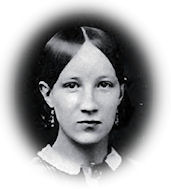
Sunday, December 8, 1859.—Mr E. M. Morse is our Sunday School teacher now and the Sunday School room is so crowded that we go up into the church for our class recitation. Abbie Clark, Fannie Gaylord and myself are the only scholars, and he calls us the three christian graces, faith, hope and charity, and the greatest of these is charity. I am the tallest, so he says I am charity. We recite in Mr Gibson’s pew, because it is farthest away and we do not disturb the other classes. He gave us some excellent advice to-day as to what was right and said if we ever had any doubts about anything we should never do it and should always be perfectly sure we are in the right before we act. He gave us two weeks ago a poem to learn by Samuel Taylor Coleridge. It is an apostrophe to God and very hard to learn. It is blank verse and has 85 lines in it. I have it committed at last and we are to recite it in concert. The last two lines are, “Tell thou the silent sky and tell the stars and tell yon rising sun, Earth with its thousand voices praises God.” Mr Morse delivered a lecture in Bemis Hall last Thursday night. The subject was, “You and I.” It was splendid and he lent me the manuscript afterwards to read. Dick Valentine lectured in the hall the other night too. His subject was “Prejudice.” There was some difference in the lectures and the lecturers. The latter was more highly colored.
Friday.—The older ladies of the town have formed a society for the relief of the poor and are going to have a course of lectures in Bemis Hall under their auspices to raise funds. The lecturers are to be from the village and are to be : Rev. O. E. Daggett, subject, “Ladies and Gentleman” Dr Harvey Jewett, “The House We Live in;” Prof. F. E. R. Chubbuck, “Progress;” Hon. H. W. Taylor, “The Empty Place;” Prof. E. G. Tyler, “Finance;” Mr N. T. Clark, “Chemistry;” E. M. Morse, “Graybeard and His Dogmas.” The young ladies have started a society, too, and we have great fun and fine suppers. We met at Jennie Howell’s to organise. We are to meet once in two weeks and are to present each member with an album bed quilt with all our names on when they are married. Susie Daggett says she is never going to be married, but we must make her a quilt just the same. Laura Chapin sang “Mary Lindsey, Dear,” and we got to laughing so that Susie Daggett and I lost our equilibrium entirely, but I found mine by the time I got home. Yesterday afternoon Grandfather asked us if we did not want to go to ride with him in the big two seated covered carriage which he does not get out very often. We said yes, and he stopped for Miss Hannah Upham and took her with us. She sat on the back seat with me and we rode clear to Farmington and kept up a brisk conversation all the way. She told us how she became lady principal of the Ontario Female Seminary in 1830. She was still telling us about it when we got back home.
December 23.—We have had a Christmas tree and many other attractions in Seminary chapel. The day scholars and townspeople were permitted to participate and we had a post office and received letters from our friends. Mr E. M. Morse wrote me a ficticious one, claiming to be written from the north pole, ten years hence. I will copy it in my journal for I may lose the letter. I had some gifts on the Christmas tree and gave some. I presented my teacher, Mr Chubbuck, with two large hemstitched handkerchiefs with his initials embroidered in a corner of each. As he is favored with the euphonious name of Frank Emery Robinson Chubbuck it was a work of art to make his initials look beautiful. I inclosed a stanza in rhyme :

Amid the changing scenes of life
If any storm should rise,
May you ever have a handkerchief
To wipe your weeping eyes.
Here is Mr Morse’s letter :
“North Pole, 10 January 1869
” Miss Carrie Richards,
” My Dear Young Fr1end.—It is very cold here and the pole is covered with ice. I climbed it yesterday to take an observation and arrange our flag, the Stars and Stripes, which I hoisted immediately on my arrival here, ten years ago. I thought I should freeze and the pole was so slippery that I was in great danger of coming down faster than was comfortable. Although this pole has been used for more than 6,000 years it is still as good as new. The works of the Great Architect do not wear out. It is now ten years since I have seen you and my other two Christian Graces and I have no doubt of your present position among the most brilliant, noble and excellent women in all America. I always knew and recognised your great abilities. Nature was very generous to you all and you were enjoying fine advantages at the time I last knew you. I thought your residence with your Grandparents an admirable school for you, and you and your sister were most evidently the best joy of their old age. You certainly owe much to them. At the time that I left my three Christian Graces, Mrs Grundy was sometimes malicious enough to say that they were injuring themselves by flirting. I always told the old lady that I had the utmost confidence in the judgment and discretion of my pupils and that they would be very careful and prudent in all their conduct. I confessed that flirting was wrong and very injurious to any one who was guilty of it, but I was very sure that you were not. I could not believe that you would disappoint us all and become only ordinary women, but that you would become the most exalted characters, scorning all things unworthy of ladies and Christians and I was right and Mrs Grundy was wrong. When the ice around the pole thaws out I shall make a flying visit to Canandaigua. I send you a tame polar bear for a playfellow. This letter will be conveyed to you by Esquimaux express.—Most truly yours, E. M. MORSE.”
I think some one must have shown some verses that we girls wrote, to Mrs Grundy and made her think that our minds were more upon the young men than they were upon our studies, but if people knew how much time we spent on Paley’s “Evidences of Christianity” and Butler’s Analogy and Karnes’ Elements of Criticism and Tytler’s Ancient History and Olmstead’s Mathematical Astronomy and our French and Latin and arithmetic and algebra and geometry and trigonometry and bookkeeping, they would know we had very little time to think of the masculine gender.