Following the American Civil War Sesquicentennial with day by day writings of the time, currently 1863.

October 2011

October 23.—To-day a battle was fought at West Liberty, Ky., between a part of the Ohio Second, supported by one company of cavalry belonging to the Ohio First, and two pieces of light artillery on the side of the Federals, and seven hundred rebels. The rebels were completely routed, with a loss of twenty-one persons killed, the number of wounded not stated. The Federals captured thirty-four prisoners, fifty-two horses, ten or twelve mules, two jacks, and one large bear, and a great number of guns, knives, and other articles. None killed on the Federal side, and only two wounded—-one of them a flesh wound in the thigh, the other shot on the end of one of his thumbs.

General Nelson, with Colonels Marshall and Metcalfe’s commands, took Hazelgreen, routed two hundred rebels, took thirty-eight prisoners, and established his head-quarters in the house of G. Trimble, one of the leading rebels. There was not a gun fired at that place.

The troops at both places were acting under General Nelson’s orders, the whole belonging to his brigade.—(Doc. 103.)

—When the Union troops were withdrawn from the Virginia side, near Harper’s Ferry, this night, the Sixteenth Indiana, occupying the most advanced and exposed position, were not aware of any withdrawal until the rest had been successfully ferried over. They lay upon the cold ground, almost frozen, with loaded muskets in their hands, every moment expecting a furious and overpowering assault from a concealed and reinforced enemy, whose numbers were known to exceed our own by many thousands; yet the only murmurs uttered by these hardy sons of the Northwest were at the orders to retire without disputing the ground inch by inch with their adversaries. Slowly and mutteringly they retired to the place of embarkation, picking up and loading themselves down with the knapsacks, canteens, guns, and equipments left there by others who had retired before them.—Balt. American, Oct. 30.

—Mr. Charles J. Helm, late United States Consul at Havana, arrived there in the British steamer from St. Thomas, with credentials from the Confederate Government, naming him consul for the Southern Confederation. He presented his papers, asking to be admitted as Consul, but the Captain-General would not do any thing in the matter beyond reporting the case to the Home Government. Other consuls, though the Madrid Government may not have granted the exequatur, are at once admitted to the free exercise of their office before that formality, but this will not be the case in the present instance.—N. Y. Com. Advertiser, Oct. 30.

—Fifty men of the Sixth Indiana regiment, under Lieutenant Grayson, were attacked on the road near Hodgeville, Kentucky, by about double their number of rebels, whom they repulsed. Three rebels were left on the field dead, and five wounded. Three of the Union men were severely wounded, Lieutenant Grayson being of the number.—(Doc. 104.)

—General Fred. W. Lander was ordered to the command of the brigade recently commanded by Colonel Baker. Only a few hours subsequent to his assumption of the command, and while engaged in a reconnoissance, he received a musket ball in the calf of the leg. It was extracted.—N. Y. Times, Oct. 24.
Tuesday, 22d—There were quite a number of visitors from Tipton today—friends of the boys from that place. The weather is cloudy and disagreeable.

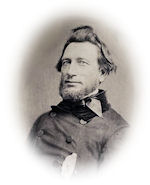
Post image for “This separation—disintegration of my family saddens me, and I wish it were otherwise.”–Journal of Surgeon Alfred L. Castleman.

22d—Went to Washington to see off a friend who has been spending a few weeks with me, as mess-mate. I felt sadly at the parting, and being lonely to-night, I cannot help thinking of home, of home! Where is it? One child in Connecticut, the other in Wisconsin, my wife in New York, and I in Virginia. This separation—disintegration of my family saddens me, and I wish it were otherwise. But the maintenance of government demands war, and war demands sacrifices, to which all patriots must yield. The whisperings of yesterday that we were repulsed at Ball’s Bluff, or Edward’s Ferry, are more than confirmed, and another good man is sacrificed on the altar of his country. General Baker fell in the battle. The particulars have not reached us, but I fear that we have been sorely defeated, notwithstanding General McClellan’s promise, a short time since, that we should meet with no more defeats. Shall we have this proclaimed through telegraph and press, as another “Great Victory?” I regret that McClellan made that foolish speech. It has lost him the confidence of many of his friends.

TUESDAY, OCTOBER 22, 1861.

Col E D Baker was killed yesterday in the fight near Leesburgh. The event has thrown a general gloom over the City especialy at the “White House” where he was esteemed as an intimate friend. Saw Judge McCook today in the office of the Sec’y of the Interior. The Judge came out of the fight at “Bolivar” unhurt with the exception of the graze of a ball across his forehead. I did not see the Sec’y today. My health is improving but cough some yet. The weather is Damp and chilly. I have only been to the Pat office today.

______

The three diary manuscript volumes, Washington during the Civil War: The Diary of Horatio Nelson Taft, 1861-1865, are available online at The Library of  Congress.

Oct. 22, 1861.—When I came to breakfast this morning Rob was capering over another victory—Ball’s Bluff. He would read me, “We pitched the Yankees over the bluff,” and ask me in the next breath to go to the theater this evening. I turned on the poor fellow: “Don’t tell me about your victories. You vowed by all your idols that the blockade would be raised by October 1, and I notice the ships are still serenely anchored below the city.”

“G., you are just as pertinacious yourself in championing your opinions. What sustains you when nobody agrees with you?”

I would not answer.

______

Note: To protect Mrs. Miller’s job as a teacher in New Orleans, the diary was published anonymously, edited by G. W. Cable, names were changed and initials were often used instead of full names — and even the initials differed from the real person’s initials.

October 22nd.—Rain falling in torrents. As I write, in come reports of a battle last night, some forty miles up the river, which by signs and tokens I am led to believe was unfavourable to the Federals. They crossed the river intending to move upon Leesburg—were attacked by overwhelming forces and repulsed, but maintained themselves on the right bank till General Banks reinforced them and enabled them to hold their own. McClellan has gone or is going at once to the scene of action. It was three o’clock before I heard the news, the road and country were alike unknown, nor had I friend or acquaintance in the army of the Upper Potomac. My horse was brought round however, and in company with Mr. Anderson, I rode out of Washington along the river till the falling evening warned us to retrace our steps, and we returned in pelting rain as we set out, and in pitchy darkness, without meeting any messenger or person with news from the battle-field. Late at night the White House was placed in deep grief by the intelligence that in addition to other losses, Brigadier and Senator Baker of California was killed. The President was inconsolable, and walked up and down his room for hours lamenting the loss of his friend. Mrs. Lincoln’s grief was equally poignant. Before bed-time I told the German landlord to tell my servant I wanted my horse round at seven o’clock.

OCTOBER 22D.—We have news of a victory at Leesburg. It appears that the head of one of the enemy’s columns, 8000 strong, attempted a passage of the Potomac yesterday, at that point pursuant to the programme furnished by the lady from Washington. That point had been selected by the enemy because the spies had reported that there were only three Confederate regiments there. But crossing a river in boats in the face of a few Southern regiments, is no easy matter. And this being the People’s War, although Gen. Evans, in command, had received orders to fall back if the enemy came in force, our troops decided for themselves to fight before retreating. Therefore, when seven or eight regiments of Yankees landed on this side of the river, two or three of our regiments advanced and fired into them with terrible effect. Then they charged; and ere long such a panic was produced that the enemy rushed in disorder into the river, crowding their boats so much that several went to the bottom, carrying down hundreds. The result was that the head of the serpent received a tremendous bruising, and the whole body recoiled from the scene of disaster. We had only some 1500 men engaged, and yet captured 1000 muskets; and the enemy’s loss, in killed, wounded, and prisoners, amounted to 2000 men. This battle was fought, in some respects, by the privates alone—much of the time without orders, and often without officers.

October 22.—Flag-officer Craven, of the Potomac flotilla, arrived at Washington, and reported the Potomac River effectually closed, rebel batteries commanding it at every point below Alexandria.

—A letter from Richmond, of this date, says: Bad news from the forces under General Lee at Big Sewall Mountain. A gentleman of this city, occupying a high position in the Government, has just reached Richmond from General Lee’s head-quarters. The enemy, under Rosecrans, was in full retreat toward the Ohio, but pursuit was impossible. The roads were in the most awful condition. Dead horses and mules that had perished in their tracks, broken wagons, and abandoned stores, lined the road to Lewisbnrg. There was no such thing as getting a team or wagon through uninjured. The road beyond Big Sewall was if any thing worse than on this side of it. To be sure, the difficulties were quite as great—perhaps even greater—for the Yankees, in their flight, as for our troops in pursuing them. But General Lee was entirely out of provision, and had not the wherewith to cook the next meal for himself or to serve the next ration to his soldiers. The General was not in the best health, and it may well be imagined, not in the best spirits. The splendid horse that was presented to him just before he left this city had been lamed in two legs, and was unfit for service. It will be absolutely necessary for General Lee to abandon hi position in a very short time as uninhabitable for his army, and go into winter-quarters. Where this will be—whether in the Kanawha Valley or on the line of the Central Railroad— is uncertain, but much depends on the choice as to the footing the Yankees will have in Western Virginia next spring.

Monday, 21st—We received orders to keep the camp clean—have to clean up every morning. The men must all keep their clothes brushed and their shoes polished.

Monday, October 21. — We again started this morning for Fortress Monroe, and as we proceeded had a calmer sea. When I got up this morning, I had my first taste of seasickness, owing to the closeness of my state-room. My chum refuses to have the window open, and the consequence is we have more foul air in the room than is pleasant for me. I was soon well, however, after getting on deck, although I carefully and secretly looked over the railing into the sea, and gave Davy Jones a scanty offering. It was amusing to see the soldiers sick and vomiting, especially after I was well. We arrived at the fort about 10 a.m., and anchored near the Atlantic. As nothing particularly interesting happened while we were here, I shall just jot down a few events interesting to myself only. I went ashore and walked all over the fortress, and all around the walls. There is a ditch all around the fort, and on some sides a water battery on the outside of it. There is one tier of guns in casemates, and one en barbette. On the sea side, outside of the walls, is the Floyd gun mounted, and the Union gun ready to mount, both of them remarkable only on account of their size. The fort is connected with the mainland by two sandy necks of land, between which is a large body of water which has access to the ocean by a channel running through one of these necks, and over which a new bridge has lately been built. This last-named neck is the one by which they go to Hampton and the mainland. The interior of the fort is quite pretty, trees growing there, and walks being laid out very much like a park. There are several houses here, and also a church. A man might make himself very comfortable here, in my opinion.

I walked over to the place where most of our troops are encamped, which lies between Hampton and the fort, and which is approached by the neck before referred to. I went to the camp of the 16th Massachusetts, and saw Waldo Merriam, the adjutant, and Bill Amory of Jamaica Plain. I had a very pleasant time, and was delighted to see old faces again. I saw a very good dress-parade, and returned to the fort again, passing through the camp of the Naval Brigade, Colonel Wardrop. I spent the night at the Hygeia Hotel, most of which is used as a hospital for our troops. Just as I had gone to sleep I was waked up by the most fearful succession of screams I ever heard in my life. It turned out to be a sick soldier in the hospital who was having his wounds dressed. The next morning I met Harry Fisher, captain’s clerk on board the Minnesota, and went with him on board of her. I was well paid, too, for a more beautiful and clean-looking ship I never saw. The decks looked clean enough to eat one’s meal off of, and the long line of guns on each side, all polished and in perfect order, seemed eager to bestow a few compliments on any rebel or enemy who might make his appearance. Hubbell went with me, and was also much pleased with the ship. I saw Captain Van Brunt[1] on board, looking as well as ever.

We waited here at Hampton Roads for a week, anxiously expecting orders to sail, and growing at times despondent and gloomy about the success of the expedition. Then, to make us still more gloomy, reports were flying about of the desertion of the commodore’s private secretary, with important papers, containing the secret naval signals, our place of destination, etc. To crown the whole, and plunge us still deeper into despair, we heard of the battle of Ball’s Bluff, and of the defeat of our forces. The news of Putnam’s death, of Holmes[2] being wounded, etc., made me feel the reality of the war, which is a hard thing to bring home to one’s self until one loses a friend, or meets with some such mishap. However, as the ships began to get up steam, and as various other little matters showed that we were going to start soon, our fears and despondent feelings began to give way to a more cheerful state of mind, and when we were actually under way every one felt buoyant and hopeful. While waiting here, one of the 7th Connecticut soldiers was drowned by jumping overboard for a plate which we had dropped. Major Pangborn, formerly editor of the Boston Bee, came on board. He is paymaster for our brigade.


[1] Captain, afterwards Commodore, Jeffrey G. Van Brunt.

[2] Oliver Wendell Holmes, Jr.