
APRIL 18TH.—The President is thin and haggard ; and it has been whispered on the street that he will immediately be baptized and confirmed. I hope so, because it may place a great gulf between him and the descendant of those who crucified the Saviour. Nevertheless, some of his enemies allege that professions of Christianity have sometimes been the premeditated accompaniments of usurpations. It was so with Cromwell and with Richard III. Who does not remember the scene in Shakspeare, where Richard appears on the balcony, with prayer book in hand and a priest on either side?
April 2012
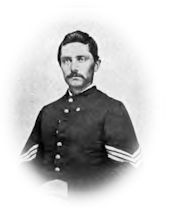
Friday, 18th—No news of importance.[1]
[1] While the battle of Shiloh was a Union victory, nevertheless it was dearly won and could easily have been a defeat. Even at that time the men in discussing it, pointed out some of the mistakes made by the Union forces. I wish to point out how the day at Shiloh was almost lost to the Union Army. In the first place, when the different commanders called out the troops under arms at 6 o’clock on Friday evening, April 4th, they kept them in line until midnight, when, since the immediate danger was past, they ordered them to return to their quarters. Then it was that a great mistake was made, for instead of sending the men back to camp, they should have been put to work, every man with shovel, pick or axe, digging trenches, throwing up breastworks and fortifying their camps. Thus by the morning of the 6th they would have had two or three lines of works. That this was not done must of course be charged to General Sherman. Each man behind the works would have been equal to five men in the open. General Prentiss’ men, protected in the old, sunken roadway, in making their attack upon us proved the worth of a man protected, to one out in the open. The mistake cost the Union army more than a thousand men, besides those captured.
In the second place, when the Union army was attacked on that Sunday morning, there were but four regiments in line of battle and ready for the assault of the Confederates. The officers did not succeed in forming a continuous line of battle until late in the day. Regiments and brigades would march to the front and form in line, but they were usually unsupported by troops on the right and left at the same time. This enabled the Confederates to come in on the flanks and the rear, thus compelling our forces to fall back or be captured. This continued till late in the afternoon, when Webster succeeded in forming a continuous line of artillery, supported by all arms. This, together with the arrival of Buell’s brigade, which formed a line on the left, saved the day to the Union cause for all time to come.—A. G. D.
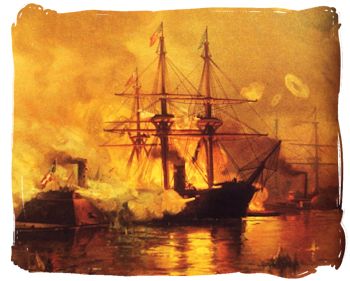 April 18th. In order to understand the proceedings of our fleet fully, it will be necessary to explain the position of the enemy. Forts Jackson and St. Philip are situated on a short bend of the river, some forty miles from its mouth, Fort Jackson occupying the right bank and being the principal fort, and the other fort being situated opposite and a little below Jackson. A chain had been stretched across the river on eight schooners, and guarded by a water battery at its extremity. This, with the forts which mounted in the aggregate more than two hundred guns, was considered impregnable and impassable. This morning early the mortar boats were placed in position, and immediately opened fire on the forts, mostly engaging Fort Jackson. We were answered from the forts, but both parties fired slowly and endeavored to get the range, which was in distance some two to two and a half miles. In the meantime our advance fleet of gunboats moved up under cover of the point in the river’s bend, and in turn dealt a few blows, all the time changing their position and dropping down with the current. In the evening a large fire in Fort Jackson gave evidence of the effect of our shells, and at night we hauled off our gunboats and ceased firing.
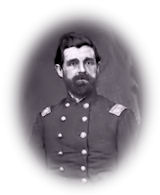
To Mrs. Lyon
April 18, 1862.—We remained at Tiptonville until yesterday afternoon, when we started and steamed down the river until dark, and then tied up to a tree, and this morning ran on down to a point said to be within ten miles of Fort Pillow, 20 of Fort Randolph and 70 from Memphis. There we were ordered back to New Madrid. We do not know the significance of this movement, but think the high water in the river prevents present operations against Fort Pillow. I think that when we get to New Madrid we shall find nearly all of General Pope’s army there.
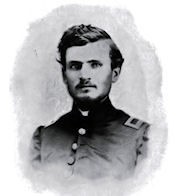
18th. Marched to Lamar, Mo. Met Major Miner’s command from Carthage. Creek at Lamar was high, so we left the baggage and a detail to guard it, and went up the creek to a bridge. Found the town, county seat of Barton County, almost deserted. Only a few dwellings.

April 18.—I remained with Mr. Wasson all night. A child could not have been more composed. He told me how good the Lord was in giving him such peace and strength at the last hour. About 4 o’clock A. M. he insisted that I should leave him, as I required rest. He begged so hard that I left him for a little while. When I returned he had breathed his last. One of his companions was with him, and was very attentive—told me that he died as if he was going to sleep. As Bryant has so beautifully expressed it:
“Like one who wraps the drapery of his couch
About him, and lies down to pleasant dreams.”
“O, gently close the eye
That loved to look on you;
O, seal the lip whose earliest sigh,
Whose latest breath, was true.”
Mr. Regan died this morning; was out of his mind to the last.
Since I have been here, I have been more deeply impressed than ever before with the importance of preparing while in health for that great change that must, sooner or later, happen to all. I see that it is almost impossible, while the physical system is suffering, to compose the thoughts on that all-important subject. For days before their final dissolution, many of those we see here are wandering in their minds, so that it is impossible for them to repent; and God has given us but one example of death-bed repentance, but his holy book is filled with denunciations against those who reject the gospel and quench the Holy Spirit. “Therefore will I number you to the sword, and ye shall all bow down to the slaughter: because, when I called, ye did not answer; when I spake, ye did not hear.” Isaiah xiii, 12.
It does seem strange that, amid all the terrible scenes of destruction that we are daily witnessing, we think as little of death as ever, and act as if it was something that might happen to others, but never to ourselves.
“The voice of this instructive scene
May every heart obey,
Nor be the faithful warning vain,
Which calls to watch and pray.
O, let us to that Savior fly
Whose arm alone can save;
Then shall our hopes ascend on high,
And triumph over the grave.”
Mrs. Lyons left this morning for home. She was very sick; and one of the doctors informed her, if she did not leave immediately, she would certainly die. I know the men whom she has been nursing will miss her very much, as she has been so attentive to them.
While I was giving some sermons to the men to read, I met with Dr. Foster of Natchez, Miss., who is here for the purpose of taking home some wounded men. He looked at the sermons. They were preached by Rev. Dr. Pierce on last fastday, in St. John’s Church, Mobile. The first warned us not to put our trust in any thing earthly, but in Him alone who sitteth in the heavens; and, as just as our cause was, if we trusted in man alone, it would come to naught. The other said, as we profess to be a Christian nation, we should act with that forbearance toward our enemies which Christians should always manifest; and, wronged and abused though we be, we must not hate. This task is a hard one; so the author advises us to have hourly upon our lips the language of his text: “Lead us not into temptation, but deliver us from evil.” After examining them, Dr. F. asked me to get some copies for him, as he thought that they would be the means of doing much good in the army.
Dr. Smith has taken charge of this hospital. I think that there will be a different order of things now. He is having the house and yard well cleansed. Before this, it was common to have amputated limbs thrown into the yard, and left there.
Mrs. Glassburn and myself started to go to College Hospital, when we met the doctor who spoke to my patient last night, and he went with us. His name is Hughes—is from Lexington, Ky. The walk was very pleasant. Met a general and his staff. The doctor thought it was General Polk—our bishop-general, as he is called. We called at a shed on the way; found it filled with wounded, lying on the floor; some men attending them. All were in the best of spirits. Mrs. G. promised to send them some of our good things. When we arrived at the hospital, we were charmed with the cleanliness and neatness visible on every side. The Sisters of Charity have charge of the domestic part, and, as usual with them, every thing is parfait. We were received very kindly by them. One was a friend of Mrs. G. She took us through the hospital. The grounds are very neatly laid out . Before the war it was a female college. I saw, as his mother requested, Mr. John Lyons, who is sick; he is a member of Ketchum’s Battery. The wounded seem to be doing very well. One of the surgeons complained bitterly of the bad management of the railroad, and said that its managers should be punished, as they were the cause of a great deal of unnecessary suffering. They take their own time to transport the wounded, and it is impossible to depend upon them. That is the reason why we see so many sick men lying around the depot. Crossing the depot upon our return, we saw a whole Mississippi regiment sick, awaiting transportation. They looked very badly, and nearly all had a cough.
18th.—Severe picket firing occasionally through the night, by which the army was twice called out. No fighting to-day, but our troops are still throwing up earthworks on the battle field of the 16th. Wrote General H. to-day, asking to be relieved from serving longer on his staff.
Joe Howland to Eliza Woolsey Howland.
Steamer Daniel Webster, April 18.
 I have a chance to send a boat ashore to get a mail and so can say good morning to you. All the steamers are lying in the stream two or three miles below Alexandria receiving their “tows.” There are about a hundred schooners and barges to take down. We tow four. All’s well. The boat is very crowded, but the men are more comfortable than I supposed they would be and are behaving admirably. The work of getting them well on board was a hard one. I have 820 officers and men on this boat and the four schooners. The sick are doing well; the change of air and rest are curing the dysentery. I do not know where we are going.
 Cousin Margaret Hodge to Georgeanna.
Philadelphia, April, 62.
My dear Georgy: I feel a great interest in dear Eliza and yourself, and also in your dear mother, and all the family, knowing how anxious you must all be about Joe. I do wish you could get to Fortress Monroe, or, as you say, to the Hygiea Hotel. . . . We had a letter this morning from Lenox, dated from on board the steamer Welden, which Dr. Smith has chartered to fit up as a hospital ship for the Pennsylvania wounded. You know we have 50,000 at Yorktown, at least so say the papers.
Lenox seems much pleased that they have the steamer, as it makes them so independent, and enables them to go where they may be most needed, without troubling any one. Dr. Smith’s plan is to have a building on shore for a hospital, and the steamer can convey the wounded to it. Some of the doctors are to attend to their removal from the field, while some are to take charge of them on the steamer, and the remainder to receive them at the hospital. . . . Lenox was just going off to Cheesman’s landing. He is very much interested in all he sees; has visited the Monitor and been all over it, and also he had been over the fortress and visited several camps.
It is a great trial to part with him, but he has wanted so long to do what he could for the cause that it is a great gratification that he can go now without interfering with his duty to his father. The lectures are over, and he can spare him better than he could before, though even now Lenox is a great loss to his father… .
My love to your dear mother and Hatty, and say I am still looking for their promised visit, and shall count on their coming here on their way home. We have Lottie and baby here now, for a little visit, but I have plenty of room for all.
April 18th. At twelve o’clock last night we were suddenly routed out by a heavy cannonading and musketry, apparently in our front. As we always sleep here fully accoutred, we had nothing to do but grasp our arms and rush for the color line. Stood in line about an hour, watching the beautiful effect of the shell fire in the dark night, and then dismissed the regiment, but got little sleep, as the firing continued, apparently, without any object. We learned subsequently that the pickets had been engaged in our front, and that quite a little engagement had taken place on the left, where the officer commanding has made a reconnoisance. During the afternoon a string of ambulances came in, bringing about one hundred wounded men and passed to the rear. In the evening we gathered some particulars of the last two or three days’ operations about the movement of the troops. The reconnoisance was made by General Smith, commanding a division of Key’s corps, at a place known as dam No. 1, on the Warwick river, between Lees and Wigans mills. The dam, defended by a rebel battery of two guns and a line of rifle pits, was attacked by Brook’s Vermont brigade, under cover of the fire of a battery of artillery. After the battery had shelled the works, the brigade made a rush for the dam, driving back the rebel pickets, and captured and occupied their rifle pits. Smith found but few troops to oppose him, and in one of the small redouts nothing but wooden guns. Later on, several companies of the Third Vermont crossed the river below the dam and carried the works there with ease, driving the enemy pell mell before them. Expecting to be reenforced, they held on to this position till the enemy moved down upon them in force, obliging them to retire across the river under a heavy and destructive fire, losing nearly one hundred men in the retreat. The heavy cannonading we heard yesterday in that quarter was Smith’s guns. There are a host of unpleasant rumors afloat which we have no means of verifying, and, therefore, I shall not mention them, but the affair was undoubtedly badly managed. The greatest need of our army seems to be general officers that know something, to lead it, but, of course, we can’t believe all we hear. After tattoo, received orders to hold ourselves in readiness to move forward into the advanced trenches to-morrow.


