7th.—Some fighting to-day, by small bodies, with slight loss on either side. In the afternoon, finding our camps commanded by the enemy’s guns, we started suddenly on a move of what we were told was to be a mile or two. The rain poured in torrents, and, instead of marching a mile or two, we kept on the move until late in the night. Many of the officers made the soldiers carry their (the officer’s) tents on their shoulders, and this, in addition to gun and knap sacks, and whilst the officers rode unincumbered. In the organization of an army under a republican government, was such a distance between officer and soldier ever contemplated? We halted about ten o’clock, drenched with the still pouring rain. The men are almost starved, having been for nearly two days entirely without rations, and lie to-night in pools of water.
April 2012
 Monday, 7th—It rained all night. The battle was renewed this morning at 6 o’clock, by our forces under General Buell. The Eleventh Iowa formed and marched forward with parts of broken regiments, in support of the left center of Buell’s army, whenever needed. It was very trying for us thus to stand in line of battle, shells exploding over our heads and cutting off limbs of trees, spent minie balls flying all about us, yet not being able to get into action, because of the line of battle just in front of us. The rebels were fighting desperately, but falling back all the while with great slaughter of men. About 3 p. m. the rebels in front of us began to retreat, with Buell’s army after them, but we remained in line. About an hour later the report came that the rebels had left the field, and we were ordered back to our camp in Jones’ Field, arriving there about dark. We had not been in our tents since Sunday morning and they were still standing, but a great many had been hit and badly torn by shells and minie balls. We found the body of a rebel soldier lying in my tent; he had been wounded and apparently had gone in, crawled between our bunks and bled to death. We carried the body out to the parade ground and then got a shovel to clean away the blood from the place where the body had lain in the tent.
A pril 7, 1862. —I left Mobile by the Mobile and Ohio Railroad for Corinth, with Rev. Mr.Miller and a number of Mobile ladies. We are going for the purpose of taking care of the sick and wounded of the army.
As news has come that a battle is now raging, there are not a few anxious hearts in the party—my own among the number, as I have a young brother, belonging to Ketchum’s Battery, who I know will be in the midst of the fight, and I have also many dear friends there.
A gentleman, Mr. Skates, has heard that his son is among the killed, and is with us on his way to the front to bring back the remains of him who a short time since formed one of his family circle. May God give strength to the mother and sisters now mourning the loss of their loved one! May they find consolation in the thought that he died a martyr’s death; was offered up a sacrifice upon the altar of his country; and that, when we have gained our independence, he, with the brave comrades who fought and fell with him, will ever live in the hearts and memories of a grateful people! I can not look at Mr. Skates without asking myself how many of us may ere long be likewise mourners! It is impossible to suppress these gloomy forebodings.
About midnight, at one of the stations, a dispatch was received prohibiting any one from going to Corinth without a special permit from head-quarters. Our disappointment can be better imagined than described. As military orders are peremptory, there is nothing for us to do but to submit. Mr. Miller has concluded to stop at one of the small towns, as near Corinth as he can get, and there wait until he receives permission for us to go on.
 Eliza’s journal.
April 7. A note from Joe tells of the regiment’s safe arrival at Manassas, where they are camped. The General had complimented J. on moving his regiment better than any of the others.
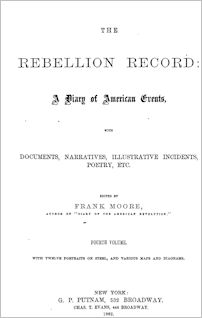
April 7.—Yesterday and to-day the battle of Pittsburgh Landing, Tenn., (by the confederates called the battle of Shiloh,) was fought, by the National forces under Major-General Grant, and the rebels under Beauregard. Early yesterday morning four hundred men of Gen. Prentiss’s division were attacked by the rebels, half a mile in advance of the National lines, when the men fell back on a Missouri regiment, closely pursued by the rebels. Further resistance was made, but without success, and all finally retreated to the lines of the Second division. At six o’clock the fire had become general along the whole line. Gen. Sherman’s division were compelled to fall back, and seek support of the troops immediately in their rear. At one o’clock both sides were fully engaged, and the most terrible fighting ensued, resulting in the National troops being slowly driven in the direction of the river. The National gunboat Tyler then came up, and aided greatly in forcing the rebels back. At five o’clock there was a short cessation in the fire of the enemy, their lines falling back for nearly half a mile, when they suddenly wheeled, and threw their whole force upon the left wing of the Union troops. The battle then raged fiercely, and the rebels would probably have succeeded in their object of cutting the Union army in two, had not General Wallace, who had taken a circuitous route from Crump’s Landing, appeared suddenly on their right wing. This move compelled the rebels to desist from their operations on the left, and they soon withdrew from the attack, and oncamped for the night. The advance regiments of Gen. Buell now appeared on the opposite side of the river, and all night long were crossing to the relief of Gen. Grant’s army. The battle was renewed this morning, at seven o’clock. The rebels commenced the attack from the Corinth road, and soon the engagement became general along the entire line. They endeavored, by massing troops at different positions, and hurling them on the weakest points, to break through, and cut off the different divisions from communication and support. But everywhere they were met by new and unwearied troops, in numbers too large to contend against. Both wings of the Union army were turned upon the enemy, and the whole line advanced to the charge, while shot and shell from the batteries rained death at every point. The rebels then fell slowly bank, keeping up a fire from their artillery and musketry along their whole column as they retreated. They were pursued by Gen. Sherman’s forces.—(Doc. 114.)
—The bridge over Stony Creek, Va., was completed yesterday, and to-day, while the National troops were crossing, the rebel battery of Ashby opened on them, but was soon silenced, and its position occupied by the Nationals.—N. Y. World, April 8.
—A large meeting of the Union men of Montgomery county, Md., was held in Rockville this day, at which resolutions, deprecating the abolition of slavery in the District of Columbia, and calling upon the President of the United States to “interpose his veto and protect the rights of property,” in the event of the passage of “the Act” by both houses of Congress, were unanimously adopted.—National Intelligencer, April 12.
—In the rebel House of Representatives, at Richmond, Va., the action of yesterday at Pittsburgh Landing, Tenn., was announced, and the following resolutions introduced:
Resolved, That Congress have learned, with feelings of deep joy and gratitude to the Divine Ruler of nations, the news of the recent glorious victory of our arms in Tennessee.
Resolved, That the death of Gen. Albert Sidney Johnston, the commander of our forces, while leading his troopsto victory, cannot but temper our exultation with a shade of sadness at the loss of so able, skilful, and gallant an officer.
Resolved, That, in respect to the memory of Gen. Johnston—the Senate concurring—Congress do now adjourn until twelve o’clock to-morrow. —Richmond Whig, April 8.
—A skirmish took place at Lawrenceburgh, Tenn., between two companies of Federal and rebel cavalry, the latter being put to flight with a loss of four men wounded. Four horses were captured, and carried into the Union lines late in the evening. One of the horses belonged to a Lieut. Polk, of Columbia, Tenn., the left side of the saddle being covered with blood.—Brig.-Gen. Lucius J. Polk, C. S. A., gave himself up to Gen. Negley, in command at Columbia, Tenn. He was released on parole.
—At Edenburg, Va., to-day, the rebels opened fire upon the National pickets, but were soon dispersed by a rapid cannonade from Capt Huntington’s battery.—N. Y. Times, April 8.
—The gunboat Pittsburgh ran the blockade of Island Number Ten, last night, under a terrific fire from the rebel batteries. Four steam transports and five barges were also got through the Slough, from Phillips’s Landing, above the Island, to New-Madrid, by Col. Bissell’s corps of engineers.
This morning, under the fire of the Union gunboats, which silenced one of the rebel batteries, a company, under Capts. Lewis and Marshall, crossed the Mississippi at New-Madrid and spiked the guns. Another force took three other batteries, spiked the guns, and threw the ammunition into the river.
At eleven o’clock, in the face of the fire of the remaining rebel batteries, Gen. Paine, with four regiments and a battery of artillery, crossed the Mississippi Subsequently the divisions of Gens. Hamilton and Stanley crossed; also Gen. Granger with his cavalry. They are now strongly posted, ready for any emergency.—(Doc. 116.)
 Milne Plantation, Port Royal Island
Monday, April 6, 1862
Yours of the 14th of February reminds me of our long interrupted correspondence. My last to you, if I remember right, was from on shipboard nearly three months ago, and was of a savage tenor. This is from an old South Carolina plantation, the headquarters of our cavalry pickets, and is likely to be of an eminently pacific tone. Here I am surrounded by troopers, missionaries, contrabands, cotton fields and serpents, in a summer climate, riding immensely every day, dreadfully sick of the monotony of my present existence, disgusted with all things military and fighting off malaria with whiskey and tobacco. So far, the island of Port Royal is a small Paradise, and no men were ever so fortunate in the inception of a military career, barring the immense labor of organizing such a regiment as this and our peculiarly rigid discipline, than we have been. So far our privations have been next to nothing and our career has been more that of a winter picnic than anything else. The future I fear has less agreeable things in store for us. Still sweets cloy, and drilling in a South Carolina cotton field hour after hour daily for weeks in succession is one of those sweets which cloy early. Perpetual roll-calls too become tiresome, and the daily superintendence of the grooming of eighty-five horses is not a pleasant phase of existence. I make no objection however to my duties, though I do to my superiors. But all in the fullness of time, and when you next see me you probably won’t know me.
Just now I am on picket and also specially detailed by General Stevens to build a road, which I had the rashness to recommend in a report the other day. So this morning I diversified my cavalry pursuits by driving a gang of niggers on my new road, which connects the sea board plantations. You would n’t have known me. I had ten slaves and drove by example. My horse was tied to a tree and my pistols and coat lay near him, while I, in heavy boots and spurs and my shirt sleeves, handled a spade by the side of my sable brethren in the midst of a combination of rice-field and cotton swamp, while my sergeant, axe in hand, headed another gang in clearing away underbrush. I am happy to say such energy was not unrewarded, as I succeeded in connecting and repairing three miles of road in one day instead of two, as I calculated. I am happy to say the Africs worked well and spared me much prepared execration; but from personal experience I am qualified to assert, that an African has about as much idea of a shovel and its uses as a wild Irishman might have of a quadrant or a cotton-hoe. My work however was completed at two o’clock and I then indulged in a delicious sea bath, declared myself a half holiday and determined to devote it to you. . . .
You and his Excellency always ask for my impressions of things here and, though I have sent them to him in little, I will enlarge them to you here and you may do with them as you see fit, only don’t publish unless my views are likely to enliven the English.
Here I am on the Milne Plantation in the heart of Port Royal Island. Cotton fields, pine barrens, contrabands, missionaries and soldiers are before me and all around me. A sick missionary is in the next room, a dozen soldiers are eating their suppers in the yard under my window and some twenty negroes of every age, lazy, submissive and as the white man has made them, are hanging about the plantation buildings just as though they were not the teterrima causa of this consuming bella. The island is now just passing into its last stage of spring. The nights are cool, but the days are hot enough to make the saddle no seat of comfort. The island, naturally one of the most delightful places in the world, is just now at its most delightful season. The brown unhappy wastes of cotton fields unplanted this year and with the ragged remnants of last years crop, still fluttering in the wind, do not add to its beauty, but nothing can destroy the charm of the long plantation avenues with the heavy grey moss drooping from branches fresh with young leaves, while the natural hedges for miles along are fragrant with wild flowers. As I canter along these never ending avenues I hear sounds and see sights enough to set the ornithologist and sportsman crazy. The mocking-bird is never silent, and the varieties of plumage are to the uninitiated infinite, while hares and grey squirrels seem to start up under your horse’s feet; wild pigeons and quail from every field, and duck and plover from every swamp. Nor are less inviting forms of animal life wanting, for snakes cross your path more frequently than hares and, even now, the soldiers under my window are amusing themselves with a large turtle, a small alligator and a serpent of curious beauty and most indubitable venom, a portion of the results of their afternoon’s investigations.
One can ride indefinitely over this island and never exhaust its infinite cross-roads and out-of-the-way plantations, but you cannot ride fifteen minutes in any direction, however new, without stumbling over the two great facts of the day, pickets and contrabands. The pickets are recruits in active service without models — excellent material for soldiers and learning the trade, but scarcely soldiers yet. The contrabands were slaves yesterday and may be again tomorrow, and what slaves are any man may know without himself seeing who will take the trouble to read Olmsted’s books. No man seems to realize that here, in this little island, all around us, has begun the solution of this tremendous “nigger” question.
The war here seems to rest and, for the present, Port Royal is thrown into the shade, and yet I am much mistaken if at this minute Port Royal is not a point of greater interest than either Virginia or Kentucky. Here the contraband question has arisen in such proportions that it has got to be met and the Government is meeting it as best it may. Some ten thousand quondam slaves are thrown upon the hands of an unfortunate Government; they are the forerunners of hundreds of thousands more, if the plans of the Government succeed, and so the Government may as well now decide what it will do in case of the success of its war plans. While Government has sent agents down here, private philanthropy has sent missionaries, and while the first see that the contrabands earn their bread, the last teach them the alphabet. Between the two I predict divers results, among which are numerous jobs for agents and missionaries, small comfort to the negroes and heavy loss to the Government. Doubtless the world must have cotton and must pay for it, but it does not yet know what it is to pay for it if the future hath it in store that the poor world shall buy the next crop of Port Royal at prices remunerative to Government. The scheme, so far as I can see any, seems to be for the Government, recognizing and encouraging private philanthropy and leaving to it the task of educating the slaves to the standard of self-support, to hold itself a sort of guardian to the slave in his indefinite state of transition, exacting from him that amount of labor which he owes to the community and the cotton market. The plan may work well; if it does, it will be the first of the kind that ever has. Certainly I do not envy the slaves its operation. The position of the Government is certainly a most difficult one. Something must be done for these poor people and done at once. They are indolent, shiftless, unable to take care of themselves and plundered by every comer — in short, they are slaves. For the present they must be provided for. It is easy to find fault with the present plan. Can any one suggest a better? For me, I must confess that I cannot. I think it bad, very bad, and that it must end in failure, but I can see no other more likely to succeed.
That this is the solution of the negro question I take it no one but the missionaries and agents will contend. That is yet to come, and here as elsewhere we are looking for it, and trying to influence it. My own impression is that the solution is coming — may already in some degree be shadowed out; but that it is a solution hurried on by this war, based on simple and immutable principles of economy and one finally over which the efforts of Government and individuals can exercise no control.
This war is killing slavery. Not by any legal quibble of contrabands or doubtful theory of confiscation, but by stimulating free trade. Let any man ride as I do over this island. Let him look at the cotton fields and the laborers. Let him handle their tools and examine their implements, and if he comes from any wheat growing country, he will think himself amid the institutions and implements of the middle ages — and so he would be. The whole system of cotton growing — all its machinery from the slave to the hoe in his hand — is awkward, cumbrous, expensive and behind the age. That the cultivation of cotton is so behind that of all the other great staples is the natural result of monopoly, but it is none the less disgraceful to the world, and to give it an impulse seems to have been the mission of this war. The thorough and effectual breaking up of its so much prized monopoly will be the greatest blessing which could happen to the South, and it seems to be the one probable result of this war. Competition involves improvement in ruin, and herein lies the solution of this slavery question. Northern men with Northern ideas of economy, agriculture and improvement, are swarming down onto the South. They see how much behind the times the country is and they see that here is money to be made. If fair competition in the growth of cotton be once established a new system of economy and agriculture must inevitably be introduced here in which the slave and his hoe will make room for the free laborer and the plough, and the change will not be one of election but a sole resource against utter ruin. The men to introduce this change or any other are here and are daily swarming down in the armies of the Government, soon to become armies of occupation. A new tide of emigration has set in before which slavery has small chance.
But how is it for the African? Slavery may perish and no one regret it, but what is to become of the unfortunate African? When we have got thus far we have just arrived at the real point of interest in the “nigger” question. The slaves of whom I see so much here may be taken as fair specimens of their race as at present existing in this country. They have many good qualities. They are good tempered, patient, docile, willing to learn and easily directed; but they are slavish and all that the word slavish implies. They will lie and cheat and steal; they are hypocritical and cunning; they are not brave, and they are not fierce — these qualities the white man took out of them generations ago, and in taking them deprived the African of the capacity for freedom. My views of the future of those I see about me here are not therefore encouraging. That they will be free and free soon by the operation of economic laws over which Government has no control, I thoroughly believe; but their freedom will be the freedom of antiquated and unprofitable machines, the freedom of the hoes they use which will be swept aside to make way for better implements. The slave, however, cannot be swept aside and herein lies the difficulty and the problem. My impression from what I see is that Emancipation as a Government measure would be a terrible calamity to the blacks as a race; that rapid emancipation as the result of an economic revolution destroying their value as agricultural machines would be a calamity, though less severe; and finally, that the only transition to freedom absolutely beneficial to them as a race would be one proportioned in length to the length of their captivity, such a one in fact as destroyed villeinage in the wreck of the feudal system. Were men and governments what they should be instead of what they are, the case would be different and all would combine in the Christian and tedious effort to patiently undo the wrongs they had done, and to restore to the African his attributes. Then the work could be done well and quickly; but at present, seeing what men are, and how remorselessly they throw aside what has ceased to be useful, I cannot but regard as a doubtful benefit to the African anything which by diminishing his value increases his chances of freedom.
A revolution in cotton production springing from competition may work differently by gradually changing the status of the African from one of forced to one of free labor, but I do not regard this as probable. The census already shows not only that cotton can everywhere be cultivated by free labor, but also that the best cotton now is so cultivated, and the most probable result of a permanent reduction in the price of cotton would seem to me to be a sudden influx of free white emigration into the cotton fields of the South. Such a result would produce untold advantages to the South, to America and to the white race; but how about the blacks? Will they be educated and encouraged and cared for; or will they be challenged to compete in the race, or go to the wall, and finally be swept away as a useless rubbish? Who can answer those queries? I for one cannot; but one thing I daily see and that is that no spirit exists among the contrabands here which would enable them to care for themselves in a race of vigorous competition. The blacks must be cared for or they will perish, and who is to care for them when they cease to be of value? I do not pretend to solve these questions or do more than raise them, and their solution will come, I suppose, all in good time with the emergency which raises them. But no man who dreams at all of the future can wander over Port Royal Island at present and mark the character and condition of its inhabitants, without having all these questions and many more force themselves upon his mind. I am a thorough believer in this war. I believe it to have been necessary and just. I believe that from it will flow great blessings to America and the Caucasian race. I believe the area of freedom will by it be immensely expanded in this country, and that from it true principles of trade and economy will receive a prodigious impetus throughout the world; but for the African I do not see the same bright future. He is the foot-ball of passion and accident, and the gift of freedom may prove his destruction. Still the experiment should and must be tried and the sooner it is tried the better….
April 6 — On picket.

Headquarters Porter’s Division, April 6, 1862.
Dear Father, – We are now encamped about 2 miles from their batteries at Yorktown. I stood under my first fire yesterday, and don’t think it is the pleasantest feeling in the world. Day before yesterday we advanced from New Market Bridge and went some 15 miles to Howard’s Creek which is 4 miles from Big Bethel. About one mile from H.’s Creek we discovered some earthworks, and some rebel horsemen there, and two guns of Wilson’s Battery. Our skirmishers opened on them, and were responded to by 4 shots from their guns, which did not reach far enough. Allen’s Battery soon put them to flight and we crossed over the creek about an hour after they had gone. Yesterday we marched on towards Yorktown, and when within about two miles or one and a half miles from the place, we discovered the presence of their batteries by a shell screeching over our heads, followed by another one, on our side, about 20 feet off, and by another about 30 feet in front and above us, which last one burst there. It was an unpleasant feeling. I am well, and to-morrow probably the batteries will be taken.
Sunday 6th
A delightful morning. Hearing that the “27th” were soon to move, I crossed the River to Alexandria and walked out to their Camp. But to my surprise found the Camp vacated. The Regt left on Friday. Lieut Gaul was left in charge of some Stores but he expects to leave tomorrow. The Regt went by RR to Warrenton junction and are on the Way to Richmond. God Speed them. A deserted camp is about the most desolate place imaginable. The tents were all standing but all was still and lonely where so lately all was life and motion. I got back to Washington about 5 o’clock. The Steam Boat was crowded both ways. The country over there looks desolate enough. “Poor Virginia” “put back half a century.”
______
The three diary manuscript volumes, Washington during the Civil War: The Diary of Horatio Nelson Taft, 1861-1865, are available online at The Library of Congress.

APRIL 6TH.—Two spies (Lincoln’s detective police) have been arrested here, tried by court-martial, and condemned to be hung. There is an awful silence among the Baltimore detectives, which bodes no harm to the condemned. They will not be executed, though guilty.


