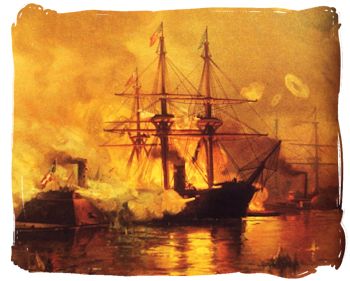
May 2d. In the midst of the excitement the U. S. steam transport Rhode Island came in with a large mail, which gladdened many a heart as they read letters from friends at home. This afternoon a collision took place between the Brooklyn and a gunboat, the latter drifting afoul of the former, when she dragged her anchor and both dropped down the stream; after going half a mile they were disengaged with the loss of the gunboat’s smoke pipe, foremast and quarter boat.
May 2012
2nd. Orders from Curtiss to go somewhere, of course we know not where, probably to Cowskin Prairie in extreme southwest corner of Missouri, near the border of Indian Territory. Went out to a grist mill, two miles, and got some flour. Enjoyed the ride very much. Letters from Uncle and L. Randall.
Beaufort, S. C. May 2d, 1862.
My dear Mother:
May has opened charmingly in Beaufort. The air is warm but not oppressive. We are luxuriating in green peas, strawberries, blackberries, all the early vegetables, and the fig trees, loaded with fruit, will soon supply us with an abundance of green figs. Fish are supplied by the rivers in great plenty. Indeed we are well supplied with all sorts of good things, so we have little of which we can complain, except inaction. It is now fifteen days since a mail has reached us from the North. Telegraphic news in the columns of the Charleston Mercury dated the 26th, speaks of the city being in great alarm from the advancing army and fleet of Genl. Butler. A sailing vessel occasionally brings us a newspaper from the North. Otherwise we would be quite separated from the rest of mankind, and would be compelled to consider the North as having regularly seceded from us.
I have received the beautiful flag you sent me. I gave it to the boys of the Company, who were delighted. The other companies are quite envious. Thanks, dear Mother, a thousand times, for the expression of your love.
I think after all I must have that new suit of clothes I wrote for before. Notwithstanding all efforts to the contrary, my old suit will persist in growing daily rustier, and more unseemly in the seams. So if you will please have the suit ordered, I shall find good use for it full as soon as it shall be ready for me.
Tell Mr. Johnson I had a right pleasant time with his friend Bronson, and add too that Sloat’s men produced such an effect on the 79th Regiment, that it is impossible to persuade them that the whole affair of allotment is anything more than a Jew swindle. I am looking forward with great delight to the next steamer arrival, anticipating a heavy mail after so long neglect. There is so little of interest to write. I believe I wrote you there was quite a charming lady, a Mrs. Caverly, stopping at the General’s. Her husband is dying with consumption and has come here to try the effect of the climate. You can imagine that a pretty and lively lady makes quite a difference in the house.
You do not know how inexpressibly indignant I feel at the attacks made on McClellan. They are certainly most scandalous, and calculated to ensure his defeat were he in any wise what his enemies represent him. It is the height of folly to suppose that men are going to sacrifice their lives, unless they have good reason to suppose that they are to be brought at the right moment to the right spot to play their part in gaining a victory. You have only to convince them that incompetent men are putting them in positions to occasion a defeat, and they will run before a shot is fired. It would seem that the enemies of McClellan are doing their utmost to produce that sort of spirit of distrust in our troops, so as to lead to new disasters. I am sick and tired of these howling politicians who would be willing to see everything we consider holy destroyed, provided they could only under the new regime get the Governmental patronage of the devil.
Affec’y. your son,
Will.
Flourishes supposed to indicate genius.
2nd.—Firing to-day in the direction of Yorktown. A report says that a general battle has commenced there. I think not, as we are moving our camp. If there were a fight we should have been ordered to hold ourselves in readiness, (which we have not.) Great rejoicing in camp at the report that Stevens’ battery and the Vanderbilt have captured the Merrimac. But these camp reports are very unreliable, and have to be repeated many times before they are believed. We have increasing indications of a fight soon. I this moment hear a man inquiring after my health. He is sorry “the old gentleman” is not well. “Fine Old gentleman.” Am I really growing old? I am not well, but better.
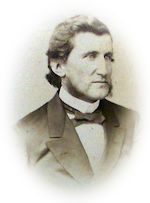 From Hugh Lenox Hodge (sent on board the hospital ship to Georgeanna.)
Cheeseman’s Landing, Friday.
Dear Georgy: I hope to see you and Eliza to-day. . . . We received all the wounded from the assault on the lunette alluded to, except one too badly hurt to move (who has since died, they tell me) and a few so slightly injured as to be retained for future service. The “boys” here say that Thomas Archer, your servant’s brother, did not belong to their Company H, but to Company A, and that he was among those left behind on account of his injuries being slight.
So far our patients, with hardly an exception, have been a superior class of men, and it has been a great pleasure to attend to them.
Dr. Tripler was here yesterday, and I was glad to hear of the probable removal of not only the 200 sick at Ship Point, but of 400 scattered elsewhere, to Boston, New York or Philadelphia.
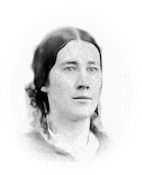 Abby Howland Woolsey to Georgeanna and Eliza.
New York, May 2nd.
My Dear Girls: We have received this, morning your letter of Monday and Tuesday (Georgy’s) written at intervals and mailed off Ship Point. What a strange life you are leading on board a hospital ship, sewing hospital flags, dispensing medicines, etc., etc. You two have always been together in the queerest and most varied circumstances, and in all parts of the world, from the heart of the Mammoth Cave to the top of the Pyramids of Egypt, in peace; and now, in war. You did not inclose the ward-list, but “Dr. Woolsey,” we feel confident, is a joke on Georgy. She deserves a title of the sort, I am sure. You thought of everything it seems, even to a flat-iron. . . . We seem to be sitting at home impotent and imbecile. It costs us no trouble to order home a few pieces of mosquito bar from Holmes’, or a few dozen towels from Milliken’s—and even these are sitting under the piano waiting. We have screwed the bandage-roller on again, and the little table stands with strips of cotton and pins and labels just as it stood one year ago, when Georgy fired away with it day after day,—between the folding doors of the parlors.
Mother came home yesterday from Philadelphia, leaving Hatty at the Hodge’s. Aspinwall, wife and baby are there. We think Mother looks well. She brought a few of Joe’s photographs. What a keen, alert, decided look he has, as becomes a Colonel and a man who has done a year’s military duty! Soon after Mother, came Mary, Robert and May to dine and spend the night. This happened very nicely, as it was Mother’s first evening at home after Washington. . . .
What great events are happening! Awhile ago, two such things as the fall of New Orleans and of Fort Macon in one week would have crazed us with surprise and delight. We are almost blasés in such matters. . . . It is a good joke and commentary on the southern doctrine of “State rights” that the Governor of North Carolina has been arrested in Richmond, Virginia, for “Unionism”!
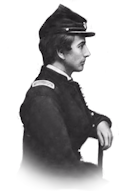
May 2d. Last night at eleven P. M., after we were all sound asleep, an orderly came from brigade headquarters with written orders, directing the regiment to be in marching order by twelve o’clock, formed on the color line. I jumped out of bed, ran to the company commanders, hustled them out, and had the regiment formed at the appointed hour. We saw the other troops of the division parading on their color line, and expected something serious was about to occur, but it did not. We stood in line till about seven o’clock and were then dismissed and ordered to pitch tents again, and get breakfast. Upon investigation, we learned the whole movement was a fancy of General Sumner, who desired to see how quickly he could get his command ready for action. He found out, and we lost a night’s sleep.
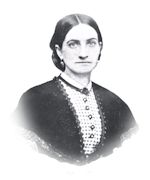
May 2.—Mr. Ogden, a member of Captain Ketchum’s Battery, called on me this morning. He has been discharged from that company, and is going to Mobile to join the engineering department; the one in which he served while in the British army. From all I can learn, he has been a brave and good soldier.
In the afternoon, Mr. J—— called; he, Miss—— , Dr. Herrick, and myself went to pay a visit to the Twenty-first Alabama Regiment. After spending some time in trying to discover its whereabouts, we learned that it was too far distant for us to go. We had a very pleasant ramble in the woods. I had no idea that the country around Corinth was so pretty—it being quite hilly. The woods were arrayed in their summer attire, and the “wind-whispers” through the forest had a soothing effect; like a sweet melody of other years,
“There is music in all things, if men had ears;
The earth is but an echo of the spheres.”
The whole wore an air of serenity and peacefulness—a vivid contrast to the fury that is raging in the heart of our remorseless foe. Alas! how “man marks the earth with ruin,” and curses “what heaven hath made so glorious.”
A company of “dire artillery’s clumsy car,” not “tugged by sluggish oxen,” but drawn by fine-looking horses, passed us. The scene was an impressive one. Nature looked so calm, as if in contrast with the terrible war-monsters before us. I could not look at them without thinking that, ere long, they might be belching forth their iron hail; dealing death and destruction; bringing woe to many a heart and household. General Polk and his staff passed; he looks every inch a soldier. I am told that he is much beloved in camp.
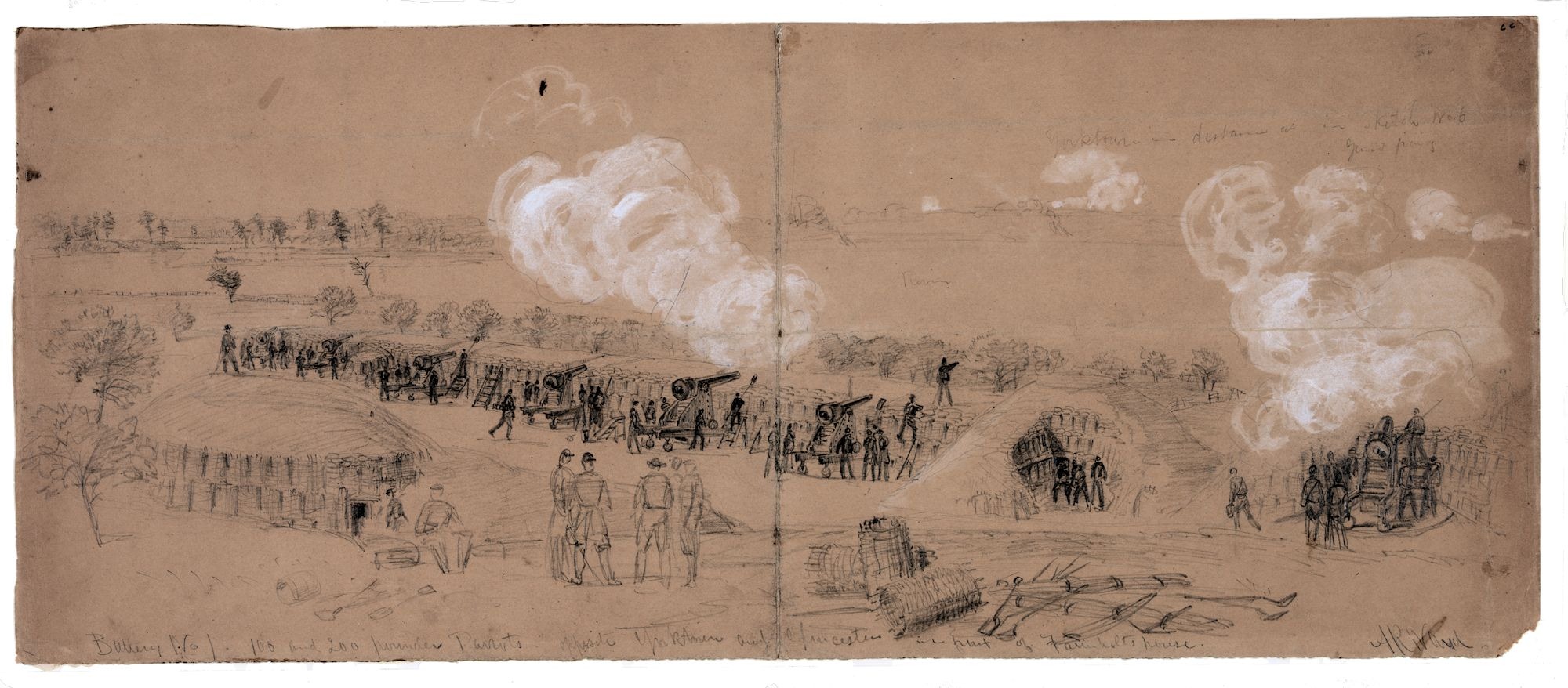
Battery No. 1.–100 and 200 pounder Parrots opposite Yorktown and Gloucester in front of Farenholt’s house.
May 2, 1862 – drawn by Alfred R. Waud.
- Signed lower right: AR Waud.
- Title inscribed below image.
- Inscribed within image: River. Inscribed upper right: Yorktown in distance as in sketch No 6. guns firing.
- Published in: Harper’s Weekly, June 7, 1862, p. 360-1.
- Dated from Harper’s Weekly.
- Gift, J.P. Morgan, 1919 (DLC/PP-1919:R1.2.729)
Part of Morgan collection of Civil War drawings. Library of Congress Prints and Photographs Division Washington, D.C. 20540 USA
Record page for this drawing: http://www.loc.gov/pictures/item/2004660461/
May 2.—Secretary Seward informed the foreign ministers that the post routes were reopened “to New-Orleans and other places which having heretofore been seized by insurgent forces, have since been recovered, and are now reoccupied by the land and naval forces of the United States;” also that a collector had been appointed for New Orleans, and that preparations were being made to modify the blockade.
—This night, the steamer Edward Wilson was fired into by rebel cavalry, six miles below Savanah, Tenn., wounding five soldiers. The gunboat Tyler immediately went down and shelled the woods, and notified the people of the vicinity that their property would be burned on the repetition of the occurrence.
—At Corinth, Miss., General Beauregard issued the following address to his troops: “Soldiers of Shiloh and Elkhorn! We are about to meet once more in the shock of battle, the invaders of our soil, the despoilers of our homes, the disturbers of our family ties, face to face, hand to hand. We are to decide whether we are to be freemen or vile slaves of those who are free only in name, and who but yesterday were vanquished, although in largely superior numbers, in their own encampment, on the ever memorable field of Shiloh. Let the impending battle decide our fate, and add a more illustrious page to the history of our revolution—one to which our children will point with noble pride, saying: ‘Our fathers were at the battle of Corinth.’
“I congratulate you on your timely junction. With your mingled banners, for the first time during this war, we shall meet the foe in strength that should give us victory. Soldiers, can the result be doubtful? Shall we not drive back into Tennessee the presumptuous mercenaries collected for our subjugation. One more manly effort, and, trusting in God and the justness of our cause, we shall recover more than we have lately lost Let the sound of our victorious guns be reechoed by those of the army of Virginia on the historic battle-field of Yorktown.”


