Following the American Civil War Sesquicentennial with day by day writings of the time, currently 1863.

August 2012

August 16, Saturday. With the President an hour or two this A.M., selecting candidates from a large number recommended for midshipmen at the naval school.

Finished a set of instructions for our naval officers in matters relating to prize captures and enforcing the blockade. Mr. Seward sent me a few days since in the name of the President some restraining points on which he wished the officers to be instructed, but I was convinced they would work injury. Have toned down and modified his paper, relieved it of its illegal features, added one or two precautionary points and sent the document to the State Department for criticism and suggestions.

Mem. It may be well, if I can find time, to get up a complete set of instructions, defining the points of international and statute law which are disputed or not well understood.

Have a long telegram from Wilkes, who informs me that the army has left, and asking for instructions what to do now that McClellan has gone. I have not been advised of army movements by either the Secretary of War or General Halleck. Both are ready at all times to call for naval aid, but are almost wholly neglectful of the Navy and of their own duties in regard to it, as in this instance.

16th.—Morning came, and found us still waiting orders, whilst immense trains of teams and masses of soldiery, sick and well, are pushing past us. Our division are again to bring up the rear, and receive the attack, if one is made. j This is said to be the post of honor; but we are beginning to feel that we may be ” honored over-much.”

At 5 P. M. came the expected and anxiously looked-for order, and we are on the road down James River. Not being a military man, I may be hypercritical, but it does seem to me that it should not require the forty-eight hours which we have taken for that purpose, to get out of camp with an army no larger than ours; or, that if so much time is required, the leaders should adopt some system in leaving, so as to call the divisions successively to get ready; not to call all at once, and wear out the rear guard with watching and with expectation, whilst the-advance is passing. Two days ago our division was ordered to be ready to march at an hour fixed, and to have two days’ rations to march on. The two days expired without further order to prepare rations, and the hour of starting found our rear guard, which is to stand the brunt of battle, worn out, and without rations to march on! “Shiftless.”

At 11 p. M. we reached Charles City, an extensive capital of of one of the oldest and richest counties in Virginia. This Charles City contains one dwelling house, with three or four , buildings for “negro quarters,” and a court house of about 20×35 feet, and one story high. In Virginia, they must have very little legal justice or very little need of it. From the direction of our march so far, I judge we go to Fort Monroe, and that we shall cross the Chickahominy at its main junction with the James.

Saturday, 16th—Ten men from each company are detailed every morning to stand on picket, while the others patrol the railroad tracks. The first thing we do is to form a line of battle every morning at 4 o’clock.

16th. Saturday. Kept up our march till morning at nine. Crossed the Osage. At nine A. M. stopped to feed and breakfast. Marched on through Johnstown. All the day the boys made for every melon patch, orchard or beehive to be seen. Had a good eat from melons and apples. Saw very few people. Encamped at sundown. For the first time had a night’s sleep. Very little water. Expected somewhat an attack before morning. Ordered to sleep on our arms. 1 slept soundly, as I usually do. Johnnie Devlin and I devoured a nice large watermelon. Enemy supposed to be six miles away.

Norwich, August 16th, 1862.

My own dear Son:

After having received intimations from various sources of the almost certainty of your appointment to the Lt. Colonelcy of the Eighteenth, you may imagine the crushing disappointment produced by the order from the War Department forbidding the removal of all officers from their present positions. Col. Ely is very anxious to have you with him. Ned Tyler told me that Ely said to the Gov.: “If you will appoint the officers I wish, I will be responsible for the reputation of the Regiment. If, however, you put in mere politicians I cannot.” I feel the sickness of “hope deferred” this morning, and my heart is very heavy. Well, I cannot resist all influences, and though I have brave hours, I have times of bitter struggling. Well, this is useless as well as discouraging to you. Pardon me, my son. I shall soon recover from this unworthy despondency. I am much gratified by the interest shown by your friends here. Mr. Johnson (Charlie’s father) told Lillie the pressure upon the Gov. from Norwich people on your behalf had been very great, the matter was now decided, and you would probably be with us next week, still, he said, we must not be too sure, for “there’s many a slip ‘twixt the cup and the lip.” For Gen. Tyler’s affectionate interest, I must always be very grateful. He has returned to Connecticut to take charge of the Regiments now preparing in the State. He has taken great interest in you always. Perhaps I am unreasonable in my disappointment at not seeing you, but I do feel you might have been appointed earlier, before these orders were issued.

We are all well, and anxiously watching for news from Burnside. I have sent to New-York for a flag to wave from our old home, the home of your childhood. I intended it to greet your return. I shall place it over the front entrance so that all who pass in or out must walk under its folds. Hunt just passing the door called out, “give my love to Will.” All are interested and excited about the new Regiments. The Twenty-second goes into camp in Norwich, on the Fair Grounds. Eating, drinking, or sleeping, our thoughts are on the war and the precious lives at stake, as well as the great issue involved. Bromley is Captain of a Company, and young Merwin his first Lieutenant. Morton Hale is a Lieutenant in one of the companies; he is to be married next Tuesday to Emily Huntington. Her sister Hannah was engaged to Charlie Breed.

Good-bye, my own dear, dear son. My whole trust is placed in the mercy of God, to whom I earnestly pray for your deliverance from all evil. God bless you wherever you may be is the cry of my anxious, loving heart.

Always lovingly,

Mother.

New London has furnished one private and an Adjutant —wants a field officer besides. They have sent four hundred men to the Fourteenth. I have just heard that perhaps the staff officers are not included in this order from the Department. Gen. Tyler will be at home this evening, when I shall learn.

Saturday, 16th.—Received orders to cook four days’ rations. Started towards Cumberland Gap, 8 P. M. Marched six miles, and halted until daylight.


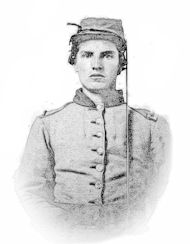
(Note: picture is of an unidentified Confederate soldier.)

1862 August Culpepper 3c02809u

In 1862, the Confederates had a training camp and army hospital at Culpeper Court House, and they established a supply base there early in 1862. General John Pope’s Union forces occupied the county in July 1862.

________

Photo taken by Timothy H. O’Sullivan, August, 1862; Library of Congress image.

AUGUST 16TH.—We have intelligence from the West of a simultaneous advance of several of our columns. This is the work of Lee. May God grant that our blows be speedy and effectual in hurling back the invader from our soil!

August 16th. We remained on duty all night, but at 7 A. M. withdrew the picket line and joined the brigade, which was in rear of the division. At 9 A. M. the whole division fell in and marched northerly, following the troops, which, together with the trains, had preceded us; our line of march lay through splendid fields of corn, now quite fit to eat, some of it so remarkably high that I could only just touch the waving plumes with the point of my drawn sword, on horseback. It afforded a grand feast for the men, who were not slow to fill up their haversacks; it is easily roasted by throwing it into burning embers, with the covering intact; this partially steams it, and gives a delicious flavor; marched until evening, making only two short halts for rest, and went into bivouac in a beautiful spot near a large house, which Sumner occupied as headquarters. The country we marched over is much in advance of anything we have seen heretofore, and has not been campaigned over; consequently, our larder contains many delicacies, and within an hour after we arrived, en bivouac, the mess was bountifully served with fricasse chicken, roasted corn, etc.; all are in buoyant spirits at the prospect of active service again. During the night Franklin’s corps passed by.

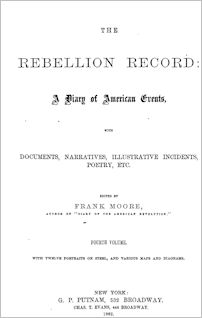
August 16.—An enthusiastic war meeting was this day held at Lake Mahopac, N. Y.—The One Hundred and Twenty-second regiment of Pennsylvania volunteers arrived at Washington, D. C. —Colonels Corcoran and Wilcox, Lieutenant-Col. Brown, and Major Rogers, reached Fortress Monroe, having been exchanged at Richmond, Va. Great joy was manifested at the release of Col. Corcoran and his fellow-soldiers.

—The United States gunboat Pocahontas, one of the blockading squadron off Charleston, proceeded up the Black River, S. C, on a reconnoitring expedition, and in search of a rebel steamer reported to be in the river. When about twenty-five miles up, it was discovered that the rebels had sunk the vessel. In returning, the Pocahontas was fired into by bands of rebel guerrillas all along the banks of the river for a distance of twenty miles, but she sustained no injury, and but one person was wounded.

—Hopkinsville, Ky., was this day captured by a force of rebel guerrilla cavalry, under the command of Colonel A. R. Johnson. A quantity of ammunition and a number of rifles fell into their hands. Colonel Johnson issued a notice to the inhabitants of the town and its vicinity, informing them that he occupied the town and had taken the arms, etc., as a confederate soldier; and that if any Southern man or his property should be molested on account of his visit, he would retaliate on the Union men of the place.

—A company of rebel cavalry dashed across the Rapidan River, Va., near Crooked Run, and captured Lieutenant Black, and five men of the Union army encamped in the vicinity.

—An expedition consisting of the Union gunboats Benton, Mound City and General Bragg, under command of Captain Phelps; the rams Switzerland, Monarch, Lioness and Sampson, under command of Colonel Ellet, and transports Rockctt and McDowell, with the Fifty-seventh Ohio, the Thirty-third Indiana, fifty cavalrymen, and two pieces of artillery on board, under command of Colonel Wood of the Fifty-seventh Ohio, left Helena, Arkansas, this day and proceeded down the Mississippi. On the eighteenth, when near the mouth of the Yazoo River, at Millikins’s Bend, they captured the rebel steamer Fairplay, laden with an entire equipment of arms, accoutrements and ammunition for an army of six thousand men. At Haines’s Bluff they captured four pieces of artillery, and a large quantity of ammunition. At Richmond, La., they destroyed the railway depot, together with its contents, a large quantity of sugar, commissary stores, ammunition, etc., and engaged a force of rebels whom they put to flight. On the twenty-fifth instant the expedition returned to Helena, without losing a man.—(Doc. 183.)

—The Richmond (Va.) Examiner of this date, speaking editorially of the approaching session of the rebel Congress, among other things, said: “It will be for Congress to repair, as it best can, the mischief done the public service by a weak and impracticable executive; to look at the reduction of our forces in the field; the decay of military discipline; the demoralization of our armies, and the jeopardy to which our cause has been put by a long course of trifling conduct, childish pride of opinion, unworthy obstinacy, official obtuseness, conceit, defiance of public opinion, imperiousness and despotic affectation on the part of those intrusted with the execution of the war.”

—The evacuation of Harrison’s Landing, on the James River, Va., by the army of the Potomac, which commenced on the eleventh instant, was this day completed.—(Doc. 184.)

—A fight took place near Lone Jack, Mo., between a force of about eight hundred Missouri State militia, under the command of Major Foster, and a body of rebel guerrillas under Colonel Coffee, numbering between three and four thousand men, resulting, after an engagement of four hours, in the defeat of the Nationals with a loss of sixty men killed and one hundred wounded and missing. The rebel loss was one hundred and ten killed and wounded.—(Doc. 185.)