Following the American Civil War Sesquicentennial with day by day writings of the time, currently 1863.

August 2012

August 30th.—A package arrived last night from our sisters, with my sister M’s diary, for my amusement. It was kept while our dear ones of W. and S. H. were surrounded by McClellan’s army. I shall use my leisure here in copying it, that our children’s children may know all that our family suffered during this cruel war. During the six weeks that they were surrounded by the foe, we only heard from them through letters written to their husbands in Richmond. These letters were captured by the enemy, and published in a New York pager; and one was republished in the Richmond Enquirer, where we were most delighted to find it. In that way W. B. N., then incarcerated in the walls of Fort Delaware, heard from his mother, wife, and children, for the first time since he was captured, in March.

Mrs. N’s diary begins: “May 18th.—S. H, Hanover County, Va. C. M. and myself set off yesterday morning for church. At my brother’s gate we met Dr. N., who told us that there were rumours of the approach of the enemy from the White House. We then determined not to go to our own church, but in another direction, to the Presbyterian church. After waiting there until the hour for service had arrived, an elder came in and announced to us that the minister thought it prudent not to come, but to have the congregation dismissed at once, as the enemy were certainly approaching. We returned home in a most perturbed state, and found that my husband had just arrived, with several of our sons and nephews, to spend a day or two with us. In a short time a servant announced that he had seen the Yankees that morning at the “Old Church.” Then there was no time to be lost; our gentlemen must go. We began our hurried preparations, and sent for the carriage and buggy. We were told that the driver had gone to the Yankees. After some discussion, one of the gentlemen determined to drive, and they were soon off. It was then eleven o’clock at night, and the blackness of darkness reigned over the earth. It was the most anxious night of my life. Surrounded by an implacable foe, our gentlemen all gone, we knew not how long we should be separated, or what might not happen before we met, and the want of confidence in our servants, which was now for the first time shaken, made us very nervous. This morning we went to W., and took leave of our sister, Mrs. C., and daughters. Her sons are in the army, and being a refugee, she says she must follow the army, and go where she can reach them if they are wounded. We found C. busily dividing her year’s supply of bacon among the servants, that each may take care of his own. As the enemy never regards locks, she knows that her meat-house will be unsafe; we secreted two guns, which had been inadvertently left, and returned, feeling desolate, but thankful that our gentlemen were safely off.

“22d.—Papers from Richmond to-day. We are not yet in the enemy’s lines.

“23d.—The enemy’s pickets gradually encroaching upon us. A squad of their cavalry has been in the Hanover Town lane all day; five or six lancers, with their red streamers, rode slowly by our gate thi3 evening. C. encountered them in her walk home, and had a conversation with an officer, Major Doyle, who made many professions of friendship!

24th.—We were aroused this morning at an early hour, by the servants rushing in, exclaiming: “The house is surrounded by Yankees, and they are coming into the house.”
[click to continue…]

[30th]

Early on the 30th we marched up close to the fort, stacked arms, and put up our tents, it being understood we were to form an additional garrison for the fort. At two o’clock, however, we were ordered to make a forced march to Centreville, leaving our tents behind us, and so started instantly, and had not gone many miles when the familiar sound of cannonading greeted our ears, increasing as we proceeded. We stepped out willingly and rapidly throughout the day, reaching Fairfax court house at midnight; here we halted for a rest of two hours, and then proceeded over a road blockaded with private carriages, ambulances, teams, and troops to Centreville, where we formed in brigade masses on the heights and rested on our arms for further orders.

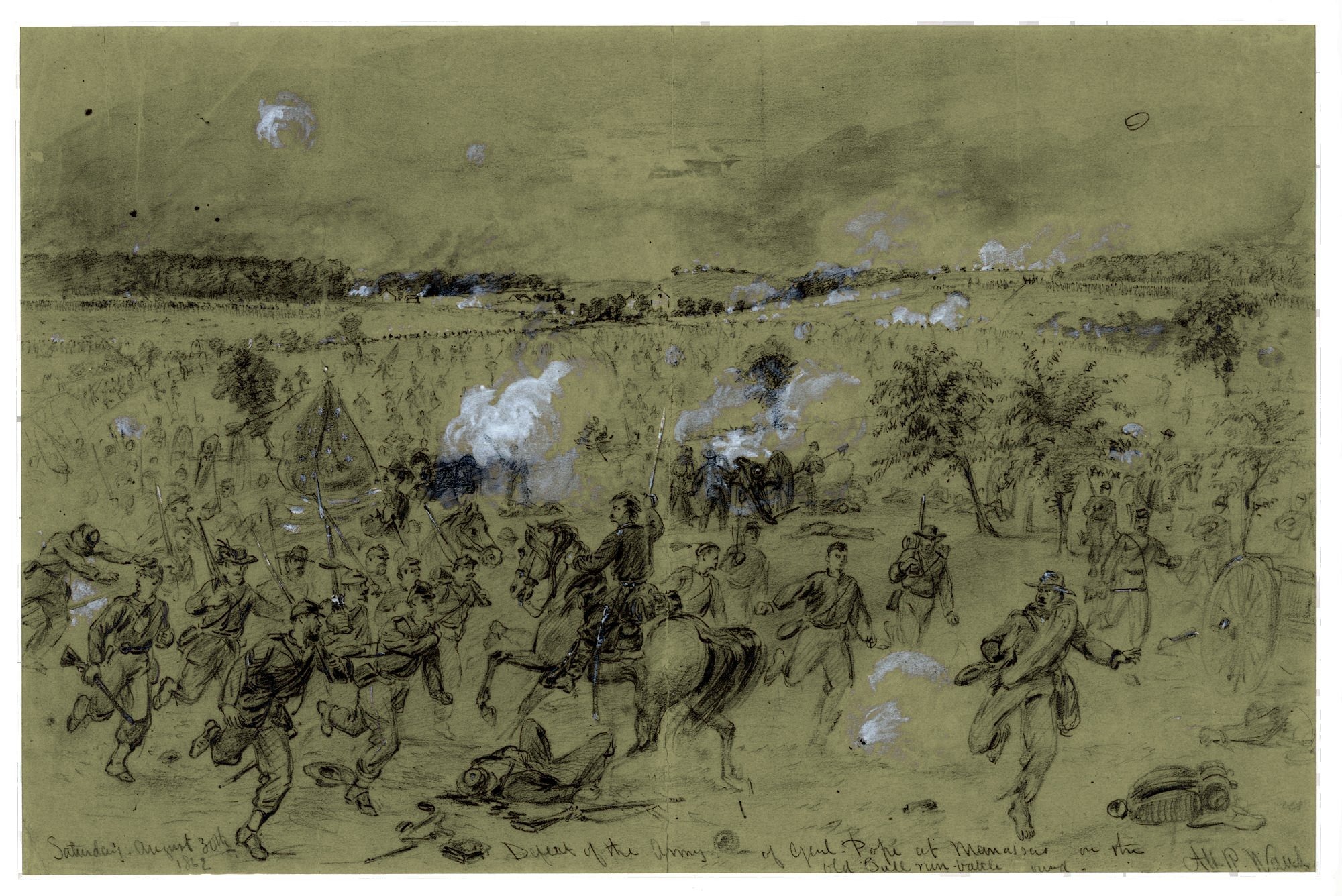
1862 August 30 Defeat of the Army of Genl. Pope at Manassas

Defeat of the Army of Genl. Pope at Manassas on the Old Bull run battleground.

Library of Congress image.

    • Signed lower right: Alf. R. Waud.
    • Title inscribed below image.
    • Inscribed lower left: Saturday August 30th 1862. Inscribed on verso: Advance of the rebel, Genl. Hills division. 30th of August 1862. In the distance is the enemies guns on the heights of Groveton. Groveton is situated to left of the middle of the sketch. Dogners [?] house in the centre. Battery in foreground captured by Penders troops. Troops in foreground part of Sch[urz]’s command. The officer on horseback may be Col. Koltes but I am not sure.
    • Inscribed in ink on verso, lower right: Edwin E.F. Store [?].

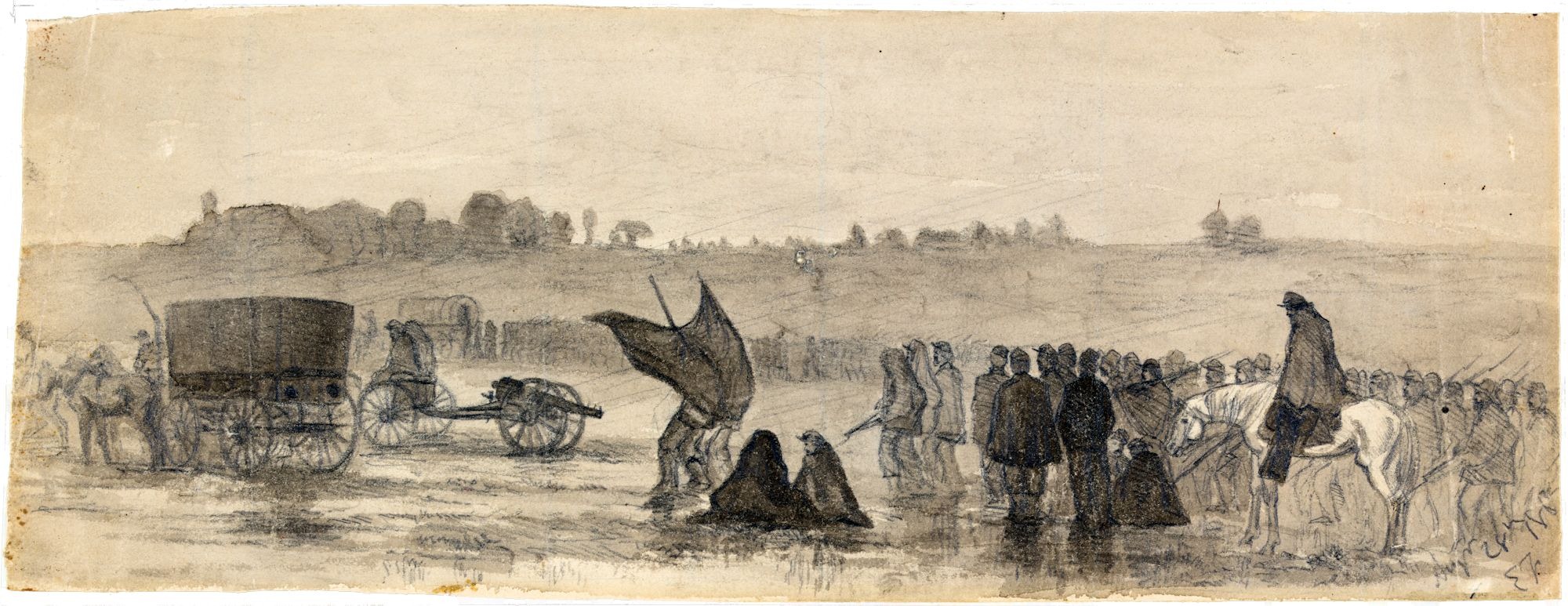
Retreat of the Army of the Rappahannock (Gen. Pope) to Groveton, Manassas Junction

This drawing seems to titled and dated wrong on the Library of Congress page for this image.  The rainy evening retreat of Pope’s forces was on August 30, not the 28th, and it was to Centreton, not Groveton or Mnassas Junction.  Where the title and date came from is not identified on LOC page.

Title: “Retreat of the Army of the Rappahannock (Gen. Pope) to Groveton, Manassas Junction”; drawing by Edwin Forbes, date August 28, 1832 on the LOC page for this image.

Library of Congress image.

August 30.—To-day three battles were fought in the vicinity of Richmond, Ky., between the Union forces, under Gen. Manson, and a numerically superior body of rebel troops, under Gen. E. Kirby Smith, resulting on each occasion in a defeat of the Nationals. The Unionists fought the third battle under the command of Gen. Nelson, but it ended in their retreat—(Doc. 107.)

—The United States War Department issued the following order: “Gen. Burnside commands his own corps, except those that have been temporarily detached and assigned to General Pope. General McClellan commands that portion of the army of the Potomac that has not been sent forward to Gen. Pope’s command. General Pope commands the army of Virginia, and all the forces temporarily attached to it. All the forces are under the command of Major-Gen. Halleck, General-in-Chief.”

—A severe fight took place at Bolivar, Tenn., between a body of Union troops, under the command of Col. Leggett, Seventy-eighth Ohio, and a greatly superior force of rebels, under Gen. Armstrong, resulting, after a contest which lasted for more than seven hours, in a rout of the rebels, with great loss. The loss of the Nationals in this engagement was five killed, among whom was Lieut.-Col. Hogg, of the Second Illinois cavalry, eighteen wounded, and sixty-four missing. — (Doc. 195.)

—Buckhannon, Va., was this day entered by a force of rebel guerrillas, and plundered of a large amount of military stores, fire-arms, ammunition, etc. Private property was respected. Before entering the town a skirmish took place between the loyal inhabitants and the rebels, but the latter being superior in numbers, the Unionists had to give way.— Wheeling Intelligencer, Sept. 4.

—On the twenty-seventh June last, the rebel Governor, Letcher, of Virginia, issued a proclamation, calling upon the State for a force of ten thousand men, to be commanded by Gen. John B. Floyd, to be employed in the defence of West Virginia; but the men not being forthcoming, the Governor issued another proclamation under this date, emphatically calling upon all officers of the State, civil and military, to give the necessary aid to expedite the raising of the required troops, and to contribute whatever might be proper to render them effective.

— A fight took place in the vicinity of McMinnville, Tenn., between a body of Union troops, under the command of Col. Fyffe, Twenty-sixth Ohio, and a superior force of rebel cavalry, under General Forrest, resulting in a rout of the latter, with considerable loss.—(Doc. 196.)

—The battle at Bull Run, Va., was renewed this day, and General Pope, after a desperate engagement, was compelled to retreat to Centreville, Va.— (Doc. 104.)

Enroute, Friday, Aug. 29. The day dawned just in time to see the suburbs (Chicago). We being about five miles from town received a magnificent view of the Western metropolis. The immense clouds of smoke issuing from the massive stacks of manufacture, and the countless rigging of the vessels lying at the dock were great sights to my country eyes. We arrived at the end of the line at 6:30 A. M. We were immediately formed in line, and forward march to the depot of the I[llinois] C[entral] R. R. about a mile distant. We were no sooner there than the shrill whistle told us we were again on a ride of three hundred and sixty-five miles to Cairo, without intermission. We crossed an arm of Lake Michigan having a fine view of the lake. Of our travel across the almost boundless prairies of Illinois I will not try to describe, but suffice it to say, we arrived at Cairo at 4 A. M.

29th.—The Richmond papers of yesterday mention two severe skirmishes on the Rappahannock within a week The enemy are retreating through Culpeper, Orange, etc., and our men are driving them on. General Jackson has reached Warrenton. Burnside’s army is said to be near Fredericksburg, and Pope retreating towards Manassas. The safe situation of this town makes it a city of refuge to many. Several of our old friends are here. Mr. and Mrs. D., of Alexandria, are just across the passage from us; the J’s are keeping house, and Mrs. M. is boarding very near us. This evening our friends the S’s arrived. None but persons similarly situated can know the heartfelt pleasure of meeting with home friends, and talking of home scenes—of going back, as we did this evening, to the dear old times when we met together in our own parlours, with none to make us afraid. We see very little of Lynchburg society, but in this pleasant boarding-house, with refugee society, we want nothing more. The warmest feelings of my heart – have been called forth, by meeting with one of the most intimate friends of my youth—now Mrs. Judge D. We met the other day in the church-door, for the first time for many, many years. Time has done its work with us both, but we instantly recognized each other. Since that time, not a day has passed without some affectionate demonstration on her part towards us. At her beautiful home, more than a mile from town, I found her mother, my venerable and venerated friend Mrs. Judge C, still the elegant, accomplished lady, the cheerful, warm-hearted, Christian Virginia woman. At four-score, the fire kindles in her eye as she speaks of our wrongs. “What would your father and my husband have thought of these times,” she said to me— “men who loved and revered the Union, who would have yielded up their lives to support the Constitution, in its purity, but who could never have given up their cherished doctrines of State rights, nor have yielded one jot or tittle of their independence to the aggressions of the North?” She glories in having sons and grandsons fighting for the South. Two of the latter have already fallen in the great cause; I trust that the rest may be spared to her.

I see that the Northern papers, though at first claiming a victory at “Cedar Run,” now confess that they lost three thousand killed and wounded, two generals wounded, sundry colonels and other officers. The Times is severe upon Pope— thinks it extraordinary that, as he knew two days before that the battle must take place, he did not have a larger force at hand; and rather “strange” that he should have been within six miles of the battle-field, and did not reach it until the fight was nearly over! They say, as usual, that they were greatly outnumbered! Strange, that with their myriads, they should be so frequently outnumbered on the battle-field ! It is certain that our loss there was comparatively very small; though we have to mourn General Winder of the glorious Stonewall Brigade, and about two hundred others, all valuable lives.

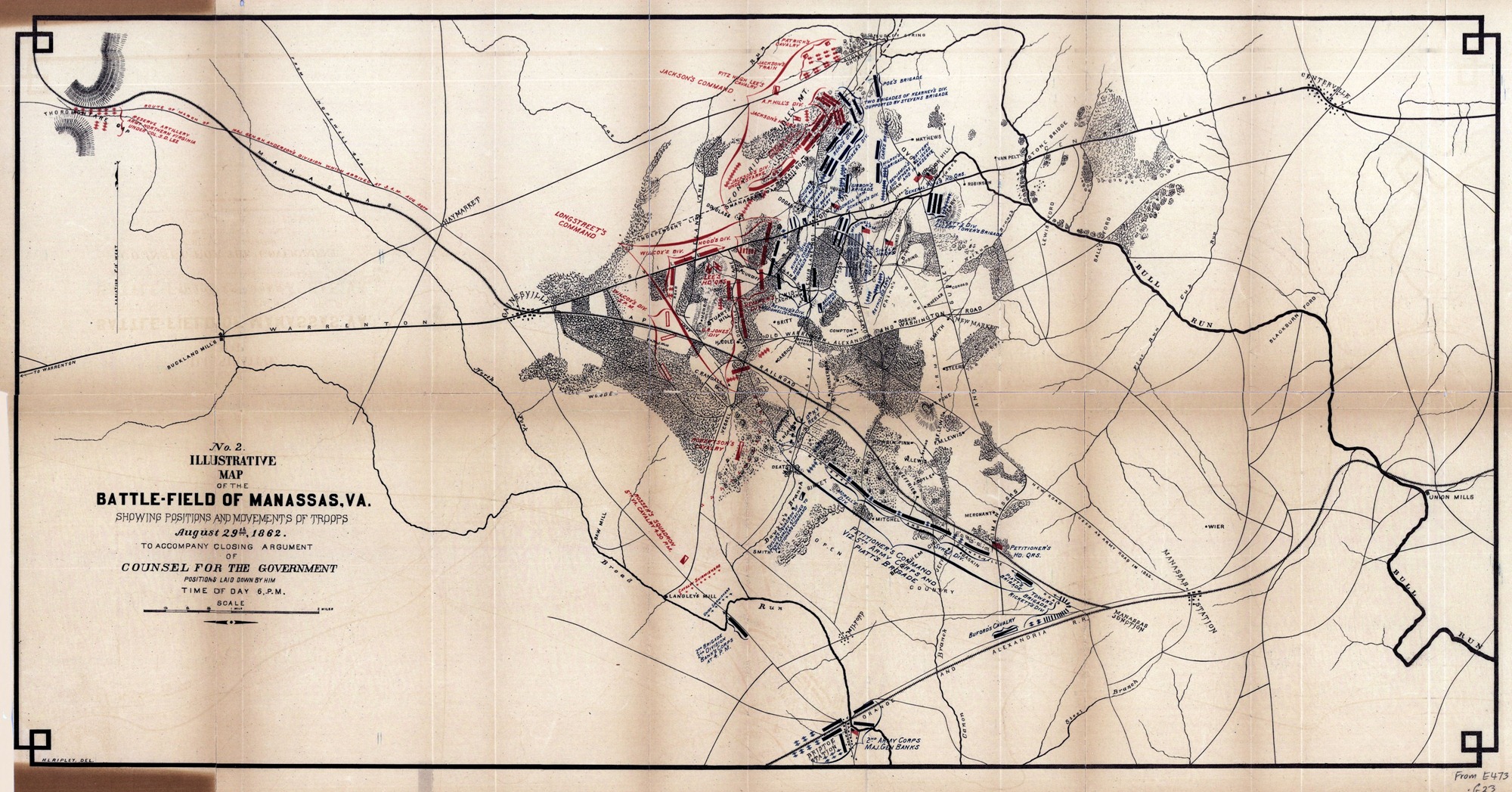
Illustrative map of the battlefield of Manassas, Va., showing positions and movement of troops August 29th, 1862

Folding map from: Argument of Asa Bird Gardner, counsel for government, after conclusion of the evidence in the case of Fitz-John Porter, before the Board of Army Officers at West Point, January 1879.

Illustrative map of the battlefield of Manassas, Va., showing positions and movement of troops August 29th, 1862. : to accompany closing argument of counsel for the government, positions laid down by him, time of day 6 P.M.

Library of Congress map.

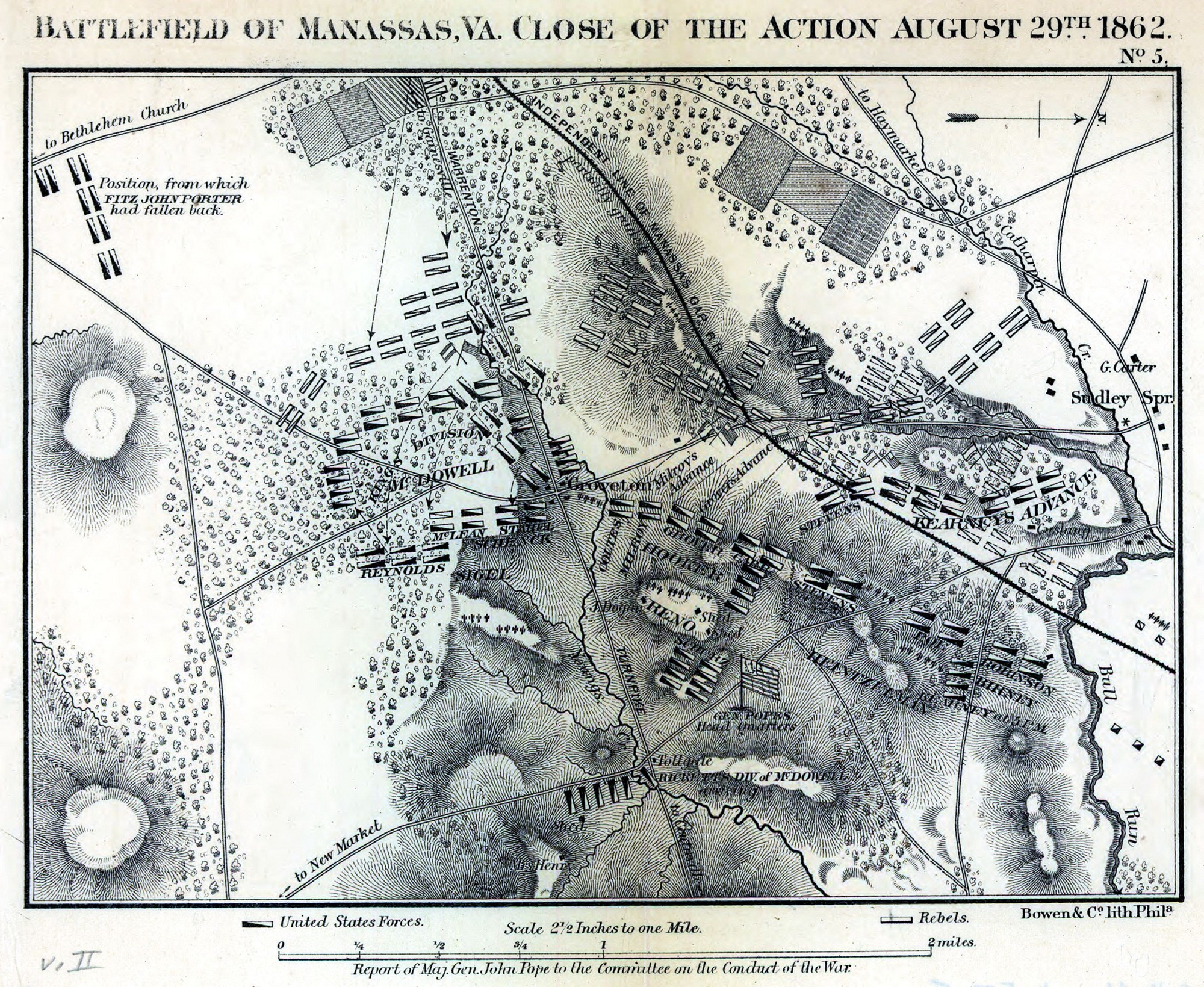
Battlefield of Manassas, Va. close of the action August 29th, 1862

Accompanies “Report of Major General John Pope to the hon. Committee on the Conduct of the War.”

Handwritten note on verso reads as follows: There is very little in accuracy in this map. Porter is entirely misplaced & thrown some miles in front of his true position. Kings division of McDowell’s Corps never reached the position assigned beyond Groveton. Kearney also is thrown too far forward. A map of the positions on 28″ 29″ & 30th was sent to the War Department when Gen. Belknap was there by Gen. Porter before this colored map was thought of-with the request it might be used in compiling any map of 2d Bull Run. The data on that map was verified by Confederate as well as our officers.

Library of Congress map.

August 29— We are still in camp at Gaines’ Crossroads, waiting for ammunition. We have no ammunition at present suitable for our Blakely gun, and there is none in the brigade ordnance train. This morning we heard heavy cannonading in the distance toward the east.