Following the American Civil War Sesquicentennial with day by day writings of the time, currently 1863.

Saturday, May 18, 2013

MAY 18TH.—The army last night made pontoons, on which this morning the Black River has been crossed. McClernand is on the left, McPherson in the center, and Sherman on the right. In this position the three great corps will move to Vicksburg by different roads. We are nearing the doomed city, and are now on the lookout for fun.
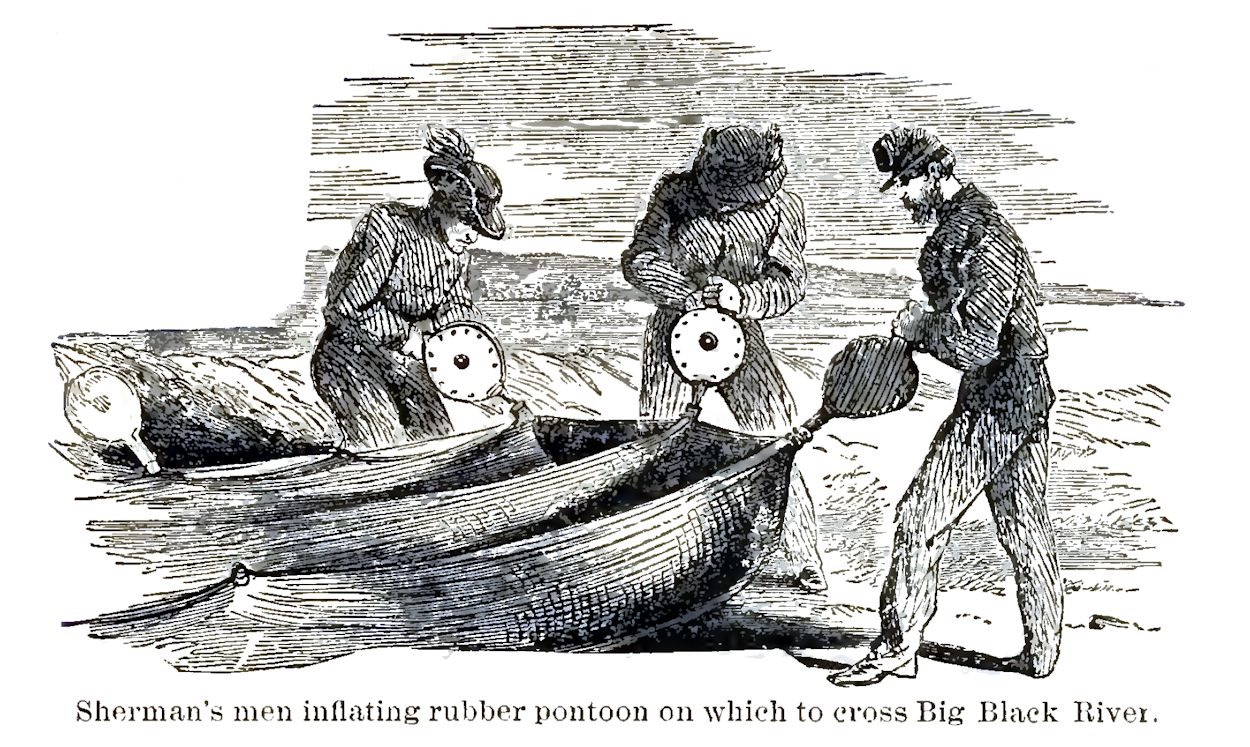
Sherman’s men inflating rubber pontoon on which to cross Big Black River

As we crossed the river and marched up the bank, a brass band stood playing national airs. O, how proud we felt as we marched through the rebel works, and up to the muzzles of the abandoned guns that had been planted to stay our progress. Every man felt the combined Confederate army could not keep us out of Vicksburg. It was a grand sight, the long lines of infantry moving over the pontoons, and winding their way up the bluffs, with flags flying in the breeze, and the morning sun glancing upon the guns as they lay across the shoulders of the boys. Cheer after cheer went up in welcome and triumph from the thousands who had already crossed and stood in waiting lines upon the bluff above. This is supposed to be the last halting place before we knock for admittance at our goal—the boasted Gibraltar of the west.

Our division has made a long march to-day, and we have bivouaced for the night without supper, and with no prospect of breakfast, for our rations have been entirely exhausted. Murmurings and complaints are loud and deep, and the swearing fully up to the army standard. General Leggett walked into our camp, and in his usual happy way inquired, “Well, boys, have you had your supper?” “No, General, we have not had any.” “Well, boys, I have not had any either, and we shall probably have to fight for our breakfast.” “Very well, General ; guess we can stand it as well as you,” came the ready answer from a score of us, and resignation settled back upon the features of tired and hungry, but unsubdued, patriot soldiers.

“You may study the hopeful, bright brows of these men,

Who have marched all day over hill and through glen,

Half clad and unfed; but who is it will dare

Claim to find on those faces one trace of despair?”
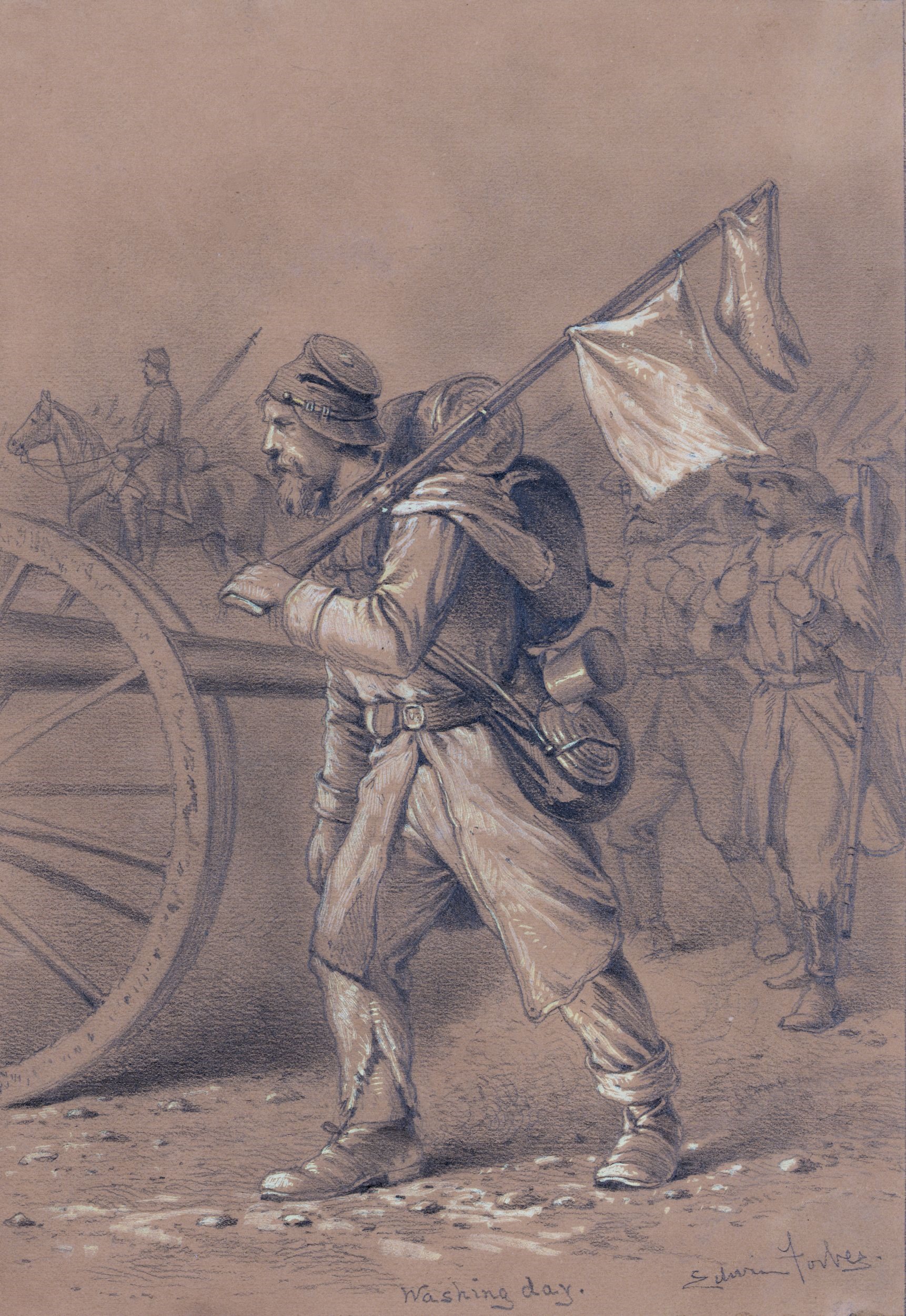
Washing DayA soldier with his latest wash hung out to dry on the barrel of his rifle. In the distance the column is seen on the march.

Part of “Life Studies of the Great Army” by Edwin Forbes (ca. 1876)

Library of Congress image.

___________

digital file from original itemNote:  This image has been digitally adjusted for fade correction, color, contrast, and saturation enhancement and selected spot removal. Also, it was one of two vignettes on the same sheet of paper.

May 18th. At nine twenty A. M. the Sachem came down and out of Red river, and anchored ahead of us. The Albatross got under way and went down the Mississippi river. Saw the smoke of a steamer up Red river; at twelve, noon, the ram Switzerland came out of Red river, and communicated with us; at two P. M. the iron-clad Pittsburgh got under way and went down the Mississippi. Ram Switzerland went up Red river. A steamer reported coming down the Mississippi river; at five P. M. the ram Gen. Sterling Price, arrived from Vicksburg; at nine thirty P. M. ram Switzerland returned from a reconnoissance up Red river, having nothing, though, to report, and anchored ahead of us.

Washington, D. C.

New York, May 18, 1863.

My Dear Sir,—I received this morning a letter from Baron Rothschild, M. P. for the city of London, to whom I had given a letter of introduction in favor of Mr. Evarts. He writes me :—

” I thank you for your information about the mission of Mr. W. M. Evarts, and shall be very glad to see him and to introduce him to some of the leading men of our government and Parliament.

” This mission seems to show a desire to preserve friendly relations with us, and nothing will contribute more to accomplish this object than for it to be known that a sincere feeling of the kind exists.”

I take the liberty of communicating this extract to you, supposing that it will interest you. Baron Rothschild, who is on very intimate terms with Lord Russell and the prominent members of the British cabinet, has for some time past given me repeated assurances of the earnest desire of the English ministry to maintain friendly relations with us, and to prevent, as far as it could do, any violation of neutrality on the part of British subjects.

May 18.—In England, in the House of Lords, the Marquis of Clanricarde moved for copies of any reports from British consular or diplomatic agents in the United States respecting the decisions or proceedings of the Federal prize courts. The Marquis accused President Lincoln’s Cabinet of having acted unfairly and illegally toward British shipping, and said it was absolutely necessary for Her Majesty’s government to take more action than it had hitherto done in defence of the rights of English ship-owners. Earl Russell, in reply, stated that every complaint made by the owners of vessels seized by Federal cruisers had been duly considered, and that the law officers of the crown had decided that no objection could so far be fairly established against the proceedings of the United States prize courts. The Earl took advantage of the opportunity to deny the statement that the British government had connived at the construction and escape of the confederate cruiser Alabama, and to repeat the assurance that England had no desire to interfere unfairly in the dispute between the North and South. Lord Derby expressed approval of Earl Russell’s speech, and the Marquis of Clanricarde, being satisfied with the discussion, withdrew the motion.

—To-day a party of twenty-two white men, of the Second Kansas artillery, and thirty-two negro soldiers, under the command of Major R. G. Ward, on a foraging expedition near Sherwood, Mo., were attacked by a gang of two hundred rebel guerrillas, under the leadership of Colonel Livingston. Under the inspiration of Major Ward, the Union party rallied together and fought desperately, falling back until the survivors reached their camp, six miles from the place where the fight commenced. Of the white men, two were killed, four wounded, and two were taken prisoners, twelve escaping. Fifteen of the colored troops were killed, two captured, and fifteen escaped, all but one of whom were wounded.

—Haines’s Bluff, on the Yazoo River, having been evacuated by the rebels, was occupied by the National forces, under Admiral Porter.—(Doc. 194.)

—A serious mistake occurred at a point between Carrsville and Deserted House, Va., in which two bodies of National troops fired into each other, and killed three men and wounded four, belonging to the One Hundred and Seventieth regiment of New-York volunteers.