Following the American Civil War Sesquicentennial with day by day writings of the time, currently 1863.

Tuesday, May 21, 2013

Before Vicksburg, Thursday, May 21. Last night we fell back near the place occupied day before yesterday in the reserve line. Unharnessed and tied to the wheel. Laid down in the corn field and slept sweetly till 9 A. M. Harnessed and fed our horses. Our haversacks were empty and no grain in the quartermasters’ department. Our last meal was brought us yesterday by our cook, which in fact was a small portion. But we kept as good cheer as possible. One of our men managed to find about a half bushel of coarse meal (for which we paid a dollar) and a beef killed, which with a good cup of corncob coffee made us a good breakfast, and all were satisfied. Unharnessed; drew two days’ rations hard crackers, rare things. Lay still all day. A slight sprinkle of rain settled the awfu1 dust.

Firing kept up-steadily from early dawn until dark, not fast, though still bombarding the fort. A flag of truce sent in by Pemberton, offering possession of the city if allowed to pass out with side-arms, which Grant respectfully declined, as a complete chain from one river to the other is thrown around them, Hurlbut coming up with 40,000 fresh troops, also Banks. Communication opened from Young’s Point with Haynes Bluff, so as to make it an easier matter to obtain provisions. Steele reported to have reached the town on the right, but compelled to fall back to his entrenchment by superior force.

May 21—Left this morning, marched twenty-one miles, halted at 5.30. It is a very hilly country, warm and dusty.

Camp 103d Illinois Infantry, Lagrange, Tenn.,

May 21, 1863.

I am still sitting on this Court Martial. We may finish up this week. Everything is quiet here. To-day three or four regiments have gone out with seven days’ rations. All mounted. Rumors reach us daily that Grant is in a critical situation; but I can’t so see it. He has enough men to annihilate in a field fight all the Rebels south of this line. We know that he has captured Jackson, Miss., and has now turned his attention to Vicksburg.

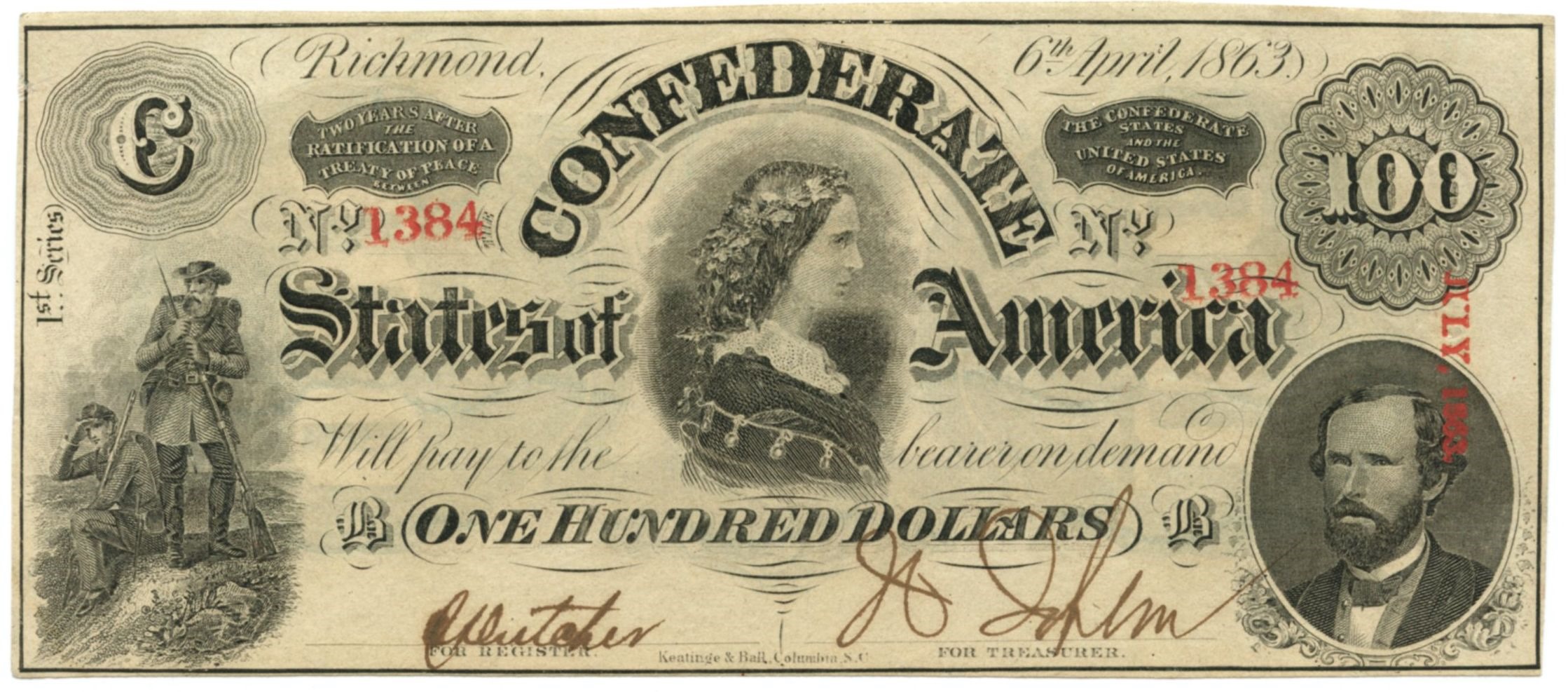
Confederate-100-dollars

May 21st. Firing was heard before daylight, down the river; at nine A. M. the steamer Gen. Sterling Price got under way and went up the Mississippi river; at nine A. M. as usual, inspected the crew at quarters. Commodore James S. Palmer went up Red river in steam gunboat Sachem; at two P. M., and from that hour until four P. M., infantry, cavalry, and artillery, were seen passing down the left bank of the river, some of Gen. Banks’s forces from the Teche country having come from Simsport or Alexandria; also two river steamers loaded with U. S. troops, came out of Red river, and made fast inshore ahead of us. Officers and men on board of them were in high spirits, knowing that it was owing to the old Hartford’s passage of the rebel batteries at Port Hudson, on the ever-memorable night of the 14th of March last, and her effective blockade of Red river since, that they could now meet with us to-day, and be transported from here to the village of Bayou Sara, a few miles above Port Hudson, and invest the latter place, and they gratefully acknowledged the service we had done them, by giving us three rousing cheers, which our boys upon manning the rigging, returned; at four ten P. M. the steam gunboat Estrella came out of Red river; at five thirty P. M. the gunboat Sachem, with Commodore Palmer and General Banks on board, came down and out of Red river, and in twenty minutes afterwards, the steamers Empire Parish, St. Maurice, Estrella, Bee, and Sachem, went down the river; at seven P. M. the steamer St. Charles, from Red river, with a coal barge for us in tow, arrived, bringing coal vessel alongside of us, and afterwards going down the Mississippi. Heavy firing heard in the direction of Port Hudson. This is a true account of all the occurrences of this day, and as the reader will readily perceive, there have been many, and such as will be remembered by us as well as by the enemy, for a long time to come. Secesh now looks crest-fallen, and thinks the mudsills of the North have got rather the best of him; he does not see what Jeff. is about.

by John Beauchamp Jones

MAY 21ST.—There was a rumor on the street last night that Gen. Johnston had telegraphed the President that it would be necessary to evacuate Vicksburg. This has not been confirmed to-day, and I do not believe it. It would be irremediably disastrous.

Mr. N. S. Walker writes from Bermuda, May 11th, 1863, that seventeen additional British regiments have been ordered to Canada. A large amount of ordnance and ordnance stores, as well as several war steamers, have likewise been sent thither. He states, moreover, that United States vessels are having their registers changed. Does this really mean war?

Strawberries were selling in market this morning at $1 for less than a pint. Coal $25 per load, and wood $30 per cord.

May 21.—A band of guerrillas who day before yesterday plundered the town of Richmond, Mo., this day visited Plattsburgh, in the same State, and carried off eleven thousand dollars belonging to the State, beside committing other depredations.

—The Mobile Register of this date said: “We are informed by the Mayor that the British subjects residing in Mobile have formed a company, known as the British Consular Guards, commanded by F. J. Helton, Captain, and have offered their services to the Mayor to aid in the preservation of the good order of the city in case of insurrection, invasion, inundation, devastation by fire, or any other duty not inconsistent with the retaining of their original nationality.”

—Last night a large steamer was discovered by the gunboat Powhatan, coming out of Charleston by the North channel. She was fired at repeatedly, and finally driven back; but before she reached the bar again the Powhatan’s fire, and that of two or three other blockaders that had slipped their cables and come up, was so heavy and well-directed that the Anglo-rebel was bored through and through and sunk in about eight fathoms of water. Nothing but her topmasts were visible this morning at daylight. She was a very large steamer, loaded with an immense cargo of cotton and tobacco. Her name was not ascertained, nor the fate of her officers and crew.—An expedition of National troops composed of levies from Massachusetts, New-York, and Maine, left Bemis’s Landing, La., this morning at daybreak.—(Doc. 197.)

—Vicksburgh, Miss., was completely invested by the National forces under Major-General Grant. The rebels sent out a flag of truce offering to surrender the place and all their arms and munitions of war, if they would be allowed to pass out. The offer was refused. —William Robe, a citizen of Morgan County, Ind., was shot while at work in his field, by a man named Bailey. Robe had been instrumental in collecting evidence against the Knights of the Golden Circle.

—The Twelfth regiment of New-York volunteers returned to Syracuse from the seat of war.— A rebel camp near Middleton, Tenn., was attacked and broken up by a party of National troops under the command of General Stanley.—(Doc. 198.)

—The citizens of Richmond, Va., were organized for the defence of the city, and officers were appointed by General George W. Randolph, assisted by a select committee of the City Council. The people of Manchester, on the opposite bank of the James River, were invited to cooperate in the movement.—Richmond Examiner.

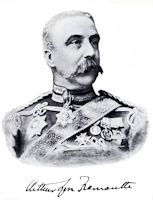
21st May (Thursday).—I rejoined General Johnston at 9 A.M., and was received into his mess. Major Eustis and Lieutenant Washington, officers of his Staff, are thorough gentlemen, and did all in their power to make me comfortable. The first is a Louisianian of wealth (formerly); his negro always speaks French. He is brother to the secretary of Mr Slidell in Paris, and has leamt to become an excellent Staff officer.

I was presented to Captain Henderson, who commanded a corps of about fifty “scouts.” These are employed on the hazardous duty of hanging about the enemy’s camps, collecting information, and communicating with Pemberton in Vicksburg. They are a fine-looking lot of men, wild, and very picturesque in appearance.

At 12 noon a Yankee military surgeon came to camp. He had been left behind by Grant to look after the Yankee wounded at Jackson, and he was now anxious to rejoin his general by flag of truce, but General Johnston very prudently refused to allow this, and desired that he should be sent to the North via Richmond. By a very sensible arrangement, both sides have agreed to treat doctors as non-combatants, and not to make prisoners of war of them.

The chief surgeon in Johnston’s army is a very clever and amusing Kentuckian, named Dr Yandell. He told me he had been educated in England, and might have had a large practice there.

My friend “Major” —— very kindly took me to dine with a neighbouring planter, named Harrold, at whose house I met General Gregg, a Texan, who, with his brigade, fought the Yankees at Raymond a few days ago.

After dinner, I asked Mr Harrold to take me over the quarters of his slaves, which he did immediately. The huts were comfortable and very clean; the negroes seemed fond of their master, but he told me they were suffering dreadfully from the effects of the war—he had so much difficulty in providing them with clothes and shoes. I saw an old woman in one of the huts, who had been suffering from an incurable disease for thirteen years, and was utterly useless. She was evidently well cared for, and was treated with affection and care. At all events, she must have benefited largely by the “peculiar institution.”

I have often told these planters that I thought the word “slave” was the most repulsive part of the institution, and I have always observed they invariably shirk using it themselves. They speak of their servant, their boy, or their negroes, but never of their slaves. They address a negro as boy or girl, or uncle or aunty.

In the evening I asked General Johnston what prospect he thought there was of early operations, and he told me that at present he was too weak to do any good, and he was unable to give me any definite idea as to when he might be strong enough to attack Grant. I therefore made up my mind to be off in a day or two, unless something turned up, as I could not afford to wait for events, I have still so much to see.

General Johnston is a very well-read man, and agreeable to converse with. He told me that he considered Marlborough a greater general than Wellington. All Americans have an intense admiration for Napoleon; they seldom scruple to express their regret that he was beaten at Waterloo.

Remarking upon the extreme prevalence of military titles, General Johnston said, “You must be astonished to find how fond all Americans are of titles, though they are republicans; and as they can’t get any other sort, they all take military ones.”

Whilst seated round the camp fire in the evening, one of the officers remarked to me, “I can assure you, colonel, that nine men out of ten in the South would sooner become subjects of Queen Victoria than return to the Union.” “Nine men out of ten!” said General Johnston— “ninety-nine out of a hundred; I consider that few people in the world can be more fortunate in their government than the British colonies of North America.” But the effect of these compliments was rather spoilt when some one else said they would prefer to serve under the Emperor of the French or the Emperor of Japan to returning to the dominion of Uncle Abe; and it was still more damaged when another officer alluded in an undertone to the infernal regions as a more agreeable alternative than reunion with the Yankees.