Monday, 25th—Tuesday, 26th—This — got my mare shod, went on, found A. at Henry Mitchell’s came back to Hardy Silver’s, found the boys and started back to the railroad to get some boots. Took supper with Mr. Hodge and on to Rodimore’s; had not the boots; then came back cross pike. I went with Berryman to shop; Hughes not there. I left him, came on to Jack Stewart’s. I, Albright and Lamb started back for Granville this evening; came on to Griggs, got supper. From there to Staffords and staid all night.
Sunday, May 26, 2013
July 26.—Spent the day at the hospital. Mr. —— has just received a post chaplaincy from Government, and is assigned to the Officers’ Hospital on Tenth Street. For this we are very thankful, as the performance of the duties of the ministerial office is in all respects congenial to his taste and feeling. I pray that God may give him health and strength for the office!
Before Vicksburg, Tuesday, May 26. Returned to camp last night after dark. This morning moved up a mile and a half to the left, put up harness racks, stretched picket in a beautiful orchard laden with fruit, which although not ripe we gathered and used for sauce. Mortar boats busy throwing shells all day; not much artillery firing from this side. Sergt. S. Hauxhurst returned from Memphis. Telegraph line put up from the landing to the several headquarters.
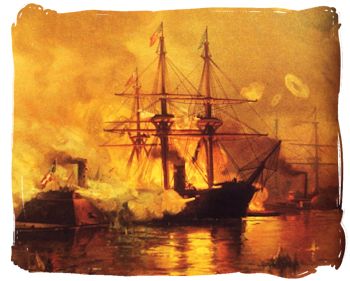
May 26th. Commences with pleasant weather, and only to find us engaged in shelling the woods around Port Hudson, which proved a big scare to the rebels, so much so that they deserted two fine river steamers they had concealed among the bushes upon what is called (it is a small stream) Thompson’s Creek, and our pickets took possession of them; our shelling continued, at intervals, from twelve to one forty A. M., of this watch, the Albatross participating in it; so there was no sleep last night on board the Hartford; at four o’clock beat to general quarters again, and shelled the woods in rear of Port Hudson; mortar vessels of the lower fleet also engaged shelling the rebel works; at five thirty hove up anchor, got under way, and dropped down to our old anchorage near the port, opposite Port Hudson, and anchored; at ten o’clock sent third cutter to land Mr. Watson, who is going across the point to take our mail for the North, and despatches for the Admiral; between the hours of five and six o’clock, P. M., saw a large fire burning at Port Hudson; sent third cutter, armed, ashore for our messenger.
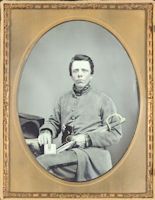
May 26 — The enemy opened fire at daylight this morning. We moved over to the river below town just before daylight and took a position in the trenches. 9 o’clock land batteries have commenced shelling town again and a number of gunboats in sight. The prospects for our success and deliverance seems to darken every day. Oh! May the God of heaven aid and deliver us from this unhappy state is the constant prayer of the writer
by John Beauchamp Jones
MAY 26TH—Reliable information of hard fighting at Vicksburg; but still, so far as we know, the garrison of the invested city has repulsed every assault made upon it. The enemy’s losses are said to be very heavy. Something decisive must occur there soon, and I hope something calamitous to the enemy.
The President and the cabinet have been in council nearly all day. Can they have intelligence from the West, not yet communicated to the public ?
We learn from Newbern, N. C., that gray-haired old men, women, and children, who refused to take the oath of allegiance, have been driven from their homes, on foot, despoiled of their property. Among these I see the names of the Misses Custis, cousins of my wife. Gen. Daniels, commanding our forces at Kinston, sent out wagons and ambulances to convey them within our lines. They were on foot.
May 26.—Colonel J. T. Wilder, with his regiment of mounted infantry, returned to Murfreesboro, Tenn., from a scout in the direction of McMinnville, in search of the rebel cavalry under the command of Colonel Breckinridge. He encountered the rebel pickets a short distance from Woodbury, and commenced an attack, which attracted the rebels in the vicinity, and they having collected, a running fight was kept up for several miles. Twelve miles west of McMinnville, the Union forces came on the camp of the rebels under Breckinridge, and after a short fight, routed them and captured nine prisoners, several horses and thirty head of cattle. Having secured the prisoners and burned the tents and baggage left by the rebel cavalry, the Nationals pushed forward, driving the enemy till within seven miles of McMinnville, when the pursuit was abandoned. On the return to Murfreesboro, the Nationals scouted the country on both flanks, and succeeded in capturing a number of rebel soldiers who were at home on furlough.—New-York Times.
—Colonel F. M. Cornyn, of the Tenth Missouri cavalry, left Corinth, Miss., in command of a strong force of cavalry, on a raid into Alabama.
—Miss Hozier, a young woman residing a few miles from Suffolk, Va., was arrested while trying to reach Richmond. In the handle of her parasol were diagrams and papers giving in detail the character and location of all the fortifications in the vicinity of Suffolk, and the strength of the forces garrisoning them. — The Thirty-second regiment of New-York volunteers, under the command of Colonel Francis E. Pinto, returned to New-York.
—At Sheffield, England, Mr. Roebuck made an address, in which he was very violent in his attack upon America. The meeting adopted resolutions in harmony with Mr. Roebuck’s views, although a respectable minority declared in favor of non-recognition of the rebel government.
—Joseph E. Brown, rebel Governor of Georgia, issued the following address to the people of that State: “I have this day received a despatch from General Joseph E. Johnston, commanding the army in Mississippi, stating that he is informed that numbers of stragglers from the army are reported going East through Georgia, especially the northern part, and requesting me to have them, officers as well as men, arrested and sent back to Jackson, ’employing for that purpose associations of citizens as well as State troops.’ I therefore order the commanding officers of the State troops, and all militia officers of this State, and request all good citizens, to be vigilant and active in arresting all stragglers and deserters, whether officers or men, and when arrested, to deliver them to Colonel G. W. Lee, commanding post at Atlanta, to be by him sent to Jackson, in obedience to the orders of General Johnston. Prompt and energetic action is necessary.”


