Following the American Civil War Sesquicentennial with day by day writings of the time, currently 1863.

May 2013

9th May (Saturday).—Started again by stage for Munroe at 4.30 A.M. My companions were, the Mississippi planter, a mad dentist from New Orleans (called, by courtesy, doctor), an old man from Matagorda, buying slaves cheap in Louisiana, a wounded officer, and a wounded soldier.

The soldier was a very intelligent young Missourian, who told me (as others have) that, at the commencement of these troubles, both he and his family were strong Unionists. But the Lincolnites, by using coercion, had forced them to take one side or the other— and there are now no more bitter Secessionists than these people. This soldier (Mr Douglas) was on his way to rejoin Bragg’s army. A Confederate soldier when wounded is not given his discharge, but is employed at such work as he is competent to perform. Mr Douglas was quite lame; but will be employed at mounted duties or at writing.

We passed several large and fertile plantations. The negro quarters formed little villages, and seemed comfortable: some of them held 150 or 200 hands. We afterwards drove through some beautiful pine forests, and were ferried across a beautiful shallow lake full of cypresses, but not the least like European cypress trees.

We met a number more planters driving their families, their slaves, and furniture, towards Texas—in fact, everything that they could save from the ruin that had befallen them on the approach of the Federal troops.

At 5 P.M. we reached a charming little town, called Mindon, where I met an English mechanic who deplored to me that he had been such a fool as to naturalise himself, as he was in hourly dread of the conscription.

I have at length become quite callous to many of the horrors of stage travelling. I no longer shrink at every random shower of tobacco -juice; nor do I shudder when good-naturedly offered a quid. I eat voraciously of the bacon that is provided for my sustenance, and I am invariably treated by my fellow-travellers of all grades with the greatest consideration and kindness. Sometimes a man remarks that it is rather “mean” of England not to recognise the South; but I can always shut him up by saying, that a nation which deserves its independence should fight and earn it for itself—a sentiment which is invariably agreed to by all.
9th. Killed beef for Sunday. Read considerably in “Les Miserables.” Reviewed “Fantine.” Never read a book which contained so much truth and sense on every page. Rob and I took a good bath and changed our clothes. Wrote home.

MAY 9TH.—Orders this morning to draw two days’ rations, pack up and be ready to move at a moment’s warning. We drew hard-tack, coffee, bacon, salt and sugar, and stored them in our haversacks. Some take great care so to pack the hard-tack that it will not dig into the side while marching, for if a corner sticks out too much anywhere, it is only too apt to leave its mark on the soldier. Bacon, too, must be so placed as not to grease the blouse or pants. I see many a bacon badge about me—generally in the region of the left hip. In filling canteens, if the covers get wet the moisture soaks through and scalds the skin. The tin cup or coffee-can is generally tied to the canteen or else to the blanket or haversack, and it rattles along the road, reminding one of the sound of the old cow coming home. All trifling troubles like these on the march may be easily forestalled by a little care, but care is something a soldier is not apt to take, and he too often packs his “grub” as hurriedly as he “bolts” it. We were soon ready to move, and filled our canteens with the best water we have had for months. We did not actually get our marching order, however, until near three o’clock P. M., so that being anxious to take fresh water with us, we had to empty and refill canteens several times. As we waited for the order, a good view was afforded us of the passing troops, and the bristling lines really looked as if there was war ahead.

O, what a grand army this is, and what a sight to fire the heart of a spectator with a speck of patriotism in his bosom. I shall never forget the scene of to-day, while looking back upon a mile of solid columns, marching with their old tattered flags streaming in the summer breeze, and hearkening to the firm tramp of their broad brogans keeping step to the pealing fife and drum, or the regimental bands discoursing “Yankee Doodle” or “The Girl I Left Behind Me.” I say it was a grand spectacle—but how different the scene when we meet the foe advancing to the strains of “Dixie” and “The Bonny Blue Flag.” True, I have no fears for the result of such a meeting, for we are marching full of the prestige of victory, while our foes have had little but defeat for the last two years. There is an inspiration in the memory of victory. Marching through this hostile country with large odds against us, we have crossed the great river and will cut our way through to Vicksburg, let what dangers may confront us. To turn back we should be overwhelmed with hosts exulting on their own native soil. These people can and will fight desperately, but they cannot put a barrier in our way that we cannot pass. Camped a little after dark.

Saturday, 9th—Start this evening, six of us, to Allen County, Ky. Went up in eight miles of Scottsville; stay all night or day in woods. To-night go by Ayres, Will Span’s and old man Span’s. At the latter place we got into hot water. Bushwhackers attacked us, killed my horse, stampeded all. I got separated from the rest, went one mile, got two horses, came on through to New Row Monday, 11th, and on across to Coatstown. Find Will at Mrs. Huffey’s, shot. Miss Sallie Key there on visit. I stay all night.

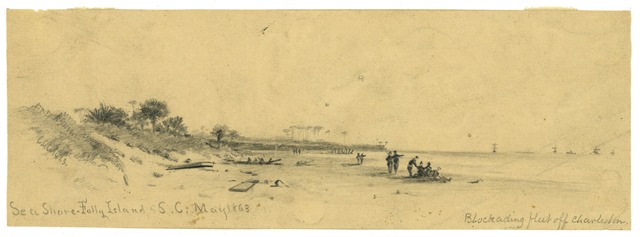
Sea Shore--Folly Island, S.C. May 1863

Sea Shore – Folly Island, S.C. May 1863

Artist – Alfred R. Waud; drawing on cream paper : pencil ; 6.7 x 19.0 cm. (sheet).

Inscribed lower right: Blockading fleet off Charleston.

Library of Congress image.

__________

The only actual fighting to occur on Folly Island was on May 10th, 1863, when confederate forces attacked federal pickets on the left side of Little Folly Island. The fighting was light, as the confederate forces were conducting a reconnaissance mission, aimed mostly at gathering information and taking prisoners.  (Source: An Educators Guide to Folly Island, South Carolina.)

May 9. — Weather warm and pleasant. Went over to headquarters to try Lieutenant Oliver’s horse. Major Spaulding’s detachment went into camp with their regiment. Enemy’s tents visible in the same place as before. General Stoneman’s force crossed the river safely, and so the canvas pontoon train returned to camp.

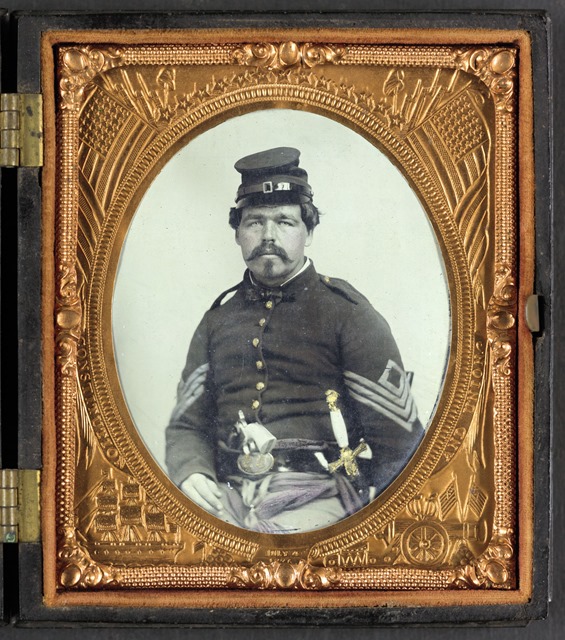
Unidentified soldier in Union first sergeant's uniform with militia sword and revolver


Unidentified soldier in Union first sergeant’s uniform with militia sword and revolver.

sixth-plate tintype, hand-colored ; 9.5 x 8.2 cm (case)

Donated by Tom Liljenquist; 2012

Liljenquist Family Collection of Civil War Photographs; Ambrotype/Tintype photograph filing series; Library of Congress Prints and Photographs Division.

Record page for image is here.

______________

http://lcweb2.loc.gov/service/pnp/ppmsca/34900/34964_150px.jpgNote:  This image has been digitally enhanced for fade correction, color enhancement and selected spot removal.

Civil War Portrait 029

by John Beauchamp Jones

MAY 9TH.—The papers contain the following order from Gen. Lee :

“HEADQUARTERS ARMY NORTHERN VIRGINIA,
“May 7th, 1863.

“GENERAL ORDERS No. 59.

“With heartfelt gratification, the General Commanding expresses to the army his sense of the heroic conduct displayed by officers and men, during the arduous operations in which they have just been engaged.

“Under trying vicissitudes of heat and storm, you attacked the enemy, strongly intrenched in the depths of a tangled wilderness, and again on the hills of Fredericksburg, fifteen miles distant, and by the valor that has triumphed on so many fields, forced him once more to seek safety beyond the Rappahannock. While this glorious victory entitles you to the praise and gratitude of the nation, we are especially called upon to return our grateful thanks to the only Giver of victory for the signal deliverance He has wrought.

“It is, therefore, earnestly recommended that the troops unite on Sunday next in ascribing to the Lord of hosts the glory due unto His name.

“Let us not forget in our rejoicing the brave soldiers who have fallen in defense of their country; and while we mourn their loss, let us resolve to emulate their noble example.

“The army and the country alike lament the absence for a time of one to whose bravery, energy, and skill they are so much indebted for success.

“The following letter from the President of the Confederate States is communicated to the army as an expression of his appreciation of its success: [click to continue…]

May 9.—The Charleston Mercury of this date published an article advocating the following plan suggested by the Jackson Appeal:

“How To Meet The Enemy.—The Northern vandals have invaded our State, not to confront our armies and decide the chances of war in pitched battles, but they have come to rob and steal, to plunder, to burn, and to starve to death our women and children. Under such circumstances we should meet them as we would meet the savage, the highwayman, or the wild beast of the forest. Partisan bands should lie in wait for them on the roadside, in fence-corners, and behind trees; and, in short, they should be hunted down in any and every way that can be made efficient and effectual until the State is relieved of their presence. Not observing the rules of civilized warfare themselves, they cannot expect its observance from us. We need more Colonel Blythes in the woods all over the State. A dozen well-directed shots from the bush will at any time put a brigade to flight, and this is the most sure and certain method of putting a stop to the marauding expeditions that are from time to time sent out through the country. In Colonel Blythe’s district or field of operations it has proved most efficacious in holding the enemy at bay, and we hope to see the plan put more extensively in practice. A big scare, occasioned by a brisk fire from a chapparal, is often more potent than would be half a dozen regiments of organized troops in the field.”

—To-night the bombardment of the rebel works at Port Hudson was renewed, and continued for an hour, but the rebels made no reply.

—The Second Indiana cavalry, under the command of Colonel E. M. McCook, made a scout near Stone River, Tenn., visiting the “haunt” of every guerrilla in that vicinity. They succeeded in capturing eight rebels, beside twenty horses belonging to the guerrilla band.—The schooner Sea Lion, from Mobile to Havana, with a cargo of cotton, was captured by the National frigate Colorado.

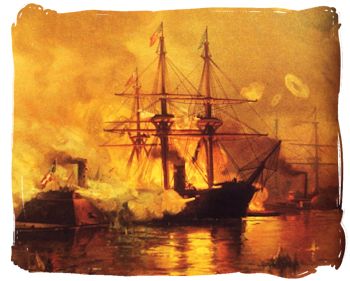
May 8th. Lying to an anchor in the Mississippi off the mouth of Red river; all quiet on the “Father of Waters,” up to four A. M., when a scene of great excitement occurred on board of the Flag-ship Hartford. The reader may ask what was the cause of it? Was the enemy near? No; but our friends were, and about bidding us, maybe, a long adieu, and leaving the good old ship for other parts; and they were our best of friends,—those who had left their wives and children, homes, relations, all that tends to make home dear, to be with us, and by their presence, kind words, and noble example, encourage us to deeds of noble daring; and well, dear reader, have they performed this duty, as the preceding pages of this book will testify, having been under their command in nine general engagements with the enemy, and have come out of all victorious, with little loss of life or limb, and the least damage to ship, while other vessels of the fleet had to succumb to the destructiveness of the enemy’s shot and shell, losing many valuable lives. This will appear more wonderful when it is taken into consideration that we always took the lead; we never asked others to go where we were afraid to go ourselves, and by this course of proceeding the Hartford has earned herself and brave Commander a name and fame at home and abroad. The rebels upon the banks of the Mississippi call her the black devil, and honorably acknowledge him who flies his broad blue pennant in defiance to them from her masthead, to be a bold, brave, and daring old warrior. I think it is a well-deserved compliment to the old naval hero, who never knew what fear or defeat was, and also to the staunch and noble old vessel whose decks he has trod with such a courageous tread and quiet mien, while guiding her movements when engaged with the enemy at close quarters, and running the gauntlet of their terrible batteries under a storm of iron hail. Success to him and his brave companions in all their future operations is the wish of the writer of these few lines, and may he be spared many years yet to brighten the rage of history with an account of his glorious deeds in the service of his country. Although rumored the day previous, the ship’s company could not be made to believe that we were going to lose one who held such a place in the hearts of all, and had become so dear—whose name was a household one; but alas! the dawn of this day proved the rumor too true, and many a countenance of these tars, tried by fire and water, every one a hero and able to relate an account of his hair-breath escapes from the enemy, was darkened and clouded over from the effect of this sad news; others’ eyes were wet with the tears they would fain conceal, but could not; their grief would find vent through this channel. All things being in readiness, at four, forty this morning, precisely, the following officers left the ship, viz . Rear-Admiral D. G. Farragut, Fleet Captain T. A. Jenkins, Fleet Surgeon J. M. Foltz, Rear-Admiral’s Secretary, E. C. Gabaudan, Fleet Captain’s Clerk, E. A. Palmer; also Lieut. Eaton of U. S. A. Signal Corps, and two soldiers of same; at five A. M., the Sachem got under way with them on board, when the lads manned the rigging, and gave three times three with a will; such cheers were seldom given by our noble sailors to any person or persons, and the honored recipients of same will long remember the event.