Following the American Civil War Sesquicentennial with day by day writings of the time, currently 1863.

May 2013

MAY 7TH.—Our company detailed and reported this morning at headquarters for picket duty, but not being needed, returned to camp. Were somewhat disappointed, for we preferred a day on picket by way of change.

Pickets are the eyes of the army and the terror of those who live in close proximity to their line. Twenty-four hours on picket is hardly ever passed without some good foraging.

We broke camp at ten o’clock A. M., and very glad of it. After a pleasant tramp of ten miles we reached Rocky Springs. Here we have good, cold spring water, fresh from the bosom of the hills.

We have met several of the men of this section who have expressed surprise at the great number of troops passing. They think there must be a million of “you’ns” coming down here. We have assured them they have not seen half of our army. To our faces these citizens seem good Union men, but behind our backs, no doubt their sentiments undergo a change. Probably they were among those who fired at us, and will do it again as soon as they dare. I have not seen a regular acknowledged rebel since we crossed the river, except those we have seen in their army. They may well be surprised at the size of our force, for this Vicksburg expedition is indeed a big thing, and I am afraid the people who were instrumental in plunging this country headlong into this war have not yet realized what evils they have waked up. They are just beginning to open their eyes to war’s career of devastation. They must not complain when they go out to the barnyard in the morning and find a hog or two missing at roll-call, or a few chickens less to pick corn and be picked in turn for the pot. I think these southern people will be benefited by the general diffusion of information which our army is introducing; and after the war new enterprise and better arts will follow—the steel plow, for instance, in place of the bull-tongue or old root that has been in use here so long to scratch the soil. The South must suffer, but out of that suffering will come wisdom.

May 7—Resumed our march at 8 A.M., got ten miles, and halted within one mile of the creek. We waded Gum Swamp, stayed there three hours, and turned about—marched nine miles to-night. This expedition was to tear up the Newbern and Kinston Railroad, and also bring some ladies and old men out of the Yankee lines, for they had been driven out of Newbern. There were about seventy in all. They were, of course, Southern people who would not take the oath of allegiance to the United States Government, and therefore were driven out of their homes.

May 7.— Day cloudy, but not rainy. Went to headquarters in the morning. We received an order to have everything ready for a move this afternoon, and from the aspect of affairs I should judge that we were to move to-night, and lay the bridges at Franklin’s Crossing. The order was revoked this evening for our crossing the river to-night. The President and Halleck were here this morning, and went away in the evening. There was a great feeling of relief when we found that we were not to cross the river immediately.

Camp 103d Illinois Infantry, Lagrange, Tenn.,

May 7, 1863.

Isn’t the Grierson “raid” glorious? Two other expeditions started from this point and were gone respectively five and ten days each. Although they made good long marches and took about 40 prisoners and 500 animals, still we forget them in looking after Grierson. We have the Rebels well scared in this country. Five thousand men could sweep everything north of Jackson, if they could only hold it. Papers to-day give us the news on the Rappahannock up to the 4th of May, which includes the route of Siegel’s Dutchmen and leaves Hooker in what seems to me a close place. Well, he can at worst but fail. What a consolation. General Oglesby wrote to Hurlbut to detail me on his staff. General Hurlbut referred the letter through division and brigade headquarters for the letter of my company and on its return to Hurlbut, General Smith objected to my being detailed out of his command. He thought Oglesby might find his staff in his own command. All right! I would like to have been with Old Dick though. I’m on a General Court Martial now. Confound the Court Martials.

by John Beauchamp Jones

MAY 7TH.—A scout came in to-day with the vexatious intelligence that a body of hostile cavalry is still in LouisaCounty. And later in the day we have information that the Mattapony bridge was burned last night! Thus again is communication interrupted between Gen. Lee and the city! Our wounded cannot be brought to the hospitals here, nor supplies sent to them! It really does seem as if an organization of Union men here were co-operating with the enemy, else they never could disappear and reappear so often with impunity. Every one is asking what Gens. Elzey and Winder are doing—and echo answers, WHAT?

There is a great pressure for passports to leave the country. Mr. Benjamin writes an indignant letter to the Secretary against Gen. Whiting, at Wilmington, for detaining a Mr. Planner’s steamer, laden with cotton for some of the nationalities—Mr. B. intimates a foreign or neutral power. But when once away from our shore, many of these vessels steer for New York, depositing large sums “for those whom it may concern.”

Mr. J. B. Campbell, attorney for J. E. Hertz (Jew), writes a long letter to “J. A. Campbell, Assistant Secretary of War,” urging the payment of the slight sum of $25,200 for ninety kegs of bicarbonate of soda seized by the agent of the department! The true value is about $250!

At two o’clock this afternoon a note was received by the Secretary of War from Lieut.-Gen. Longstreet (still in the city), stating that the President last night desired him to go to Gen. Lee immediately; but the general, during the day, has become convinced that he should not leave the city until communications are reestablished with Gen. Lee, and the city in a condition of defense against the sudden dash of one or two columns of the enemy—an event, he thinks, meditated by the Yankees! And the persistency of the Federal cavalry in hanging round the city in spite of all the generals here, and the many companies, battalions, and regiments vainly sent out in quest of them, would seem to indicate such purpose. [click to continue…]

Montague House, London.

New York, May 7, 1863.

My Dear General,—We returned from Havana a few weeks ago, when I found your very kind letter. I am delighted to hear that you and yours continue to enjoy excellent health, and that you have passed a very pleasant winter in your family circle, notwithstanding that general society in Nice had not been on the same agreeable and cordial footing as the winter before. One hardly ever finds the same social resources two consecutive seasons at a small place of resort, and then the impetuous “Prefette” was sure, sooner or later, to conjure up a storm. She has entirely too much electricity to allow continued sunshine around her.

*******

While I am morally convinced that our government, as well as the vast majority of our people look upon a war with England as a fearful calamity, I must confess that the events of the last few months, and the tone of your leading papers, have filled me with the most gloomy apprehensions for the future.

The fitting out of armed war vessels, like the Alabama, Florida, and Virginia, in your ports, in open violation of the Queen’s proclamation and the foreign enlistment act, have produced a most painful feeling here, and I am afraid that it will require the greatest moderation and the most cordial understanding between the two governments to prevent complications of the gravest nature. I know that Mr. Lincoln, as well as his Secretary of State, are very desirous to maintain the most friendly relations with England, and I trust that they will be met by your ministers in the same spirit.

Ten days ago an intimate friend of Mr. Seward, and one of our most prominent and respected members of the bar, Mr. Evarts, went out to England on a semi-official mission from our government. He is to assist Mr. Adams in his endeavors to come to a more definite and friendly understanding about the fitting out of privateers and other knotty questions, and I have the best hopes of his mission. I know him to be a very intelligent, upright, and well-disposed man.

I have taken the liberty of giving him a letter of introduction to you, being sure that you will gladly contribute, by your influence, to aid the good cause of peace and good-will between two kindred nations.

Mr. Evarts is an extremely well-informed man, and I am sure that you will derive pleasure and much valuable information in regard to our affairs from his acquaintance. You will oblige me, personally, very much, by extending that kindness and urbanity to him which I have received at your hands and which I value so much.

The newspapers give you detailed accounts of our present military position. I can safely say that our cause in the Southwest looks more favorable and hopeful than it has for many days past.

The successes of General Banks in Louisiana have placed the most fertile part of that State under Federal control. I have every reason to hope that we shall soon hold the Mississippi and compel the Confederates to evacuate Vicksburg.

The hopes of the whole nation are at this moment centred upon the army under Hooker, who has crossed the Rappahannock with his entire force, and is probably at this moment engaged in battle with the enemy. He has one hundred and forty thousand men under him, his army is in excellent condition, and his friends are very sanguine of success. God grant that these expectations may be realized.

In the stress in which the rebels are for food and all the necessaries of life, a signal defeat of their main army may bring us to an end of the war, by the re-establishment of the Federal authority over the old Union. On the other hand, a defeat of our army will only prolong the strife. The people of the North have never been so determined as they are now to carry on the war until the integrity of the government is re-established.

In this regard a most decided change has taken place, even among the ultra opponents of the administration. The men who were willing to purchase peace even at the surrender of our nationality, and whose number and influence were increasing last autumn and winter by the mismanagement of the Washington cabinet, have been entirely put in the background.

The North is at this moment more unanimous in support of the government and the war than it has been at any time since the beginning of this unfortunate struggle. Of this there can be no doubt, and I see in it the undeniable certainty that the war will never end except by the rebellion being crushed.

An evidence that the people have the utmost confidence in such an ultimate result, is in the eagerness with which, for the last two months, the people of all classes have invested their money in the securities of the government. The subscriptions to the Federal loan average over three million of dollars a day.

The North is united and prosperous, while at the South they are not only in sad want of the elements of life, but serious misunderstandings have broken out between the Richmond authorities and some of the States, particularly the State of Georgia, the most powerful and influential of the Confederacy. The latter opposes the conscription act, and refuses to guarantee the bonds of the Confederacy, notwithstanding a resolution of the Confederate Congress to that effect.

We found Havana very hot and unpleasant. The people do not know what comfort and cleanliness mean, and an Italian albergo is a palace in comparison with their best hotels. We went to some of the plantations of the wealthiest nabobs of the island, and it is really difficult to believe, that within five days’ sail from New York, people of wealth and education should live in such a state of semi-barbarism as I have seen there.

All this is the direct consequence of slavery, which exists on the Spanish sugar plantations in the most revolting form. It is exercised with the most inhuman cruelty on the poor black, and degenerates the white both morally and physically.

I found the Cuban planters generally in favor of the South, because they openly avowed that they saw in the success of the North the end of slavery in the United States, and that they would also be compelled to set their negroes free. You see, thus, that the aid and sympathy which the rebellion receives by a portion of your people, can only be construed into a direct assistance to uphold and perpetuate a most inhuman and degrading institution.

I was very sorry to see the British Vice-Consul, Mr. Crawford, not only an open, uncompromising, and bitter Secessionist, but also to find him engaged in transactions directly opposed to the Queen’s proclamation of neutrality, and entirely incompatible with the dignity of his office. It was generally known in Havana that he was openly engaged in running the blockade, and using his office to assist Confederate vessels to evade our cruisers under the British flag, etc., etc. It was under his auspices that, during my stay in Havana, the captain of the British war-steamer, the Immortality, a Mr. Hancock, sent the band of his ship to play at a party given by the Southern commissioner, Mr. Helm. The Cubans themselves were astonished to see a British officer allow his band to play rebel airs under the rebel flag, and expressed their opinion pretty freely at so questionable a proceeding. How far all these acts are reconcilable with the professions of strict neutrality I must leave to others to explain, but no fair-minded man can be astonished that they should excite bitterness and mortification.
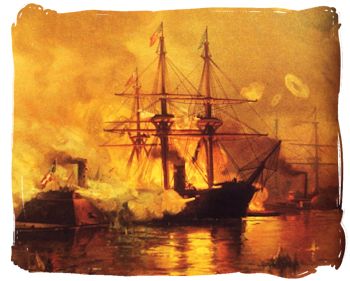
May 7.—The English steamer Cherokee, while endeavoring to run the blockade out of Charleston, S. C, was captured by the National gunboat Canandaigua.—A portion of the Fourth army corps, under the command of Major-General Keyes, reached West-Point, Va., this day, when a reconnoissance towards White House was ordered. After the command had proceeded a few miles from town, the detachment of company F, of the Sixth New-York cavalry, was fired on by a party of ambushed rebels, killing two of the horses. The reconnoissance was continued to White House, and on the route Lieutenant Estes, aid to General Kilpatrick, and fifteen men who were made prisoners by the rebels near Fredcricksburgh, were rescued. — General Robert E. Lee, the rebel commander at Fredericksburgh, issued an order to his army, “expressing his sense of the heroic conduct displayed by officers and men during the arduous operations” in which they had been engaged.

—Colonel Kilpatrick, with his regiment, the Harris Light cavalry, and a portion of the Twelfth Illinois cavalry, belonging to the expedition of General Stoneman, arrived at Gloucester Point, Va.—(Doc. 188.)

May 6th. Commences with clear and pleasant weather, and light breezes from the northward and westward; at six thirty-five A. M., the steamer Sachem got under way and steamed up the river, exchanging signals with lower fleet from mast-head; at eight forty-five called all hands up anchor, got under way, and proceeded up the river; at eleven thirty came to anchor off Point Coupée; sent forth cutter, in charge of an officer, and with six marines and an armed boat’s crew, to destroy some Confederate property; at one thirty P. M., under way steaming up the Mississippi; at 3 o’clock passed the Sachem; at seven o’clock came to anchor off the mouth of Red river; Albatross also came up and anchored.

Wednesday, 6th.—All quiet to-day. Have very good place to camp; plenty of mulberries.

Near Black River, Wednesday, May 6. Remained quiet. Foraging parties sent out bringing plenty of corn, fresh meat and many other things, taken from the deserted houses of fleeing chivalry. Mail arrived. Rec’d two letters from home dated 18th and 26th ult. Pontoon train of eighteen wagons passed to the right.