Mrs. Lyon’s Diary.
May 27.—Mr. Stanton came to our quarters before daylight and said that the boat had come and would wait an hour. I got ready and we walked over to the landing and took the boat Sunny Side. We have parted with our husbands—perhaps to meet no more on earth. It was a sad parting, but we will hope for the best. God is good, and in His infinite mercy He doeth all things right.
Arrived at Smithland about two o’clock. Mrs. Chapman left us here. We were sorry to part with her. We realized here that we had forgotten Rachel and had to go back to camp after her. She had found out that the boat had arrived and was all ready. [Rachel was a colored woman that I had promised to take to Chicago with me.] We changed boats at Smithland. Some of the party took a Government boat in the night, but we preferred to wait for the packet. We were late and the boat left us.
MAY 27TH.—It was three o’clock this morning before we camped. A tiresome tramp we have had, and after halting, but a few minutes elapsed before we were fast asleep. We were up, however, with the sun, took breakfast and were on the march again at eight o’clock. We halted two hours at noon, during which time we had dinner and rest. Camped again in the evening without having come in contact with the enemy. We do not know where Johnston is, but shall find him if he is in the neighborhood. This excursion party is composed of six regiments, and should we meet Johnston, and his force prove to be the largest, we shall have to fight hard, for we are now some distance from reinforcements. The health of our boys, however, is good—although one of them complains of worms—in his crackers. A change from city to country life seems generally acceptable—and yet as it was, our residence was only suburban.
May 27, Wednesday. No decisive news from Vicksburg. The public mind is uneasy at the delay, yet I am glad to see blame attaches to no one because the place was not taken at once. There have been strange evidences of an unreasonable people on many occasions during the War. Had Halleck shown half the earnestness and ability of Farragut, we should have had Vicksburg in our possession a year ago.
Admiral Foote handed me a letter from Thomas Turner, in command of the Ironsides off Charleston. Turner anticipates the withdrawal of Du Pont from the command, and thinks Foote or Dahlgren will succeed him. Is willing to continue under Foote, but not under D., who is his junior and has been promoted for his scientific attainments, and not for nautical experience or ability. These views are natural and proper enough to an old naval and social companion. But he proceeds to comment on the ironclads; speaks of the “miserable monitors,” though he admits they are admirably adapted for harbor defense; is astonished the Department should build so many; says it is to fill the pockets of the speculators. These are Du Pont’s tactics. If true, the Secretary is a knave, or a blockhead the tool of knaves, and so of others connected with the Department. But the fact is, Tom Turner is a simple dupe, and merely echoes the insinuations of another, who moulds him at pleasure and is demoralizing that entire command.
Had some talk with Admiral Foote respecting Charleston. He believes the place may be taken, but does not express himself with confidence. Has great respect for Du Pont, who, I fear, will exercise a bad influence upon him, should he be given the command. Admiral Gregory is too old and has some ailments. I have great faith in the old man, but the country would not forgive me the experiment, were he selected and to fail. There would be bitter opposition to Dahlgren from some good officers as well as the Tom Turners, were he given the squadron. Could he and Foote act together, it would be the best arrangement I could make.
27th. In the morning Rob went over to town with his Charlie. I believe he has said that he would prefer to give up a hope in Heaven rather than the horse. In the afternoon I took my boots over to town to get them repaired. Went for them in the evening.
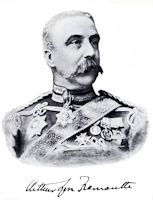
27th May (Wednesday).—Arrived at Montgomery, the capital of Alabama, at daylight, and left it by another railroad at 5.30 A.M.
All State capitals appear to resemble one another, and look like bits cut off from great cities. One or two streets have a good deal of pretension about them; and the inevitable “Capitol,” with its dome, forms the principal feature. A sentry stands at the door of each railway car, who examines the papers of every passenger with great strictness, and even after that inspection the same ceremony is performed by an officer of the provost-marshal’s department, who accompanies every train.[1] The officers and soldiers on this duty are very civil and courteous, and after getting over their astonishment at finding that I am a British officer, they do all they can to make me comfortable. They ask all sorts of curious questions about the British army, and often express a strong wish to see one of our regiments fight. They can hardly believe that the Coldstream is really dressed in scarlet. To-day they entered gravely into a discussion amongst themselves, as to whether British troops would have taken the position at Fredericksburg. The arguments on both sides were very amusing, and opinion was pretty evenly divided. We met three trains crammed full of soldiers for Johnston’s army. They belonged to Breckenridge’s division of Bragg’s army, and all seemed in the highest spirits, cheering and yelling like demons. In the cars to-day I fell in with the Federal doctor who was refused leave to pass through General Johnston’s lines; he was now en route for Richmond. He was in full Yankee uniform, but was treated with civility by all the Confederate soldiers. I had a long talk with him; he seemed a sensible man, and did not attempt to deny the universal enthusiasm and determination of the Southerners. He told me that General Grant had been very nearly killed at the taking of Jackson. He thought the war would probably terminate by a blow-up in the North[2]
I had to change cars at West Point and at Atlanta! At the latter place I was crammed into a desperately crowded train for Chattanooga. This country, Georgia, is much more inhabited and cultivated than Alabama. I travelled again all night.
[1] This rigid inspection is necessary to arrest spies, and prevent straggling and absence without leave.
[2] Notwithstanding the exasperation with which every Southerner speaks of a Yankee, and all the talk about black flag and no quarter, yet I never saw a Federal prisoner ill treated or insulted in any way, although I have travelled hundreds of miles in their company.
Wednesday, 27th—Met Thompson’s and Staley’s men.
May 26 and 27—Rested. I went to see my brother Morris, who belongs to Dowles’ Brigade, 44th Georgia Regiment. Did not see him, as he was on picket.
Before Vicksburg, Wednesday, May 27. Called out a little past midnight; hitched up with haste and moved out, took a position on the right the best we could and in the road. The gunners were ordered to have spikes ready so as to be able to spike their pieces if obliged to abandon them. They expected an attempt to break through the lines. Put on my overcoat, lay down at the head of my team, halter in hand, and did not awake till broad daylight, within dangerous proximity to Jack’s feet, but he would not hurt his rider while asleep. Returned to camp, the scare being over. Lay quiet all day, a heavy bombardment kept up all day. The sharp-shooters busy picking off our cannoneers. Most of the convalescents left at Millikens Bend returned to-day. 11th Ohio Battery gone to Sulphur Springs with brigade of infantry.
May 27th. At daylight this morning it was apparent to all who heard the heavy firing of artillery, and rapid discharges of musketry, that an attack had been made by our forces upon the enemy’s works. The firing continued without intermission during the whole forenoon of this day. During the afternoon, occasionally heavy firing of artillery and musketry, the rebels replying at intervals with two great guns; lower fleet bombarding the rebel earthworks at Port Hudson, mortars, or bombers, as our boys call them, engaged also. A report has been circulated about the decks that during Banks’s attack this morning, a battery of six guns had been captured by us, the enemy drove into their main works, and some two or three of our regiments were inside of their entrenchments.
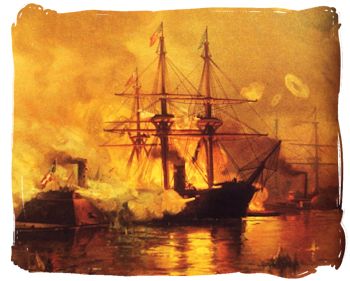
May 27—Three gunboats come up opposite our line and shell us rapidly for an hour but hurt none of our regt. One man just to our right had his head shot off and two others were wounded. In the meantime another boat attempted to pass down by our batteries which was sunk up at town. Sharp shooting and cannonading is going on along our back lines and a general engagement is expected daily. It is reported that Genl. Johnson has attacked the enemy in the rear. 4 o’clock p.m. — The yankee pickets have come in sight of our lines.