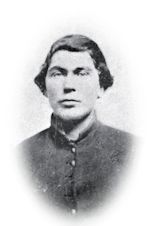
Before Vicksburg, Thursday, June 4. But little fighting done to-day with the exception of sharp-shooting. Sultry and heavy. Battery drew clothing. I got a rubber poncho.
Tuesday, June 4, 2013
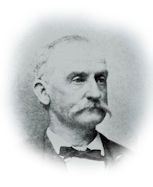
Thursday, June 4th.
On yesterday evening we received orders to cook three days rations and be ready to march today at daylight. We were up late at night cooking and left this morning early, wading the Rapidan at Raccoon Ford. We are now, 2 o’clock p. m., one mile from Culpepper Court House, haying marched fifteen miles this morning
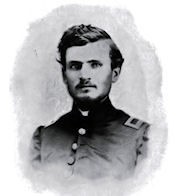
4th. After usual work, read some in paper. In the afternoon, went for some strawberries for Brother A. B. and ourselves. Had a nice meal of them, 25 cents per quart. Enjoyed them much. Mailed a letter to Melissa from A. B. Offered to write myself.
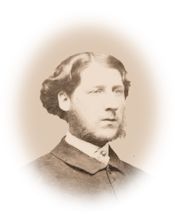
a copy of this original paper written by Charley June 4th:
“Major General Meade, commanding 5th Corps.
General: I have the honor of transmitting to you herewith a copy of a telegram just received from the President respecting sentences of Daily, Magraffe and Harrington.
(Signed) C. W. W., A. D. C.”
—and Charley had the pleasure of hurrying to Meade’s headquarters with the reprieve of these men from sentence to be shot. These are among the very few papers connected with Charley’s position at headquarters which are now in our possession, many others having been lost in the Morrell fire.
June 4—Got orders to cook three days’ rations immediately. We left our camp at 3 this morning, marched fourteen miles and halted. We march one hour and rest ten minutes.
Middleton, Tenn., June 4, 1863.
We made another little change yesterday. The regiment is now guarding the M. C. & R. R. from Grand Junction to Pocahontas. We are in detachments of two companies each. H Company is with mine. We marched 23 miles to make this point yesterday, and arrived at 10 o’clock p.m. We only made four miles after dark, and the road was so horrible and the woods so thick we had much difficulty in finding it at all. We occupy the depot and have strengthened it by a revetment of fascines, so that we consider ourselves perfectly safe if attacked by even ten times our number of infantry. Artillery would scoop us. This little town had when the war commenced some 40 houses; now it boasts of not more than 12 or 15, though a number of extra chimneys add so much to the picturesqueness of the scene, that I can excuse the houses for “going out.” This country has literally been scraped, swept and scoured. The guerrillas first ran the Union men off, and then when we came here the Unionists returned, took up arms and drove out all the secesh families. You can hear of murders being committed in every neighborhood by either one party or the other. It will take at least 8,000 years for this people alone to make this country what Illinois is now, on the average, and at least 1,000 to bring it up to the standard of poor, God-forsaken Lewistown township. I have never been so comfortably situated in the army, except when with Colonel Mizner, as I am now. The boys have rigged up nice bunks in the depot wareroom, which are dry and comfortable, have good water, light guard duty, and the citizens bring in to us their extra vegetables, etc., and trade them for our surplus rations. The boys give one pound of coffee for two dozen eggs, or two pounds of butter; sell them bacon for 15 cents per pound, etc. Two very fine elderly ladies pleading for a horse to-day, told stories of tremendous length about how “Union” their husbands were prior to their deaths. I’d almost rather give up my head than have two women of their age begging of me for anything that way. I have the telegraph room for myself and have fixed it up nicely. I know well enough that it is too good to last long and shall resign it without a sigh, and if ordered to Vicksburg, with a cheer. I fixed up our last camp as well as I could in hopes that my pains would bring us marching orders, and we got them, but the direction was wrong. This is so much better that it must surely win. Maybe you don’t know that there is a superstition (almost) among soldiers that arranging a camp particularly nice and comfortable brings marching orders.
June 4th. Commences with pleasant and calm weather. Slight firing heard, early this morning, at Port Hudson. Nothing worthy of mention occurred during the remainder of this day.
June 4 — We are now in Col. Brad rear on the Hauls Ferry road sharp shooters opened fire at daylight this morning in our front. An attack is expected today. The minies and shells are now whistling over our heads. God speed the happy hour when we shall be delivered from this unhappy state. 5 o’clock p.m. -I have just now been informed that some La troops went over the river and spiked those mortars opposite town last night. A negro boy had his head shot off with cannon ball in sight of us this morning and two other were wounded. He was in a house near the breastworks. 9 o’clock p.m. — firing has about ceased — occasionally we can hear a sharp report from the pickets. W.R.C.
by John Beauchamp Jones
JUNE 4TH.—To-day we have characteristic unintelligible dispatches from Mississippi. They say, up to third instant, yesterday, everything is encouraging; but the Memphis papers say Grant’s losses have not been so large as was supposed. Then it is reported that Grant has retired to GrandGulf. Yet it is expected the town will be stormed in twenty-four hours!
When Grant leaves Vicksburg, our generals will pursuer and assume the aggressive in more directions than one. Lee has some occult object in view, which must soon be manifest.
Major-Gen. D. H. Hill writes that if the enemy penetrates to the railroad, a great many men in North Carolina will welcome them, and return to their allegiance to the United States. The general wants Ranseur’s brigade sent him. He Says Mr. Warren, one of the governor’s council, in a recent speech remarked, if the enemy got the railroad, it would be a question whether they would adhere to the Confederate States or to the United States. Does the general mean to alarm the authorities here?
After a month of dry weather, we have just had a fine rain, most refreshing to the poor kitchen vegetables in my little garden, which I am cultivating with careful assiduity in hopes of saving some dollars in the items of potatoes, tomatoes, beets; etc.
The crops of wheat, etc. south of Virginia, mature and maturing, are perfect in quality and unprecedented in quantity.
June 4.—Joseph A. Gilmore was inaugurated Governor of New-Hampshire. In his message he stated that over eighteen thousand troops had been furnished for the war, and continued: “In such a contest as that in which we are now involved, I am unable to discriminate between the support of the Government and the support of the National Administration. It is no time now to speculate upon the causes of the rebellion. The only facts which we need are that it exists, and that it is our duty to put it down. It was a remark made to me, by a former Governor of this State, the late venerable Isaac Hill, in which I fully concur, that ‘a man who will not stand by his Government is a coward and a traitor.'”
—Prince Gortchakoff, in a dispatch to Mr. Clay, the American Minister at St Petersburgh, after expressing the satisfaction of the Emperor at the reply of Secretary Seward to the proposal of France to join the diplomatic intervention in favor of Poland, remarks: “Such facts draw closer the bonds of sympathy between Russia and America. The Emperor knows how to appreciate the firmness with which Mr. Seward maintains the principle of non-intervention.”
—Major-General Stahl sent the following dispatch to the War Department, from his headquarters at Fairfax Court-House, Va.: “All is quiet along our lines and in front, on the Orange and Alexandria Railroad. This morning, when the relief passed, our pickets were attacked on Sawyer’s road by guerrillas. Colonel Gray at once started, with about one hundred and twenty men, in pursuit of them, but could find nothing of them in the woods. He then went on to scout the whole country, and when he passed Frying Pan, his rear-guard was attacked by about one hundred rebels, who were hidden in a thick wood. Colonel Gray turned his column, and charged the rebels, who fled in great haste through the woods. He followed them up to Aldie, and from there returned, via Drainesville. Our entire loss is three, and some horses wounded. We captured their surgeon, Dr. Alexander.”
—An expedition left Yorktown, Va., proceeding to West-Point, and thence to Walkerstown, by way of the Mattapony. Thence it proceeded to Aylette’s Warehouse, about ten miles from the point of landing. At this place, the iron foundry, machine-shops, cotton mills, lumberyard, and four government warehouses, containing large quantities of corn and grain, were burned; also a large mill owned by Colonel Aylette, of the rebel army, with six thousand bushels of grain. The Colonel made his escape, although in the vicinity. The surgeon of the Fourth Delaware captured his horse, which was ready, saddled and bridled. A great number of barns, containing stores for the rebels, such as grain, corn, whisky, cotton goods, etc., were destroyed.—(Doc. 56.)
— A large and enthusiastic Union meeting was held at Chicago, Ill., this evening, at which speeches were made by Senators Trumbull and Doolittle and others.—Colonel A. Baird, in command of the garrison at Franklin, Tenn., was attacked by a force of rebels under General Forrest, and driven into his intrenchments, but being reenforced by a brigade of infantry sent by General Granger, he succeeded in repulsing the enemy with a heavy loss. At the same time an attack was made on Triune, but the rebels were driven off with a loss of two hundred men, four hundred horses, and a large quantity of camp and garrison equipage.—(Doc. 4.)
—General Burnside’s order suppressing the circulation of the Chicago Times was revoked.— The Twenty-second regiment N. Y. S. V., under the command of Colonel Phelps, returned to Albany from the seat of war.
—A fight took place at Sartoria, Miss., between a body of National troops, under General Nathan Kimball, and two thousand rebels commanded by General Wirt Adams, resulting in the defeat and rout of the latter after a contest of half an hour. The National loss was one killed and seventeen wounded, while the rebels lost over one hundred taken prisoners, and a number killed and wounded.—Simmsport, on the Atchafalaya River, La., was destroyed by the Union ram Switzerland, under the command of Lieut-Colonel John A. Ellet—(Doc. 53.)
—The rebel General Wheeler, with a body of cavalry, made an attack upon the National troops on the Shelbyville road, near Murfreesboro, Tenn., and skirmishing was kept up the whole day. The Second Indiana cavalry, on picket-duty, was first attacked, but being reenforced by the Thirty-ninth Indiana, under the command of Colonel Thos. J. Harrison, they succeeded in putting the rebels to rout, with a loss of several killed and wounded. The National loss was one killed and a number wounded.


