Following the American Civil War Sesquicentennial with day by day writings of the time, currently 1863.

June 2013

June 17, Wednesday. Had a telegram at ten last night from Mr. Felton, President of the Philadelphia & Baltimore Railroad, requesting that a gunboat might be sent to Havre de Grace to protect the Company’s ferryboat and property. Says he has information that the Rebels intend going down the river to seize it.

I went forthwith to the War Department to ascertain whether there was really any such alarming necessity, for it seemed to me, from all I had been able to learn, that it was a panic invocation. Found the President and Stanton at the War Department, jubilant over intelligence just received that no Rebels had reached Carlisle, as had been reported, and it was believed they had not even entered Pennsylvania. Stanton threw off his reserve, and sneered and laughed at Felton’s call for a gunboat. Soon a messenger came in from General Schenck, who declares no Rebels have crossed the Potomac, that the stragglers and baggage-trains of Milroy had run away in affright, and squads of them, on different parallel roads, had alarmed each other, and each fled in terror with all speed to Harrisburg. This alone was asserted to be the basis of the great panic which had alarmed Pennsylvania and the country.

The President was relieved and in excellent spirits. Stanton was apparently feeling well, but I could not assure myself he was wholly relieved of the load which had been hanging upon him. The special messenger brought a letter to Stanton, which he read, but was evidently unwilling to communicate its contents, even to the President, who asked about it. Stanton wrote a few lines, which he gave to the officer, who left. General Meigs came in about this time, and I was sorry to hear Stanton communicate an exaggerated account of Milroy’s disaster, who, he said, had not seen a fight or even an enemy. Meigs indignantly denied the statement, and said Milroy himself had communicated the fact that he had fought a battle and escaped. While he (Meigs) did not consider Milroy a great general, or a man of very great ability, he believed him to be truthful and brave, and if General Schenck’s messenger said there had been no fight he disbelieved him. Stanton insisted that was what the officer (whom I think he called Payson) said. I told him I did not so understand the officer. The subject was then dropped; but the conversation gave me uneasiness. Why should the Secretary of War wish to misrepresent and belittle Milroy? Why exaggerate the false rumor and try to give currency to, if he did not originate, the false statement that there was no fight and a panic flight?

The President was in excellent humor. He said this flight would be a capital joke for Orpheus C. Kerr to get hold of. He could give scope to his imagination over the terror of broken squads of panic-stricken teamsters, frightened at each other and alarming all Pennsylvania. Meigs, with great simplicity, inquired who this person (Orpheus C. Kerr) was. “Why,” said the President, “have you not read those papers? They are in two volumes; any one who has not read them must be a heathen.” He said he had enjoyed them greatly, except when they attempted to play their wit on him, which did not strike him as very successful, but rather disgusted him. “Now the hits that are given to you, Mr. Welles, or to Chase, I can enjoy, but I dare say they may have disgusted you while I was laughing at them. So vice versa as regards myself.” He then spoke of a poem by this Orpheus C. Kerr which mythologically described McClellan as a monkey fighting a serpent representing the Rebellion, but the joke was the monkey continually called for “more tail,” “more tail,” which Jupiter gave him, etc., etc.
June 16—Resting to-day.

June 17—We crossed the Potomac River to-day at 1 P.M., and camped in Williamsport, Maryland, on the banks of the Potomac. Two miles to-day. The river is knee-deep.

Wednesday, 17th—Drill morning and evening inspection. Received two letters, one from Cousin Jennie, one from Tom Maxwell.

June 17th. Early this morning, mortars of lower fleet firing at intervals. At ten A. M. gunboat Sachem came down the river with despatches, and anchored ahead of the Albatross, off Falls river; burned several buildings on left bank of river; artillery and musketry firing in rear of Port Hudson, which continued until twelve o’clock; at ten thirty P. M., two rockets were seen sent up from Port Hudson.

A Soldier’s Story of the Siege of Vicksburg 31JUNE 17TH—I was detailed to the charge of a squad of men to guard rebel prisoners in the corral at Logan‘s headquarters. They were not hard to guard, for they think themselves in pretty good hands, and surely they seem to get better grub here than in their own lines. Some of them are deserters, and upon such I look with contempt. I am ready to share my rations with an honest prisoner, but have no use for a man who enlists in a cause, and then deserts his comrades when they get into a tight place.

If what they say is true, the garrison over there is already familiar with mule meat and scanty meal rations. If they have had to eat mules such as we have killed in the trenches, I pity them, for they are on a tough job. Several cows which I suppose had served families there with milk, we had to kill for browsing too close to our lines.

I am pretty well convinced Pemberton would not hold out much longer but for the help he expects from Johnston. If that, however, is all the hope they have, they might as well surrender at once, for if Johnston should come, he can not do them any good.

A ball struck a little drummer boy a while ago, and he limped off, whimpering: “I wouldn’t care a darn, but my other leg has been shot already.” Some of the boys went to his assistance, and then they had to hurry towards the hospital, for the rebels got range of them and began firing quite briskly.

I was quite amused to see one of the prisoners brought in today, eating his supper. We gave him all he could eat, and that was no small amount. But he was certainly a very hungry man, and if he is a fair sample of those remaining in Vicksburg, Uncle Sam’s commissary will have to endure quite a burden, for after the surrender, no doubt, Grant will have to feed them all.

__________

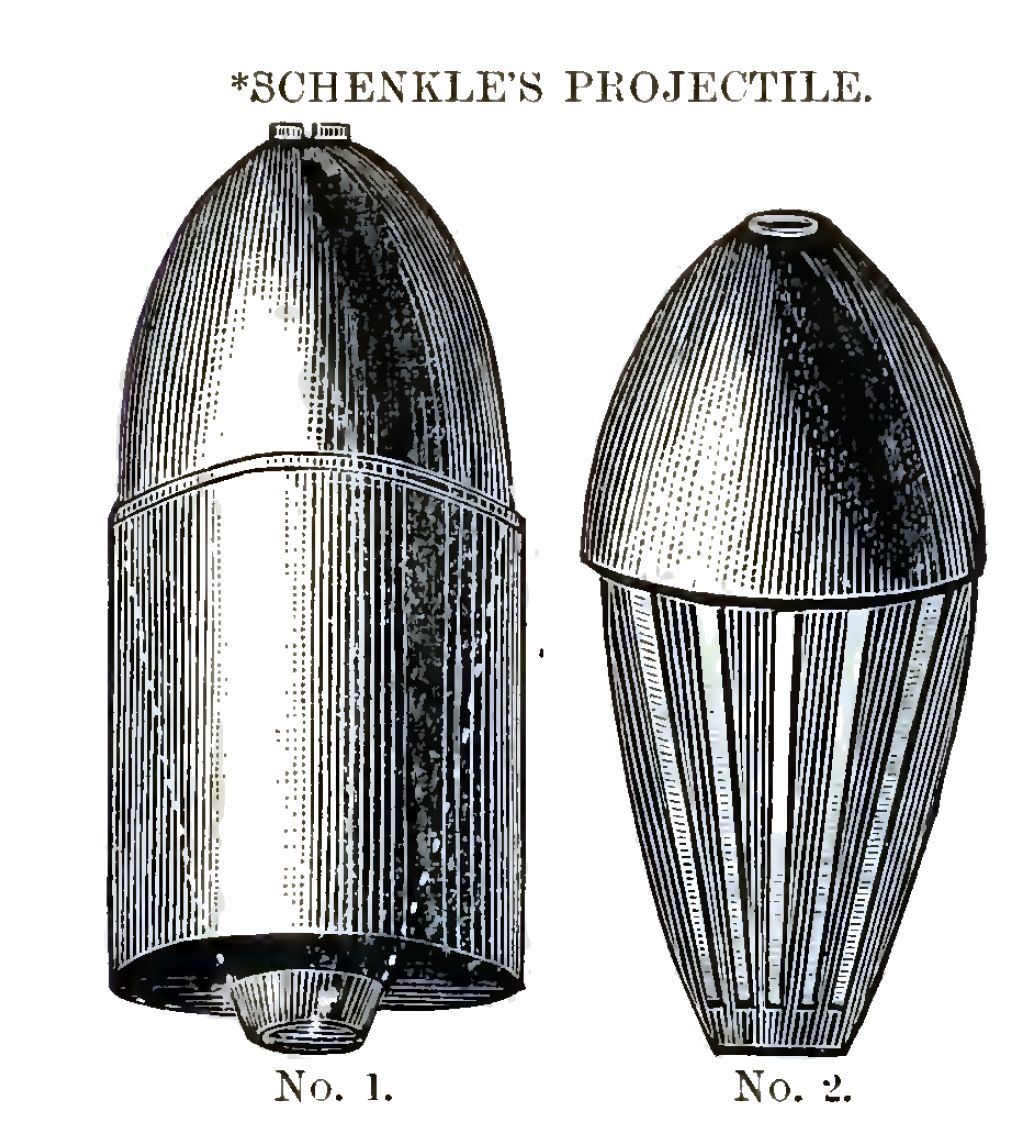
* Shenkle’s Projectile – This projectile, as shown in No. 1, is composed of a cast-iron body.  The expanding portion is a paper-mache wad, which being forced on to the cone, is expanded into the rifling of the bore.  On issuing from the bore, the wad is blown to pieces, leaving the projectile entirely unencumbered in it’s flight through the air (No.2.)

June 17 — There was a right smart shooting during the last night. Firing as usual this morning. 6 o’clock p.m. — Co’s B and G now starts out on picket in front of the trenches. 7 o’clock — we have arrived at the picket post. The bullets cut pretty close to us here. Speed — speed the hour that we’ll deliver from this place. W.R.C.

by John Beauchamp Jones

JUNE 17TH.—The city has been gladdened by the reception of this dispatch from Gen. Lee :

“JUNE 15th, 1863.

“HIS EXCELLENCY, JEFFERSON DAVIS.

“God has again crowned the valor of our troops with success. Early’s division stormed the enemy’s intrenchments at Winchester, capturing their artillery, etc.

“(Signed)R. E. LEE, General.”

Subsequent reports to the press state that we captured some 6000 prisoners, Gen. Milroy among them, 50 guns, and a large amount of stores. If we caught Milroy, the impression prevails that he was hung immediately, in accordance with the President’s order some time since, as a just punishment for the outrages inflicted by him on our helpless old men, women, and children.

A sealed envelope came in to-day, addressed by the President to the Secretary of War, marked “Highly important and confidential,” which, of course, I sent to the Secretary immediately without breaking the seal, as it is my duty to do to all letters not private or confidential. I can as yet only conjecture what it referred to. It may be of good, and it may be of bad import. It may relate to affairs in the West; or it may be a communication from abroad, several steamers having just arrived. Can it be from the Government at Washington? I care not what it is, if we hold Vicksburg.

The Commissary-General reports that he has some 8,000,000 pounds of bacon, and quite as much salt and fresh beef at [click to continue…]

June 17th, 1863.—Vague and contradictory rumors fill the air; we seem to be upon the brink of a change some way. The army of Northern Virginia is on the move and we can only pray and work, for it grows more difficult with every passing day to provide the barest necessities for our brave boys at the front. Never did men fight under greater disadvantages. The armies must be supplied even if the home-folks starve. We do not let them know how we have to stint ourselves. They must not have our burdens to bear in addition to their own.

Wednesday, 17th.—Rained light shower yesterday. On detail; worked all night on abatis. Sick and sent to sick camp; firing about as usual.

Headquarters 1st Army Corps,
Camp at Centreville, June 16, 1863.

Dear Father, Last week we received orders to move up the river and support the Fifth and Third Corps which were guarding the fords. Accordingly we started at daylight last Friday on our way, and marched until four in the afternoon, camping at Deep Run, in exactly the same spot that General Porter encamped last August when on his way to join Pope. While on the march, and just before reaching Berea Church, I met an orderly coming from the headquarters of the Fifth Corps, with my commission as a captain. I was quite glad to get it, I assure you. At Berea Church we halted for an hour, and just before starting, a deserter from an Indiana regiment of General Wadsworth’s division, was shot to death by musketry, he having been found guilty by a court-martial. I did not see the affair, as I had no desire to do so. The distance marched the first day was about 23 miles. The second day we pushed on to Bealeton Station, about 20 miles. On the way we passed another camp where General Porter stayed. About nine o’clock in the evening of our arrival at Bealeton, I was sent hack to General Barnes, some 12 or 15 miles from us. As guerillas were round about, it was rather unpleasant, but I saw nothing of them. Here at Bealeton we received orders to march to Centreville and take up our position there. General Reynolds then had command of five corps, General Hooker, with the three remaining corps, taking the route by Dumfries. From Bealeton our corps moved to Manassas Junction, over twenty miles. Our headquarters were at Catlett’s Station. Yesterday we arrived here at Centreville, soon to be on the march again, I imagine, for Pennsylvania, or the Valley of the Shenandoah. I hear that the enemy have whipped Milroy, and I suppose that I refused. After I had got my orders, General Butterfield asked me if I had had any dinner. I told him I had not, and he sent me to Major Lawrence, who provided me with a very nice dinner. I started back at 6 P.M., and reached camp at Herndon’s Station at 11.30, having a guide and a pass provided me by Colonel Gray, of the 4th Michigan, who were on picket near Fairfax Court House. The guide had strange stories to tell about the guerilla Mosby. In all I travelled about 6o miles to-day, and was pretty well used up, as the day was extremely warm and sultry. Found camp at Herndon Station.

[In connection with Mosby, an interesting story was told of Major Fraser. He was out scouting after Mosby, and as they were passing a house close by the road, a sergeant, with the troops with him, saw a man in a gray uniform standing at the window of the house. The sergeant drew his pistol and fired. He instantly went into the house, and there was a Confederate on the floor with his cloak drawn over his face. He said, “I am mortally wounded, please leave me alone.” They pulled up his waistcoat and saw a hole right through his abdomen, where he had been shot, and they left him, supposing he was dying. Five minutes after, they found it was Mosby. They turned around and went back, but he had been taken away by his friends. It turned out that the bullet had only penetrated the outer skin, followed around, and come out at the back, so that Mr. Mosby got well and tormented us as usual. Had Fraser captured him, he would have got a brigadier general’s commission.]