Following the American Civil War Sesquicentennial with day by day writings of the time, currently 1863.

June 2013

June 15, Monday. Met Blair at the depot. Told him of the conversation I had last evening with the President and the appearance of things at the War Department. It affected him greatly. He has never had confidence in either Stanton, Halleck, or Hooker. He fairly groaned that the President should continue to trust them and defer to them, when the magnitude of the questions is considered. “Strange, strange,” he exclaimed, “that the President, who has sterling ability, should give himself over so completely to Stanton and Seward.”

Something of a panic pervades the city. Singular rumors reach us of Rebel advances into Maryland. It is said they have reached Hagerstown, and some of them have penetrated as far as Chambersburg in Pennsylvania. These reports are doubtless exaggerations, but I can get nothing satisfactory from the War Department of the Rebel movements, or of our own. There is trouble, confusion, uncertainty, where there should be calm intelligence.

I have a panic telegraph from Governor Curtin, who is excitable and easily alarmed, entreating that guns and gunners may be sent from the navy yard at Philadelphia to Harrisburg without delay. We have not a gunner that we can spare. Commodore Stribling can spare men, temporarily, from the navy yard.

I went again, at a late hour, to the War Department, but could get no facts or intelligence from the Secretary, who either does not know or dislikes to disclose the position and condition of the army. He did not know that the Rebels had reached Hagerstown; did not know but some of them had; quite as likely to be in Philadelphia as Harrisburg. Ridiculed Curtin’s fears. Thought it would be well, however, to send such guns and men as could be spared to allay his apprehension. I could not get a word concerning General Milroy and his command, — whether safe or captured, retreating or maintaining his position. All was vague, opaque, thick darkness. I really think Stanton is no better posted than myself, and from what Stanton says am afraid Hooker does not comprehend Lee’s intentions nor know how to counteract them. Halleck has no activity; never exhibits sagacity or foresight, though he can record and criticize the past. It looks to me as if Lee was putting forth his whole energy and force in one great and desperate struggle which shall be decisive; that he means to strike a blow that will be severely felt, and of serious consequences, and thus bring the War to a close. But all is conjecture.

June 15—Left here at n A.M., and got to the Potomac river at dusk, a distance of twelve miles. We have as yet been very fortunate. Have driven the enemy from the Rapidan to the Potomac, captured prisoners, arms, camps, quartermaster and commissary stores, and the Yankees were any moment as strong in numbers as we, with the advantage of having breastworks to fight behind. Still they always ran at our appearance.

Md, Heights, June 14, 1863.

Dear Family:

Yours of Sunday found us all well. I made a tour to Antietam last week; I hired a horse for a $1.00, rode about 30 miles, was tired enough when I got back. There were four of us, had a fine time. Visited all the places of interest; but the farmers have cleared up the grounds and it does not look as if a great battle had been fought there. I got but few relics. The Capt. is heading a paper to get Jere a bugle. Affairs are progressing in Co. B as usual, that is every one is dissatisfied. Co. I has gone to Winchester to garrison there. A dispatch came yesterday that the rebs were making a raid up this way and to have all ready and manned for an emergency. When last heard from they were at Berryville on the Shenandoah river and working this way. Genl. Imbroke had command. We lost several officers and men. Some one has come up from the Ferry and says citizens are coming in from Martinsburg and reporting the rebels 10000 strong within a mile of that place; probably the number is exaggerated. We have now five companies on the hill. They do picket duty around the hill, front of the battery.

Monday morning.

We were turned out again about 12 M. last night with a report that the rebs were at Martinsburg and working this way. We saw a big engagement about 10 miles from here, saw the flash of the guns plain. Humors say it was Milroy’s forces and that they have been beaten. The Hook is full of women and children from the country, 40 trains came down from the valley yesterday. Saw a train of cars on fire last night. We may have a small engagement before the week is out. From

Lev.

Monday, 15th—I took dinner to-day with Mr. Guess. Relieved this evening. Five of us went on scout; got supper at Mr. Mankin ‘s. I left my valise at Mr. Guess’s. I forgot to note leaving undershirt and pair of drawers at Mr. Brown’s on Falling Water.

June 15th. At 1 o’clock A. M. the mortars of the army and navy firing into Port Hudson; at two forty-five A. M. the mortars of lower fleet ceased bombardment. From this time up to four A. M. brisk firing of musketry—the rebels replying with two guns; at two thirty P. M. got up steam; at four P. M. hauled fires; at nine fifteen P. M. beat to quarters. Several transports came down from Bayou Sara, on account of guerillas being about.

JUNE 15TH.—Our regiment went into the rifle-pits again before daylight, at which time the din of musketry and cannonading from both sides had begun, and will cease only when darkness covers the earth.

We are now so close to Fort Hill that a hard tack was tossed into it by one of our boys, and then held up on a bayonet there, to satisfy us of its safe arrival. Some of the boys have become reckless about the rifle-pits, and are frequently hit by rebel bullets. Familiarity breeds a contempt of danger.

Some of the boys wounded at Raymond have got back to us, and are now ready again to do their part. They are, however, more timid than we who have been at the front so long. It is fun to see these new-corners dodge the balls as they zip along. But they, too, will soon become accustomed to flying lead.

Several of the boys have been hit, but not hurt badly, as the balls were pretty nearly spent before reaching them. Those returning from Raymond say they have marked the graves there, but I fear it will not be long before the last vestige of the resting places of our late comrades will be lost

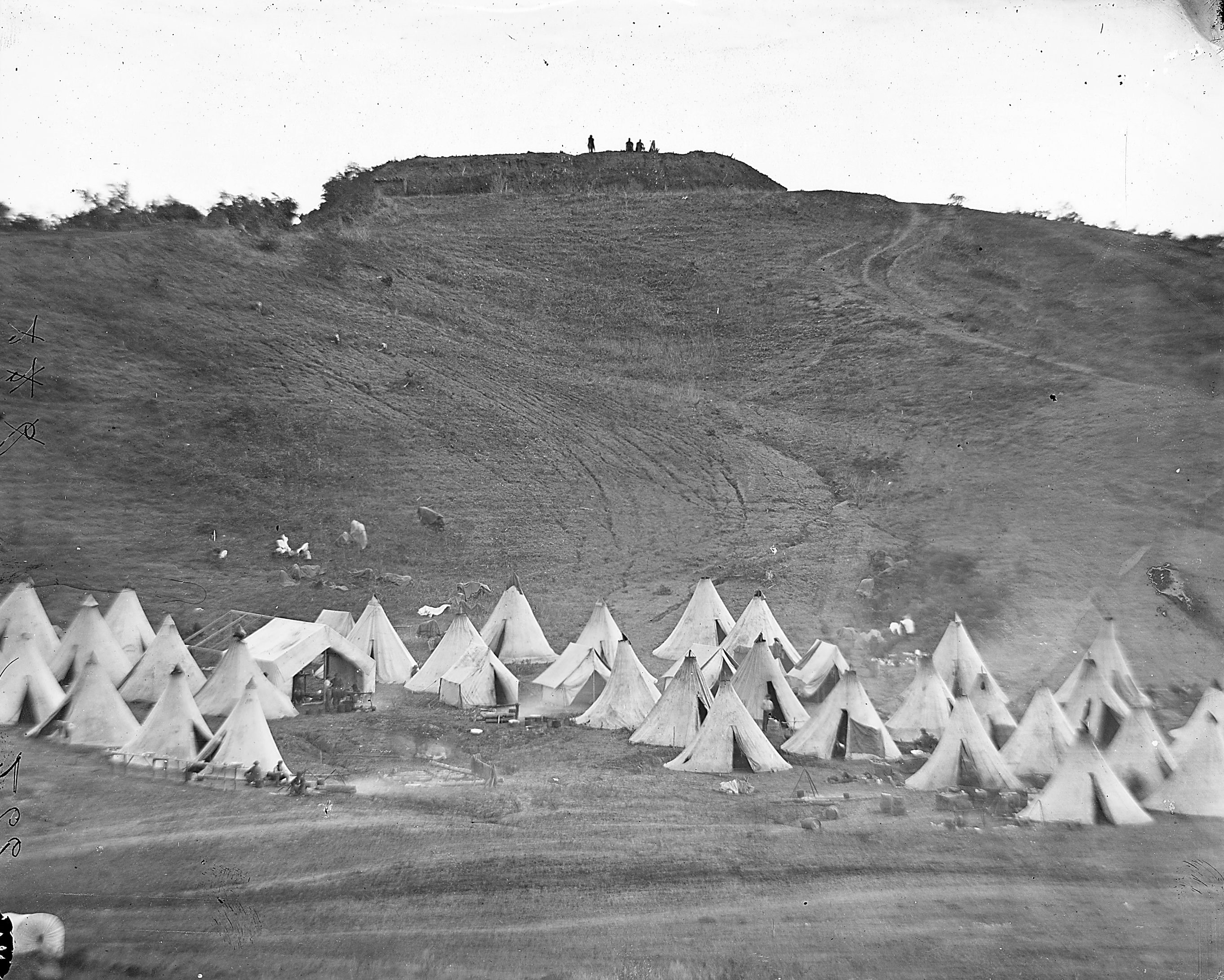
Camp and fort – Mathew Brady Photographs of Civil War-Era Personalities and Scenes; circa 1863; U. S. National Archives image. (No other information provided)

Camp and fort – Mathew Brady Photographs of Civil War-Era Personalities and Scenes; circa 1863; U. S. National Archives image. (No other information provided)

Confederate Earthworks, Belle Plain, Virginia, James Gardner Collection, photo by Timothy H. O’Sullivan (one of Brady’s photographers); Albumen silver print from glass negative; The Metropolitan Museum of Art image.

June 15 — Sharp shooting as usual today. It has the appearance of rain this morning. All the convalesce that are able have come out from the hospital by order of the Brig. surgeon. I judge from this that a heavy attack is expected upon our line. It is reported that the Yankees are receiving heavy reinforcements. 7 o’clock p.m. — This day passed off tolerably quiet. We wait impatiently for the hour of our deliverance. May God speed the hour.

by John Beauchamp Jones

JUNE 15TH.—The enemy have abandoned the vicinity of Fredericksburg, falling back across the river, and probably retiring toward Alexandria, or else they have taken to their transports, and intend making another effort to capture Richmond. It is rumored that Gen. Ewell has taken Winchester ; but this, I think, is at least premature.

Certainly the government is taking steps to guard against a blow at Richmond. All the civil officers (subordinates, only, of course) are being mustered into the service for “local defense or special duty ;” but Gen. Elzey, the Marylander, it is reported, has said the “d___d clerks have given me so much trouble, that I intend to keep them on duty in such a way that they cannot perform their functions in the departments, and so others must be appointed in their places.” This would be in violation both of the Constitution and several acts of Congress. Yet they are to be mustered in this evening “for three years, or the war.” And the Secretary of the Treasury has announced that all who refuse to volunteer are to be reported, by the President’s command, and will be removed. The President has intimated no such thing. Of course they will volunteer. There is much censure of the President for “bad faith”—most of the clerks being refugees, with families to support.

Mayor Mayo has refused to admit Gen. Winder’s three policemen (all imported) to bail, and they remain in prison ; and Judge Meredith has refused to discharge them on a writ of habeas corpus —resolving first to test the validity of the martial law set up for them in their defense.

I believe the government is acting on my suggestion to Col. Johnston, A. D. C., in regard to searching blockade-runners, caught in the lines, bearing sealed letters to the North. To-day the Attorney-General sent to the department, for Mr. Seddon’s approval, instructions to Confederate Attorneys and Marshals to aid and co-operate with M. Greenwood, a detective agent of the government. I think about the first men he detects in treasonable practices will be Gen. Elzey and Gen. Winder’s detectives. [click to continue…]

June 15th, 1863.

Orders have come at last. “Forward to Vicksburg!” is the cry. We are steaming down the grand old river once again, ready to face danger in any form, either by Rebel bullets or the more dealy miasma of the Southern swamps, for “Liberty and Union.” The way from Memphis down is not entirely safe for transports. Guerillas have a trick of concealing themselves along the banks and firing on them as they pass. We have a strong guard, with loaded guns, ready to return their greeting should they salute us. As we do not travel nights, it will take us at least two days to make the trip.