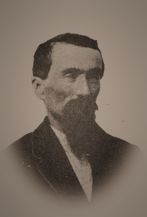
by John Beauchamp Jones
JUNE 14TH. —W___ll, one of the Winder detectives that fled to Washington last year, is back again. But the Mayor has arrested him as a spy, and it is said a lady in the city can prove his guilt. Gem Winder wanted to bail him; but the Mayor was inexorable, and so W___ll is in the jail, awaiting his trial. Two others, of Winder’s police, have likewise been arrested by the city authorities for some harsh treatment of a citizen supposed to have a barrel of whisky in his house. The justification offered is the jurisdiction of martial law, which Gen. Winder still thinks exists, although annulled by Congress.
The company (of 104) organized in the War Department as independent volunteers for local defense, being objected to by Gen. Elzey, because they would not be subject to his command, was rejected by the President, who insisted that the officers of the departments (civil) should be mustered into the service under the act of August 21st, 1861, and are subject to his control, and liable to be attached to battalions, regiments, etc., he appointing the field and staff officers. This was communicated to the lieutenant of the company by the Secretary of War, who stated also that the President required the names of all refusing to reorganize on that basis to be reported to him.
There is an indefinable dread of conspiracy, and the President is right, perhaps, to frown upon all military organizations not subject to his orders. Mr. Randolph, late Secretary of War, has been very busy organizing the second class militia of the city for “local defense,” under the supposition that he would command them; but the President has made a requisition for 8000 of this class of men, for the same purpose, which will put them under Confederate orders, perhaps. A jealousy, I fear, is growing up between Confederate and State authority. This when the common enemy is thundering at all our gates!
June 14th.
We are still in the harbor at Memphis awaiting orders. Eight hundred and fifty wounded men were brought to this place yesterday from Vicksburg. Grant is still hammering away at that seemingly impregnable fortress. The weather is extremely hot, which renders our situation, huddled together as we are, very uncomfortable. Yesterday we steamed up the river about a mile to a fine grove, and all went on shore while the crew gave the old boat a thorough cleaning. This morning our surgeon ordered us all on shore as a “sanitary measure.” We marched off by companies, each company going where it chose, but to different points. We went to Court House Square and disbanded. It was like being transferred from a gloomy prison to “smiling fields and shady groves.” The square contains about five acres; is enclosed by an iron fence; is thickly set with trees of different varieties—the brave old oak, with its spreading branches and delicious shade; the gorgeous magnolia, the tree of paradise; the orange and lemon, with an almost endless variety of evergreens. Near the center of the square is a bust of General Jackson, cut in marble.
On one side of the pedestal is incribed those memorable words of that grand old patriot: “The Federal Union; it Must Be Preserved.” I noticed the word “Federal” was partly obliterated, and inquired the cause. A citizen told me it was done by a Rebel Colonel at the beginning of the war; that his men, still cherishing some regard for the hero of New Orleans, took him outside the city and shot him. At four o’clock we were marched on board our prison ship.
Sunday, 14th.—Some cannonading up to 2 P. M., when heavy cannonading and rapid volleys of musketry began about the center; Federal officers tried to get their men to charge, but failed.
Colonel Lyons.
Fort Donelson, June 13, 1863—None but light draught boats can go up the river now, and not many of them.
I have had a small bed put in my room for the Paymaster to occupy. I hear of Hinson’s gang, forty strong, three miles from the rolling mill, but having no cavalry, I can not pursue him. He has not molested us yet.
June 13th. Turned out very early this morning. Waiting for orders to march. While waiting for orders our cavalry scouts are coming in, reporting the enemy coming down the valley in force. Somewhat of a surprise, they having come through the mountain passes in the night, making a forced march. While near the Colonel’s quarters I saw a scout coming, almost flying, down the pike. Jumped his horse over a stone fence that surrounded our camp. Headed straight for the Colonel’s tent. Without any ceremony rushed in, informed the Colonel the enemy was almost upon us. I ran to the Colonel’s quarters and heard the report. With a shout the Colonel called out “Fall in, fall in, double quick.” We soon formed in line, ready for orders. Left our camp on double quick time to meet the enemy. They opened fire on us and our camp with a battery well posted on a high hill about one mile from our camp. We held them in check for a while when orders came for us to fall back and take position in the line of battle that had been formed near the town. In the meantime the enemy had taken possession of our camp with all its equipage and our knapsacks that contained all our belongings, making a great loss to every man. The sudden appearance of so large a force was a surprise. We were under fire all day and were obliged to change our position at different points to meet the enemy, who were trying to get into Winchester. It was plainly seen that a large force of Confederates were surrounding the town and that we were in a bad fix, as we could see the gray in all directions and knew that we were more than outnumbered.
13th. Another hot sultry day. Flies swarm about the commissary by thousands—a continual fight to keep them off. Got some lemons for Henry and some candy. Independent and Congregationalist came. Good sermon by Beecher. Both Thede and I are bothered with diarrhœa.
June 13. —We started on our march again at daybreak, and went to Bealeton Station on the Orange and Alexandria Road, a distance of 15 miles. General Reynolds has now the command of three corps, the Third, First, and Eleventh. Day warm, and the evening threatening showers. The chaplain of the 4th Michigan was shot in three places near Deep Run last Monday. Day before yesterday, General Birney’s advance guard was fired on by guerillas, while on the road to Bealeton. I was sent at 6.40 P.M. to General Birney, with an order for him to prepare to move, as the army was to start that evening for I delivered the order to General Reynolds at General B.’s headquarters, at 6.45. On the way up I met Major Stirling, Captain Dahlgren, and Lieutenant Bates, all from General Hooker’s headquarters. I started at 9.30 for General Barnes’s headquarters at Grove Church, with a dispatch for General Meade, which I delivered at 11 P.M., reaching camp at 2.34 A.M.
Saturday, 13th—The Eleventh Iowa moved out towards the rear about four miles, to relieve the Ninety-third Illinois on picket. The land around here is very rough and heavily timbered. There is an occasional small farm. The people around here are all rank secessionists.
13th June (Saturday).—Colonel Rice, aide-de-camp to General Beauregard, rode with me to “Secessionville” this morning. I was mounted on the horse which the General rode at Manassas and Shiloh. We reached James Island by crossing the long wooden bridge which spans the river Ashley. The land of James Island is low and marshy, and is both by repute and in appearance most unhealthy. Three years ago no white men would have dreamed of occupying it at this time of year; but now that the necessity has arisen, the troops, curiously enough, do not appear to suffer.
“Secessionville,” the most advanced and most important of the James Island fortifications, is distant by road eight miles from Charleston bridge, with which it is connected by a chain of forts. It was surprised by the enemy just a year ago (June 1862), and was the scene of a desperate conflict, which resulted in the repulse of the Federals with a loss of nearly 800 men. The Confederates lost 150 men on this occasion, which as yet has been the only serious loss of life at Charleston during the war. Colonel Lamar, who commanded the garrison with great gallantry, was one of the few victims to yellow fever last year. The Yankees attacked the fort three times with much bravery and determination, and actually reached the superior slope of the parapet before they were driven back. They were within an ace of being successful; and although they deserved great credit for their behaviour on that occasion, yet it is understood that the officer who organised the attack has either been dismissed the service or otherwise punished.
Lieutenant-Colonel Brown, the commandant, who showed me over the fort and bomb-proofs, is quite young, full of zeal, and most anxious to be attacked; he has artillerymen to man this and the neighbouring works, and two regiments of infantry are also encamped within a short distance.
At the time of the attack on Charleston last April there were 30,000 men to defend it; since that time 20,000 had been sent into Mississippi to reinforce Johnston. I imagine that, as the fortifications are so very extensive, the Charleston garrison ought to consist of at least 30,000 men.
June 13 — This morning two regiments of Yankee cavalry crossed the Rappahannock at Beverly’s Ford and drove in our outer pickets. We were immediately ordered forward with our section of artillery, and went into battery on Fleetwood Heights at the very same position we held in the battle a few days ago. At first our two guns were the only ones on the field, but after we were in battery about an hour two batteries of Major Beckham’s battalion came on the field.
General Stuart and staff and General Hampton arrived on the field immediately after we went into position. Fleetwood is about two miles and a half from the Rappahannock. It seems that the Yanks did not venture very far inland this morning after they crossed to our side of the river.
We remained in position about two hours, when the enemy recrossed the river, and we moved back to our picket post at Brandy Station.