6th. After breakfast and morning work issued rations—beef— at daylight. Felt rather tired after the work. Cleaned a carbine I had used for some time. Rather hard job. Another dry sultry day. Thede feels under the weather. Both have the diarrhœa. Boys went for strawberries, but could not get any. Paymaster here.
June 2013

June 6.—All kinds of rumors are coming in daily from the army. A battle is expected momentarily.
We have had a great deal of rain lately, which makes it sickly and otherwise disagreeable.
Vallandigham passed through here a few days ago. He had little or no notice taken of him, as he is not a southerner; but still clings to the delusion that the Union can again be restored. What madness in any sane man! That can never be until the terrible past is wiped out, and sinks into oblivion; or until the many thousands who have been slain shall be brought to life, and the outrages which have been committed on our people undone. I can not but admire him for his independence of character in defying Lincoln and his minions. Would that we had many more like him in the North, then our hopes of peace would be bright indeed. Many think if we can only hold out a little longer, that the peace party there will rise in its might, and demand of the black republicans to desist from this unholy strife.
June 6—Marched five miles and halted for the day.
June 6, 1803.
Dear Sister L.:—
Headquarters are at Crittenden’s Mill, twenty miles above Fredericksburg. The Eighty-third guards Kempel’s Ford. The Sixteenth Michigan and Twentieth Maine guard Ellis’ Ford. The Forty-fourth New York is in reserve at the Mill. Franklin has crossed below Fredericksburg and is fighting this morning. I can hear the cannon.
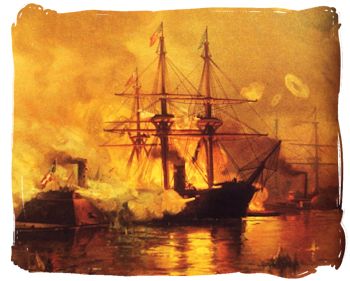
June 6th. Early this morning the shell from the mortar vessels was seen exploding over the rebel batteries; at ten A. M. our Assistant Surgeon, S. D. Kennedy, being detached, left the ship for New Orleans, for passage North. Artillery firing was heard in rear of Port Hudson during the remainder of this day.
June 6 — The sharp shooters opened fire at daylight this morning but in a milder manner than common — continued all day. Night has come on and the firmament is again decked with the beautiful stars, while we lay us down again to sleep upon the rough ground of Vicksburg. I pray heaven’s blessings to rest upon us. W.R.C.

by John Beauchamp Jones
JUNE 6TH.—We have not even a rumor to-day from Mississippi. The Examiner has made a pretty severe attack on Judge Campbell, Assistant Secretary of War, for the great number of persons he has “allowed” to pass into the enemy’s country. It does not attribute the best motives to the Judge, who was late coming over to the Confederacy.
The British consul here, it seems, has been meddling with matters in Mississippi, the President states, and has had his exequatur revoked.
Gen. D. H. Hill recommends the abandonment of the line of the Blackwater, for Gen. Martin informs him that the enemy are preparing their expeditions to cut our railroads in North Carolina. Gen. Hill fears if the present line be held we are in danger of a great disaster, from the inability to transport troops from so remote a point, in the event of a sudden emergency. Gen. Lee refuses to let him have Ranseur’s brigade.
There are rumors of picket fighting near Fredericksburg, and Davis’s (the President’s nephew) brigade, just from North Carolina, proceeded through the city to-day in that direction. Shall we have another great battle on the Rappahannock? I think it a ruse.
Lebanon, Ky., June 6th, 1863.
I did not go to Jamestown, as I intended. I called on the Provost Marshal for a pass and learned the program had been changed, and the Seventeenth was then on its way back to Lebanon. I found the company about nine o’clock in the evening, a half mile from Columbia, tired and worn by a march of twenty-six miles. The boys had stretched themselves on the ground, too tired to erect their tents, but when they learned of our arrival, they flocked around us to learn the latest news from home. And such warm greetings I seldom ever witnessed. The Colonel said we were all right on time; he did not expect us to start from home until Monday.
Here I learned the Ninth Corps had received orders to report immediately at Louisville. We started early next morning and marched twenty miles. After supper we threw ourselves upon the ground and forgot our pains and aches in “balmy sleep.”
At two o’clock we were aroused by “the shrill bugle’s cry,” and were told we were to be in Lebanon at 12 m.—eighteen miles. We turned out, cooked and ate our breakfasts, and at four o’clock were on the move. The Quartermaster soon overtook us with teams that he had “pressed” to carry our knapsacks for us. With many thanks to Colonel Luce—it was he that ordered the wagons to follow us—we started on our way with light hearts and lighter feet. But eighteen miles in half a day is no easy task, even in light marching order, and soon the men, worn out by repeated forced marches, began to tire, and many were ready to declare they could go no further, when we were met by a wagon train, sent from Lebanon to bring in those not able to walk. The train was soon filled to its utmost capacity. Not being one of the unfortunates, I “hoofed it” the entire distance.
The all-absorbing question with us is, where are we going? The Louisville Journal says we are “goin” to take a new lesson in geography.” Of course, then, we leave the state. Our officers are about equally divided between Washington and Vicksburg. But which? If we are to take a new lesson we will not go east. Then it must be Vicksburg. Our men say it makes but little difference to them, if only we go where work is to be done.
June 6.—The rebel General J. E. B. Stuart held a grand review of the forces under his command, at his camp near Culpeper, Va., preparatory to his advance into Maryland and Pennsylvania.—Near Nicholasville, Ky., a locomotive exploded, killing six and wounding three soldiers belonging to the Thirty-fifth Massachusetts, Seventh Rhode Island, Fifty-first New-York, and Ninth New-Hampshire regiments.—The schooner Statesman, loaded with cotton, was captured by the National gunboat Tahoma, under the command of Lieutenant Commander Semmes.—Shawneetown, Johnson County, Kansas, was sacked and burned by a force of rebel bushwhackers, under Cy Gordon, and Dick Yeager. They plundered a number of Union men, and killed four, who resisted. When they had obtained all the plunder possible, they fired the village in several places, and left by the light of the flames.—The bark Whistling Wind, in latitude 33° 38′, longitude 71° 29,’, was captured and burned by the rebel privateer Coquette.— Guerrillas destroyed portions of the railroad track, near Germantown, Tenn.—General Sibley’s command left St. Paul, Minn., for an expedition against the Sioux. There were two columns employed in this expedition. One started from Sioux City, Iowa, and consisted of three thousand cavalry, one battery of artillery, and a proportionate amount of infantry, under command of Brigadier-General Sully. The other column was under command of Brigadier-General H. H. Sibley, and numbered three full infantry regiments, one battery mountain howitzers, and one thousand two hundred mounted rangers. The two divisions will meet at a given rendezvous in Dacotah. The object in sending a part of the force up the Missouri is to cut off the retreat in that direction of the Indians.
—The ship Southern Cross was captured and burned in latitude 1° 34′ south, longitude 36° west, by the rebel privateer Florida.—Major General John C. Fremont addressed a letter to the Secretary of War, on the subject of the ranking officer in the army of the United States.— A skirmish took place near Berryville, Va.— (Doc. 57.)
—The battle of Milliken’s Bend commenced this day.—(Docs. 5, 8 and 27.)
—General Foster, in command of the Union forces at Newborn, N. C., received instructions from the authorities at Washington, to place in close confinement all rebel officers captured by him.—The rebel steamer Lady Walton, was surrendered by her crew. She was engaged in the carrying trade for the Confederacy up Arkansas River, and left Little Rock under orders to proceed through the cut-off into White River, thence up that river for a load of corn. On reaching White River, her Captain, Moses Pennington, a native of Illinois, and W. H. Caldwell, another of the crew, put in execution, with the concurrence of the rest of those on board, being three white men and six negroes, a scheme they had long meditated, and, instead of going up White River, turned her head down-stream, and coming into the Mississippi, under a flag of truce, delivered her over to the officers of the first gunboat they met, which was near Island No. 82.

6th.—We have been interested lately by a visit to this village of our old friend, Mrs. T., of Rappahannock County, She gives most graphic descriptions of her sojourn of seven weeks among the Yankees last summer. Sixty thousand surrounded her house, under command of General Siegel. On one occasion, he and his staff rode up and announced that they would take tea with her. Entirely alone, that elegant old lady retained her composure, and with unruffled countenance rang her bell; when the servant appeared, she said to him, “John, tea for fourteen.” She quietly retained her seat, conversing with them with dignified politeness, and submitting as best she could to the General’s very free manner of walking about her beautiful establishment, pronouncing it ” baronial,” and regretting, in her presence, that he had not known of its elegancies and comforts in time, that he might have brought on Mrs. Siegel, and have made it his head-quarters. Tea being announced, Mrs. T., before proceeding to the dining-room, requested the servant to call a soldier in, who had been guarding her house for weeks, and who had sought occasion to do her many kindnesses. When the man entered, the General demurred: “No, no, madam, he will not go to table with us.” Mrs. T. replied, “General, I must beg that you will allow this gentleman to come to my table, for he has been a friend to me when I have sadly wanted one.” The General objected no farther; the man took tea with the master. After tea, the General proposed music, asking Mrs. T. if she had ever played; she replied that “such was still her habit.” The piano being opened, she said if she sang at all she must sing the tongs of her own land, and then, with her uncommonly fine voice, she sang “The Bonnie Blue Flag,” “Dixie,” and other Southern songs, with great spirit. They listened with apparent pleasure. One of the staff then suggested that the General was a musician. Upon her vacating the seat he took it, and played in grand style; with so much beauty and accuracy, she added, with a twinkle of her eye, that I strongly suspected him of having been a music-master. Since that time she has heard that he was once master of that beautiful art in Mobile. Well, he was at least a more innocent man then than now. Almost every woman of the South, or at least of Virginia, will have her tale to tell when this “cruel war is over.” The life of too many will be, alas! as a “tale that is told;” its interest, its charm, even its hope, as far as this world is concerned, having passed away. Their crown of rejoicing will be in the public weal, which their loved and lost have fought, bled, and died to establish; but their own hearts will be withered, their hearths deserted.
Mrs. G. D., of Fredericksburg, has been giving some amusing incidents of her sudden departure from her home. She had determined to remain, but when, on the night of the bombardment, a shell burst very near her house, her husband aroused her to say that she must go. They had no means of conveyance, and her two children were both under three years of age, and but one servant, (the others having gone to the Yankees,) a girl twelve years old. It so happened that they had access to three straw carriages, used by her own children and those of her neighbours. They quickly determined to put a child in each of two carriages, and to bundle up as many clothes as would fill the third. The father drew the carriage containing one child, the mother the other child, and the little girl drew the bundle of clothes. They thus set out, to go they knew not whither, only to get out of the way of danger. It was about midnight, a dark, cold night. They went on and on, to the outskirts of the town, encountering a confused multitude rushing pell-mell, with ever and anon a shell bursting at no great distance, sent as a threat of what they might expect on the morrow. They were presently overtaken by a respectable shoemaker whom they knew, rolling a wheelbarrow containing a large bundle of clothes, and the baby. They were attracted by the poor little child rolling off from its elevated place on the bundle, and as Mrs. D. stopped, with motherly solicitude for the child, the poor man told his story. In the darkness and confusion he had become separated from his wife and other children, and knew not where to find them; he thought he might find them but for anxiety about the baby. Mrs. D. then proposed that he should take her bundle of clothes with his in the wheelbarrow, and put his child into the third straw carriage. This being agreed to, the party passed on. When they came to our encampment, a soldier ran out to offer to draw one carriage, and thus rest the mother; having gone as far as he dared from his regiment, then another soldier took his place to the end of his line, and so on from one soldier to another until our encampment was passed. Then she drew on her little charge about two miles farther, to the house of an acquaintance, which was wide open to the homeless. Until late the next day the shoemaker’s baby was under their care, but he at last came, bringing the bundle in safety. As the day progressed the cannon roared and the shells whistled, and it was thought advisable for them to go on to Chancellorsville. The journey of several miles was performed on foot, still with the straw carriages, for no horse nor vehicle could be found in that desolated country. They remained at Chancellorsville until the 2d or 3d of May, when that house became within range of cannon. Again she gathered up her little flock, and came on to Ashland. Her little three years old boy explored the boarding-house as soon as he got to it, and finding no cellar he became alarmed, and running to his mother, exclaimed, “This house won’t do, mother; we all have no cellar to go into when they shell it!” Thus our children are born and reared amid war and bloodshed! It seemed so sad to me to see a bright little girl, a few days ago, of four years old, stop in the midst of her play, when she heard distant thunder, exclaiming, “Let me run home, they are firing!” Poor little child, her father had been a sacrifice; no wonder that she wanted to ran to her mother when she thought she heard firing. Tales far more sad than that of Mrs. D. are told, of the poor assembled by hundreds on. the roadside in groups, having no shelter to cover them, and often nothing to eat, on that dark winter’s night.


