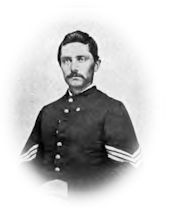
Tuesday, 22d—Everything is very quiet. We learned that Alexander Ragan of Company E died at Benton Barracks, St. Louis, on the 9th of this month. His is the first death in our company since August 3, 1862, when Ebenezer McCullough died at Corinth, Mississippi, on that date.
September 2013
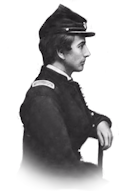
September 22d. General Caldwell took us all along and climbed Clark’s Peak this morning, and from the signal station we saw a very pretty cavalry skirmish. There was some artillery firing, which in the mountains makes a thousand echoes. During the evening two deserters from the enemy were brought in to headquarters, a sergeant and a private. They declared themselves sick of the Confederacy and war, and wished to be sent to the rear.
September 22.—General Buford, with a portion of his division, drove the rebel pickets through Madison Court-House, Va. Three miles beyond he encountered a strong force of the enemy’s cavalry, and after a spirited fight he forced them to retreat, and drove them across the Rapidan at the point where the Gordonsville Railroad intercepts the river. The National casualties were one killed and about twenty wounded. Forty-five prisoners were taken; among them Lieutenant-Colonel Delaney, of Cobb’s Georgia Legion, Lieutenant Boyce, and two privates of North-Carolina regiments, who were seriously wounded. Unionists wounded include Lieutenant Hines, of the Fifth New-York cavalry, and Lieutenant G. W. Bullock, of the Ninth; also, R. Minshall, of the Third Indiana, and Sergeants Dunning, Cummings, and Bell, and Corporal Bell, all of the Eighth Illinois, and J. Ingmonson, of the Twelfth Illinois, (the last-named a bugler.) B. F. Soder, of the Third Indiana, was killed.
—A scout of the Sixth Provisional regiment, E. M. M., commanded by Captain Holloman, attacked a party of guerrillas in Arkansas, killing four, wounding four, and capturing one — the wounded also being prisoners. — The steamer Leviathan, which was captured at an early hour this morning by the crew of the rebel yacht Teaser, was recaptured by the National gunboat De Soto, soon after she had left the mouth of the Mississippi River.—the battle of Blountville, Tenn., was fought this day between the Union forces under the command of Colonel Foster, and the rebels under Carter.—(Doc. 173.)
—The English steamer Juno, which had run the blockade of Wilmington the night previous, was captured by the National gunboat Connecticut—A body of rebel cavalry crossed into Upper Maryland, a few miles from Rockville, but had not proceeded far before they were met by a portion of Scott’s “Nine Hundred ” cavalry and an infantry force. A fight ensued, and thirty-four rebels were killed and wounded. Among their killed was Captain Frank Kilgore, (of Maryand,) the commander of the enemy’s forces, The rebels finding they were contending with superior numbers, retreated.

by John Beauchamp Jones
SEPTEMBER 22D.—Another dispatch from Bragg, received at a late hour last night, says the victory is complete. This announcement has lifted a heavy load from the spirits of our people and as successive dispatches come from Gov. Harris and others on the battle-field to-day, there is a great change in the recent elongated faces of many we meet in the streets. So far we learn that the enemy has been beaten back and pursued some eleven miles; that we have from 5000 to 6000 prisoners, some 40 guns, besides small arms and stores in vast quantities. But Gen. Hood, whom I saw at the department but a fortnight ago, is said to be dead! and some half dozen of our brigadier-generals have been killed and wounded. The loss of the enemy, however, has been still greater than ours. At last accounts (this morning) the battle was still raging—the enemy having made a stand (temporarily, I presume) on a ridge, to protect their retreat. They burnt many commissary stores, which they may need soon. Yet, this is from the West.
The effects of this great victory will be electrical. The whole South will be filled again with patriotic fervor, and in the North there will be a corresponding depression. Rosecrans’s position is now one of great peril; for his army, being away from the protection of gun-boats, may be utterly destroyed, and then Tennessee and Southern Kentucky may fall into our hands again. To-morrow the papers will be filled with accounts from the field of battle, and we shall have a more distinct knowledge of the magnitude of it. There must have been at least 150,000 men engaged; and no doubt the killed and wounded on both sides amounted to tens of thousands!
Surely the Government of the United States must now see the impossibility of subjugating the Southern people, spread over such a vast extent of territory; and the European governments ought now to interpose to put an end to this cruel waste of blood and treasure.
My little garden has been a great comfort to me, and has afforded vegetables every day for a month past. My potatoes, however, which occupied about half the ground, did not turn out well. There were not more than a dozen quarts—worth $10, though—in consequence of the drought in June and July; but I have abundance of tomatoes, and every week several quarts of the speckled lima bean, which I trailed up the plank fence and on the side of the wood-house—just seven hills in all. I do not think I planted more than a gill of beans; and yet I must have already pulled some ten quarts, and will get nearly as many more, which will make a yield of more than 300-fold! I shall save some of the seed. The cabbages do not head, but we use them freely when we get a little bacon. The okra flourishes finely, and gives a flavor to the soup, when we succeed in getting a shin-bone. The red peppers are flourishing luxuriantly, and the bright red pods are really beautiful. The parsnips look well, but I have not yet pulled any. I shall sow turnip seed, where the potatoes failed, for spring salad. On the whole, the little garden has compensated me for my labor in substantial returns, as well as in distraction from painful, meditations during a season of calamity.
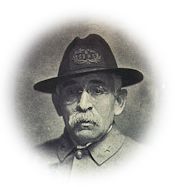
September 22—I spoke and exchanged papers with a Yankee of the 7th Ohio Regiment.
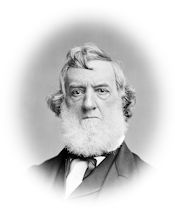
September 21, Monday. A battle was fought on Saturday near Chattanooga and resumed yesterday. Am apprehensive our troops have suffered and perhaps are in danger. As yet the news is not sufficiently definite.
The President came to me this afternoon with the latest news. He was feeling badly. Tells me a dispatch was sent to him at the Soldiers’ Home shortly after he got asleep, and so disturbed him that he had no more rest, but arose and came to the city and passed the remainder of the night awake and watchful. He has a telegram this P.M. which he brings me that is more encouraging. Our men stood well their ground and fought like Union heroes for their country and cause. We conclude the Rebels have concentrated a large force to overpower Rosecrans and recapture Chattanooga. While this has been doing, Halleck has frittered away time and dispersed our forces. Most of Grant’s effective force appears to have been sent across the Mississippi, where a large force is not needed. Burnside is in northeastern Tennessee, two hundred miles away from Chattanooga. While our men are thus scattered, a large division from Lee’s army in our front has been sent under Longstreet to Bragg; and Hill’s and Ewell’s corps, it is reported, are there also. I trust this account is exaggerated, though the President gives it credence. I do not learn, nor can I ascertain, that General Halleck was apprised of, or even suspected, what was being done; certainly he has made no preparation. The President is, I perceive, not satisfied, but yet he does not censure or complain. Better, perhaps, if he did.
I expressed surprise to the President at the management and his forbearance, and it touched him. I asked what Meade was doing with his immense army and Lee ’s skeleton and depleted show in front. He said he could not learn that Meade was doing anything, or wanted to do anything. “It is,” said he, “the same old story of this Army of the Potomac. Imbecility, inefficiency — don’t want to do — is defending the Capital. I inquired of Meade,” said he, “what force was in front. Meade replied he thought there were 40,000 infantry. I replied he might have said 50,000, and if Lee with 50,000 could defend their capital against our 90,000, — and if defense is all our armies are to do, — we might, I thought, detach 50,000 from his command, and thus leave him with 40,000 to defend us. Oh,” groaned the President, “it is terrible, terrible, this weakness, this indifference of our Potomac generals, with such armies of good and brave men.”
“Why,” said I, “not rid yourself of Meade, who may be a good man and a good officer but is not a great general, has not breadth or strength, certainly is not the man for the position he occupies? The escape of Lee with his army across the Potomac has distressed me almost beyond any occurrence of the War. And the impression made upon me in the personal interview shortly after was not what I wished, had inspired no confidence, though he is faithful and will obey orders; but he can’t originate.”
The President assented to all I said, but “What can I do,” he asked, “with such generals as we have? Who among them is any better than Meade? To sweep away the whole of them from the chief command and substitute a new man would cause a shock, and be likely to lead to combinations and troubles greater than we now have. I see all the difficulties as you do. They oppress me.”
Alluding to the failures of the generals, particularly those who commanded the armies of the Potomac, he thought the selections, if unfortunate, were not imputable entirely to him. The Generals-in-Chief and the Secretary of War should, he said, know the men better than he. The Navy Department had given him no trouble in this respect; perhaps naval training was more uniform and equal than the military. I thought not; said we had our troubles, but they were less conspicuous. In the selection of Farragut and Porter, I thought we had been particularly fortunate; and Du Pont had merit also. He thought there had not been, take it all in all, so good an appointment in either branch of the service as Farragut, whom he did not know or recollect when I gave him command. Du Pont he classed, and has often, with McClellan, but Porter he considers a busy schemer, bold but not of high qualities as a chief. For some reason he has not so high an appreciation of Porter as I think he deserves, but no man surpasses Farragut in his estimation.
In returning to Secretary Seward a dispatch of Minister Dayton at Paris, in relation to the predatory Rebel Florida, asking one or more fast steamers to intercept that vessel, which is now at Brest, I took a different view from the two gentlemen. To blockade Brest would require not less than five vessels. If we could spare five such vessels, whence would they get supply of fuel, etc.? England and France allow only sufficient to take the vessel home; and for three months thereafter our vessels receiving supplies are excluded from their ports. As England and France have recognized the Rebels, who have no commerce, no navy, no nationality, as the equals of the United States, with whom they have treaties, and, professedly, amicable relations, I deem it best under the circumstances to abstain from proceedings which would be likely to complicate and embroil us, and would leave those countries to develop the policy which shall govern themselves and nations in the future. They must abide the consequences.
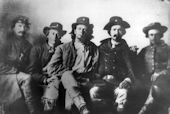
Monday, 21st—I and Mr. Nolin went up to the Tanyard this evening and took supper and sit till 10 o’clock. Miss E. was looking very nice indeed.
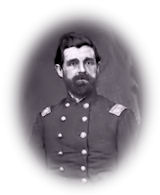
Colonel Lyons.
Stevenson, Ala., Sept. 21, 1863.—Just as I closed my letter to you yesterday, I received an order to take command of this post, and with the 13th relieve the regiment that was doing provost guard duty here. So I found myself up to my eyes in business immediately. I relieved Lieut.-Colonel Cahill, of the 16th Illinois, whose regiment has gone to Bridgeport. I moved over this morning and have a house with plenty of room for headquarters. I wish you were here to enjoy it with me. The regiment is moving into town today. There is a great deal of work at this post.
There is doubtless a terrible battle raging some fifteen or twenty miles south of Chattanooga [battle of Chicamauga], but we can not get any definite intelligence as to how it is going. We hear many rumors, some of success and some of disaster, but nothing reliable. This is the third day of the fight. The cannonading can be heard at Bridgeport, and Lieut. Warren told me that he heard the firing yesterday morning distinctly from a little east of this place. You may hear of this battle before we do. Keep up good spirits, for the usual luck of the 13th still clings to us.
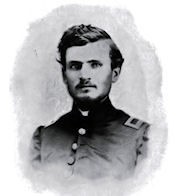
21st. A rainy unpleasant day. Col. saw Burnside and got order (?) for us to be mustered. Sergt. Munson did the business. All right. Saw Pike and Co. D boys. Wrote a letter to Fannie. How anxious I am to know the future. It looks dark enough to me now. C. G. and other boys doing well—100 and 125 dollars per month. Tully and Allie home on furlough.
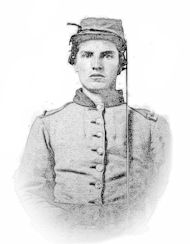
Monday, 21st.—Heavy fighting eleven miles from Ringgold. Reported five thousand killed. Drove Federals back Saturday. Yesterday drove them back on each flank, but they held their center.


