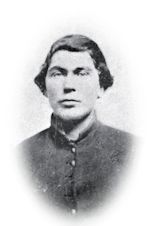
Vicksburg, Tuesday, Sept. 8. Preparing to march. There are but four pieces going, ten days’ rations supposed to be enough. Oiling harness, etc. On guard. Music by the fiddlers in the evening, who were not much disposed to put their lights out at taps. Orderly Jenawein dictates, which resulted in quite a row. Lieutenant Hood finally succeeded in getting things dark, but the minstrels kept on with their fun till midnight, quite sprung, some of them, by whiskey.
September 2013
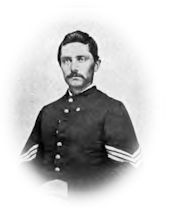
Tuesday, 8th—Captain McLoney is going home for thirty days and there are still others from our regiment going on furloughs. We have no drilling, dress parade, camp guard or picket duty to perform, nor yet fatigue duty—our whole duty at present is to help care for the sick boys.

September 8.—The Government employed the cars yesterday bringing Longstreet’s Corps from Fredericksburg, on its way to Chattanooga. We all stood at our gate last night to give the soldiers water; we had nothing else to give them, poor fellows, as there were three long trains, and they had no time to stay. They looked healthy and cheerful, and went off hurrahing for Virginia.
The year of our sojourn at this cottage is nearly over. Our mess must be broken up, as some of our gentlemen are ordered away. We have had a very pleasant time, and it is painful to dissolve our social relations. Not one of the families is provided with a home; we are all looking out for lodgings, and find it very difficult to get them. This change of home, habits, and association is very trying to old persons; the variety seems rather pleasant to the young.
September 8.—The United States gunboats Clifton and Sachem were captured by the rebels at Sabine Pass, La., being disabled by the fire from the fortifications on shore. They were operating for the landing of a column of United States troops under Major-General Franklin, to be employed in a movement against Louisiana and Texas. In consequence of the failure at this point, the movement was abandoned.—(Docs. 125 and 165.)
—Chattanooga was evacuated by the rebels, who retreated to the south.—The bombardment of Fort Moultrie, by the monitors Nahant, Montauk, Patapsco, and Lehigh, was renewed and continued during the first half of the day. A house on Sullivan’s Island was set on fire by the shells.—The Washita River expedition, consisting of the greater part of General Logan’s old Brigade, a regiment of cavalry, and a battery of artillery, returned to Vicksburgh from the portion of Louisiana lying adjacent to Washita River. No organized force of the rebels could be found. The detour was made to the north-west, in direction of the village of El Dorado, Ark. A large number of rebel soldiers came voluntarily into he Union lines and surrendered.—A force of National troops assaulted Fort Sumter, but were repulsed, leaving in the hands of the rebels a large number of prisoners.—(See Supplement.)
—The National forces at Bath, Va., composed of a portion of two companies of Colonel Wynkoop’s Seventieth Pennsylvania cavalry, were attacked this morning at three o’clock by a party of rebels, numbering over two hundred, who were repulsed and driven off.—At Baltimore, Md, General Schenck issued an order suppressing the substitute business in Maryland and in his department, it having been found that the agencies for procuring substitutes to go out of the State and department interfered with the operation of the draft and recruiting.

by John Beauchamp Jones
SEPTEMBER 8TH. —We have nothing further from Charleston, to-day, except that the enemy is not yet in possession of Sumter.
Mr. Seddon, Secretary of War, said to Mr. Lyons, M. C., yesterday, that he had heard nothing of Gen. Lee’s orders to march a portion of his army to Tennessee. That may be very true; but, nevertheless, 18,000 of Lee’s troops (a corps) is already marching thitherward.
A report on the condition of the military prisons, sent in to-day, shows that there is no typhoid fever, or many cases of other diseases, among the prisoners of war. Everything is kept in cleanliness about them, and they have abundance of food, wholesome and palatable. The prisoners themselves admit these facts, and denounce their own government for the treatment alleged to be inflicted on our men confined at FortDelaware and other places.
An extra session of the legislature is now sitting. The Governor’s message is defiant, as no terms are offered but he denounces as unjust the apportionment of slaves, in several of the counties, to be impressed to work on the defenses, etc.
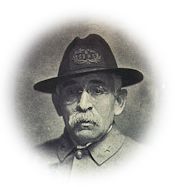
September 8—We are getting ready for a corps review for to-morrow.
Monday, 7th—Camped at Col. Shorter’s; one brigade of infantry near us.

August 7. [September]—We arrived at Dalton about 6 P.M., and expect to be detained here all night. I must say this last move has not made me the better Christian, for I certainly love my enemies less than ever.
I can not count the trains that are with us; they are so many. On them are all the hospitals which were in Ringgold— sick, attendants, and much of the furniture. We have left all our bunks. We are in a box-car, and in it are not less than twenty-five persons, besides bedding, trunks, tables, chairs, etc.
Our journey from the Springs to Ringgold was a laughable one. We had two wagons, one filled far above its sides with baggage of all kinds; on top of all was seated Mrs. A., her children, servant, and Mrs. W. I took my seat with them, but it was a higher position than I had been accustomed to, and I was fearful of having a downfall, in the way of a bath, as we had some of the worst kind of roads to go on, and a few streams to cross. Accordingly I made a trial of the other wagon; it contained Miss S. and two sick officers, Lieutenant P. and Dr. M. They were on mattresses. I managed to get a seat, and did very well. On leaving that beautiful spot, I could not help thinking of her who was the primitive cause of all our woe leaving the garden of Eden; I do not presume to think that the place was like that garden where sin had never entered to blight its beauties, which Milton has portrayed so beautifully; a place
“Where gods might dwell,
Or wander with delight.”
But it was a lovely spot, and I have no doubt came as near it as any other in this sin-stricken world. I had not, like Eve, “hoped to spend the respite of my days” there, but I did think we would be permitted to remain in it a little longer, and could not “patiently resign what so unjustly we had lost.”
Lieutenant Green asked to be raised up, to “cast one long lingering look behind,” and he exclaimed, “O, how beautiful! Is it not hard to be driven from it?”

September 7 — We are on picket again this evening on Fleetwood.
Monday, 7th.—Moving hospitals from this part of country; would not be surprised if Bragg falls back in short time. Returned to Dalton, P. M.


