Following the American Civil War Sesquicentennial with day by day writings of the time, currently 1863.

March 2014

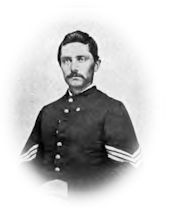
I left the army at Rappahannock Station, having been appointed Lieutenant Colonel of the 56th Massachusetts Volunteers. This was one of four new regiments, the 56th, 57th, 58th, and 59th. The idea was to have them largely composed of veterans who had recovered from wounds or sickness. I came home and set about the work of recruiting my regiment. I was appointed superintendent of recruiting for several counties in Massachusetts. We finally started for the war, for Annapolis, in March, 1864, most of the winter being spent in Readville recruiting the regiment and getting it into shape for service. Camp life at Readville had many pleasant features. We had a splendid regiment and a very fine band, led by Martland, who for some time had led the band at Brockton, Massachusetts. The band was so well known in the army that it was selected to go to Gettysburg when Lincoln made his celebrated speech and dedicated the monument there.

My life while recruiting had many pleasant and many disagreeable incidents. I had a chance to go to parties and see the young ladies, dance, etc., but the difficulty of getting recruits and drilling them, and the constant disciplining the new men, was very wearing, and I was only too thankful when we finally got off and I started for the front. As I have said, we had a splendid band, and I used to enjoy them very much. We had for adjutant a fellow named Lipp, a very brave fellow, but excitable, and, being a foreigner, not understanding very well how to get along with our men. I had Horatio D. Jarves, my classmate, for major, and afterwards for lieutenant colonel. He always did well, but having lost his foot in the early part of the War, he was disabled a good deal of the time and could not always be present. I started out with my classmate, Charles J. Alills, as adjutant, but we lost him soon, as he was detailed on staff duty and was killed in the last battle of the War, before Petersburg, while on General Humphreys’s staff. He was a brave and charming fellow and a delightful companion. His mother gave me his ring, which I still have,— an antique representing a lion tearing a hare. Colonel Griswold, my colonel, had been in the 22d Massachusetts; he suffered from a chronic trouble, which compelled him to resign from there. He used to be with me in the cadets. He was a brave man and a good officer. Captain Hollis, Captain Cartwright, Lieutenant Mitchell, Lieutenant Cadwell, and a great many others were fine officers and good men. Captain Duncan Lamb was also a good officer of the regiment, a brother of William E. Lamb of ’59. Major Putnam was also a fine officer. He was mortally wounded at Cold Harbor. Some of the incidents of recruiting were quite amusing. A letter sent in by the mother of a recruit is reproduced on the opposite page.
Saturday, 19th—It is quite cool. We reached Memphis at 4 o’clock this morning and remained all day, not starting on our trip till late this evening. The supply train of the Sixteenth Army Corps was unloaded here from our boat, and we took on the Thirty-fifth New York Infantry.

March 19, Saturday. The Wilkes court martial moves slowly. Thus far I have no reason to be dissatisfied with the court. Wilkes himself strives to make it a personal matter. I have no feeling on the subject. Would rather he should not have driven me into the work, and shall be glad to have it disposed of.

March 19.—The correspondent of the Cincinnati Gazette, at Washington, Mr. Whitelaw Reid, (“Agate,”) wrote as follows concerning the Emancipation Proclamation: “A recent allusion to the fact that Mr. Secretary Chase’s pen supplied the concluding sentence of the Emancipation Proclamation, has been received with a surprise that indicates a less general knowledge on the subject than might have been expected.

“When the final draft of the Proclamation was presented by the President to the Cabinet, it closed with the paragraph stating that the slaves if liberated would be received into the armed service of the United States. Mr. Chase objected to the appearance of a document of such momentous importance without one word beyond the dry phrases necessary to convey its meaning; and finally proposed that there be added to the President’s draft the following sentence:

“‘And upon this act, sincerely believed to be an act of justice, warranted by the Constitution, I invoke the considerate judgment of mankind, and the gracious favor of Almighty God.'”

“Mr. Lincoln adopted the sentence as Mr. Chase wrote it, only interlining after the word ‘Constitution’ the words, ‘upon military necessity;’ and in that form the Proclamation went to the world, and history.

“The President originally resolved upon the policy of issuing this Proclamation in the summer of 1862. As he has expressed it himself, every thing was going wrong; we seemed to have put forth about our utmost efforts, and he really didn’t know what more to do, unless he did this. Accordingly, he prepared the preliminary Proclamation, nearly in the form in which it subsequently appeared, called the Cabinet together, and read it to them.

“Mr. Montgomery Blair was startled. ‘If you issue that proclamation, Mr. President,’ he exclaimed, ‘you will lose every one of the fall elections.’

“Mr. Seward, on the other hand, said: ‘I approve of it, Mr. President, just as it stands. I approve of it in principle, and I approve the policy of issuing it I only object to the time. Send it out now, on the heels of our late disasters, and it will be construed as the convulsive struggle of a drowning man. To give it proper weight, you should reserve it until after some victory.’

“The President assented to Mr. Seward’s view, and it was withheld till the fall, when it was issued almost precisely as originally prepared. The one to which Mr. Chase supplied the concluding sentence was the final Proclamation, issued on the subsequent first of January”

—The Legislature of Georgia in both branches to-day adopted Linton Stephens’s peace resolutions, earnestly “recommending that our government, immediately after every signal success of our arms, when none can impute its action to alarm instead of a sincere desire for peace, shall make to the government of our enemy an official offer of peace, on the basis of the great principle declared by our common fathers in 1776, accompanied by the distinct expression of a willingness, on our part, to follow that principle to its true logical consequences, by agreeing that any Border State whose preference for our association may be doubted, (doubts having been expressed as to the wishes of the Border States,) shall settle the question for herself, by a convention to be elected for that purpose, after the withdrawal of all military forces on both sides from her limits.”

They also adopted his resolution declaring that “the recent act of Congress to suspend the writ of habeas corpus in cases of arrests, ordered by the President, Secretary of War, or general officer commanding the Trans-Mississippi military department, is an attempt to maintain the military in the usurpation of the constitutional judicial functions of issuing warrants, and to give validity to unconstitutional seizures of the persons of the people; and the said act, by its express terms, confines its operation to the upholding of the class of unconstitutional seizures, the whole suspension attempted to be authorized by it, and the whole act itself, are utterly void.”

“That in the judgment of this General Assembly, the said act is an alarming assault upon the liberty of the people, without any existing necessity to excuse it, and beyond the power of any possible necessity to justify it; and our Senators and Representatives in Congress are earnestly urged to take the first possible opportunity to have it blotted from the record of our laws.”

Both houses also adopted a resolution turning over to the confederate government all persons between the ages of seventeen and eighteen, and forty-five and fifty years.

They also unanimously adopted a resolution expressive of confidence in the President, and thanks to the confederate armies for reenlisting for the war.—Mobile Papers.

by John Beauchamp Jones

            MARCH 19TH.—Warmer, calm and cloudy.

            I saw a large turkey to-day in market (wild), for which $100 was demanded.

            I saw Dr. Powell to-day. He says the Federals asked his servants where the master and mistress had gone? and they were told that they had been called to Petersburg to see a sick daughter. They then asked where the spoons were, and were told none were in the house. They asked if there was not a watch, and the servant said her master wore it. They then demanded where the money was kept, and were told it was always kept in bank. They made the servants open drawers, press, etc.; and when they discovered some pans of milk, they took them up and drank out of them with eagerness. They took nothing from the house, destroyed nothing, and the doctor deems himself fortunate. They left him two horses and eight mules.

March 19th. L. A. Manning and I off duty. Weather being fine, we decided to take a long walk out into the country. Passed a few farm houses. Came to a small school house where we heard the music of a violin. Looking at the building and listening to the music, a gentleman came out and invited us in. He was the teacher. It being Saturday there was no school. He was practising on the violin. A fine looking young man. Inclined to ask us many questions, which we avoided answering. His sympathy was with the South all right We were about four miles from camp. Returned very much pleased with our tramp. Maryland is a fine country. We had passed through different sections of it.

Huntsville, Friday, March 18. A beautiful day. Sick none the better. Tommy is very low, unable to be up, while he is kept strong by medicine all of the time. 111th Illinois Infantry marched in from Nashville direct from the State, the largest regiment I have seen South, said to be attached to our Division. Matthies is commanding Division. Smith on furlough.

9 A. M. Formed procession and marched to the funeral of Murphy, fourth piece leading the procession. A chaplain officiated at the grave. Received mail in the afternoon. Reports of the guerrilla raid not as hideous as yesterday.

Friday, 18th. Spent most of the day in the house. So interested in a game of chess that I forgot the church prayer meeting till too late. Attended preaching in the evening.

[Diary] March 18.

Mr. Parker, the preacher, whom we mistook for Dr. Parker, the agent of the Baptists, came to see the school to-day. He is a kind-looking old man. We mistaking him, as I said, told him we heard he meant to put us out of the church, but he assured us that in his private opinion, we should not be disturbed. He stayed all the morning and spoke to the children. He asked what they had in their heads. They answered, “Sense;” “Brains” he told them. “How did their knowledge get into their heads?” “God put it there,” they answered. He pointed to his eyes, ears, mouth, nose, and explained how ideas got in, in so low a voice that my class could not hear and could only see his motions, and these seemed so comical that Fairy Jenkins burst into a fit of laughing that nearly upset me and the whole class.

He says he thought he should find peace and zeal down here — a band of fellow workers living in harmony and working with combined effort, but that he finds friction, friction in every quarter — military, religious, and political.

March 18th.—Went out to sell some of my colored dresses. What a scene it was—such piles of rubbish, and mixed up with it, such splendid Parisian silks and satins. A mulatto woman kept the shop under a roof in an out-of-the-way old house. The ci-devant rich white women sell to, and the negroes buy of, this woman.

After some whispering among us Buck said: “Sally is going to marry a man who has lost an arm, and she is proud of it. The cause glorifies such wounds.” Annie said meekly, “I fear it will be my fate to marry one who has lost his head.” “Tudy has her eyes on one who has lost an eye. What a glorious assortment of noble martyrs and heroes!” “The bitterness of this kind of talk is appalling.”

General Lee had tears in his eyes when he spoke of his daughter-in-law just dead—that lovely little Charlotte Wickham, Mrs. Roony Lee. Roony Lee says “Beast” Butler was very kind to him while he was a prisoner. The “Beast ” has sent him back his war-horse. The Lees are men enough to speak the truth of friend or enemy, fearing not the consequences.