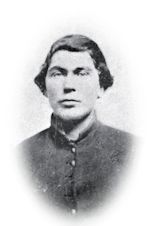
Huntsville, Sunday, March 13. A delightful Sabbath morning. T. J. Hungerford very sick, heavy fever and hard breathing. Afraid he is going to have a fever. Bathed him, towels kept around him, and all we can do for him is done gladly. After inspection 8 A. M. attended Sabbath school and meeting at the Methodist Church with Booth and D. Evans. The society was in deep mourning for Mrs. Jordan, principal teacher and superintendent of the Sabbath school, who was killed in the railroad accident of the 5th inst. Fitting resolutions were passed by the school in memoriam. The minister preached from the 35th and 36th verses of the fourth chapter of St. John, a discourse filled with hell fire and eternal misery, with but little consolation to the many bereaved mothers and sisters present who had lost their all in the Confederate army. Although enemies, I could but feel for their distressing sobs, that were audible all over the room. In the afternoon the day was so cheering that I could not resist the temptation of another walk to town, where in a crowded house of soldiers and citizens I listened to an excellent practical sermon on the ten virgins, wise and foolish.
March 2014

13th. Felt so unwell and uneasy, concluded not to go to church. Lay down part of the day. Read “Bitter Sweet,” by Holland. Much interested.
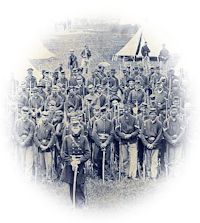
March 13th, 1864.
I received a bundle of Northern papers today. The Tribune thinks the Rebels and their Northern allies will exert themselves to prolong the war until after the next election. I fully agree with it, and think it better for the cause of freedom that they do so. Every day the war continues is another guaranty of the downfall of slavery. The time is not far distant when every Northern man will become an Abolitionist. Look at the Woods, the Brookses, the New York Herald, the New York World and all the leading pro-slavery men and journals of the North. Already are they trying to disengage themselves from the fetid carcass of their dead ally. I do not know as it matters where the final struggle takes place. It may be here, but I think not. Lee and his army will never forsake their native state. There they will fight, and there they must be met and conquered. That done, the rest is comparitively easy. My health is improving. I think I might now take charge of my ward, but the Doctor will not permit it yet.
I am overwhelmed with joy at so favorable report of my only son. God bless my faithful, patient, persevering boy. May he be kept from deception and craft, his lips from guile.

Sunday, 13th—The Eleventh and the Fifteenth Iowa, together with the Twelfth Wisconsin, all veterans, went aboard the “Continental” this afternoon and about dark left for the North. I could not go with my regiment, as I have not yet been relieved from guard duty at the roundhouse.
March 13.—A Union meeting was held at Huntsville, Alabama, at which resolutions were passed deprecating the action of the South, and calling upon the Governor of the State to convene the Legislature, that it might “call a convention to provide some mode for the restoration of peace and the rights and liberties of the people.” Speeches were made by Jere Clemens and D. C. Humphreys in support of the resolutions.
—General Butler, learning that the Fifth and Ninth Virginia cavalry, with a large force of armed citizens, were in the vicinity of King and Queen Court-House, immediately despatched an expedition from Yorktown under command of General Wistar, with which General Kilpatrick and a portion of his command essayed to cooperate. This rebel force was ascertained to be one thousand two hundred strong, and the same that ambushed and killed Colonel Dahlgren.
General Kilpatrick left Gloucester Point on Tuesday night, March eighth, in charge of the cavalry, and was ordered to scout Gloucester County to the north and east as far as Dragon River, and drive the enemy up the Peninsula, while Wistar landed his forces by transports on Wednesday at Shepherd’s warehouse, six miles above West-Point, on the Mattapony, with the purpose of heading off their retreat and charging their front and rear. Owing to a misapprehension of General Wistar’s orders, General Kilpatrick marched direct to West-Point, where he arrived about the same time with General Wistar.
A small cavalry force was then despatched to New-Market, and the infantry and artillery moved out as far as Little Plymouth, while Kilpatrick scouted across the Dragon River and tried to cross at Old and New-Bridge, but could not, owing to the swollen state of the stream. Our forces then moved down through the counties of King and Queen, Middlesex and Gloucester, making many captures and destroying large quantities of supplies. King and Queen Court-House was destroyed, and when near Carrolton’s store, Colonel Onderdonk, commanding the First New-York Mounted Rifles, and Colonel Spear, of the Eleventh Pennsylvania cavalry, came upon the looked-for rebel force of cavalry and citizens. This was in the midst of a severe rain-storm which had been pouring all day, and the mud was knee-deep; yet the rebels were gallantly charged, dispersed, and chased ten miles, their camp destroyed, about twenty killed, and seventy wounded and taken prisoners. The remainder made good their escape by recrossing the river into King William County.
The Union force comprised the Forty-fifth, Sixth, and Twenty-second National colored troops the First New-York Mounted Rifles, the Eleventh Pennsylvania cavalry, parts of Hart’s and Belger’s batteries, and some five hundred of Kilpatrick’s Richmond raiders. The only organized rebel force encountered were the Fifth and Ninth Virginia cavalry, having, however, many mounted and armed, though ununiformed citizens in their ranks, who claimed to be noncombatants.
On the raid large amounts of grain, provisions, arms, etc., were destroyed. One mill filled with corn belonging to the Ninth Virginia cavalry was burned. Several of Lee’s soldiers at home on recruiting service were captured; two Union officers recently escaped from Libby Prison were rescued, and one of Longstreet’s men captured.
The National forces returned to Yorktown today, without the loss of a man, and but very few horses, and the objects of the expedition were as fully accomplished as were possible. The enemy was severely punished for the death and brutalities perpetrated upon Colonel Dahlgren, and General Wistar highly complimented for the success of his expedition.
—President Lincoln addressed the following to Michael Hahn, the newly elected Governor of Louisiana: “I congratulate you on having fixed your name in history as the first free State Governor of Louisiana: now you are about to have a commission which, among other things, will probably define the elective franchise. I barely suggest, for your private consideration, whether some of the colored people may not be let in, as, for instance, the very intelligent, and especially those who have fought gallantly in our ranks. They would probably help in some trying time to keep the jewel of Liberty in the family of freedom. But this is only a suggestion, not to the public, but to you alone.”
—Two men belonging to the Thirty-second Missouri infantry, Archibald Towner, of company B, and Thomas Norris, of company D, while beyond their picket-lines, in Mo., were taken prisoners by a party of guerrillas, who took them to the top of a mountain near by and tied them to a tree, where they were kept until about sundown, when they were shot, robbed of every thing valuable, and thrown from the summit of the mountain down a precipice sixty feet. Norris miraculously escaped death, which he feigned while being handled by the murderers, and succeeded in reaching camp very much exhausted. He implicated many of the citizens who received their daily rations from the Government, and several in that vicinity were arrested for trial.
The body of Towner was found by the men of his regiment, while out in search of the guerrillas, and carried into camp.—Captain John T. Campbell’s Report.

by John Beauchamp Jones
MARCH 13TH.-A lovely spring day—bright, warm, and calm.
There is nothing new, only the burning of houses, mills, etc. on the York River by the Yankees, and that is nothing new.
Subsequently the day became very windy, but not cold. The roads will be dry again, and military operations will be resumed. The campaign will be an early one in Virginia, probably. Our people are impatient to meet the foe, for they are weary of the war. Blood will flow in torrents, unless the invaders avoid great battles; and in that event our armies may assume the offensive.
It is now thought that the Department Battalion will be kept here for the defense of the city; the clerks, or most of them, retaining their offices. Those having families may possibly live on their salaries; but those who live at boarding-houses cannot, for board is now from $200 to $300 per month. Relief must soon come from some quarter, else many in this community will famish. But they prefer death to submission to the terms offered by the Abolitionists at Washington. The government must provide for the destitute, and array every one capable of bearing arms in the field.
Huntsville, Saturday, March 12. Very cold night but warm and beautiful day. No drill to-day, it being general policing, which was done in a short time. Games daily in camp, ball, etc. Spent most of the day reading the Phrenological Journals received from home. At night I laid awake long, and restless, thinking of home and its endearments. After sleep came I dreamt of mother. T. J. Hungerford quite unwell this evening, heavy fever. Exercised rather too much for his strength in the morning, and his system impaired from previous illness.
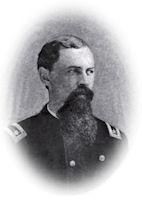
Scottsboro, Ala., March 12, 1864.
I have been tremendously demoralized for nearly a month in consequence of a terrible cold I caught by some of my carelessness, I suppose, but am now coming out of it all right. Weather is most beautiful. Not too much duty, excellent camp, remarkably good health, and everything so near right, that almost think a soldier who’d grumble here deserves shooting. Were I disposed to complain am sure I could only find two little topics whereof to speak; one being the fact that ’tis impossible to get anything to eat here excepting regular army rations, not even hams can be had, and the other the long-continued absence of the paymaster. We are hoping that both these matters will be remedied ‘ere long, but have been so hoping for months. We have a division purveyor now, who pretends that he will furnish us in good eatables. We have had but a few articles from him, and I’ll tell you the prices of those I remember. Can of strawberries, $1.75; cheese, 80 cents a pound; bottle (about one and one-half pints) pickled beets, $1.50. If I could draw the pay of a brigadier general, and then live on half rations, think I might come out even with said purveyor for my caterer.
Everything perfectly stagnant. We did hear day before yesterday some quite rapid artillery firing for an hour or two; it sounded as though it might have been some ten or twelve miles southwest of us. ‘Twas reported by scouts a few days ago that the enemy was preparing flatboats at Guntersville to cross the river on, with intent to make a raid up in this direction or toward Huntsville. The 15th Michigan Mounted Infantry was sent down to look after the matter, ran into an ambuscade and lost a dozen or so killed and wounded. That’s all I heard of the matter. We were very sorry that the loss was so light, for they are a miserable set. We are going to have a dance here in a few days. Think I’ll go. Anything at all to get out of camp. I’m as restless as a tree top after marching so much. You don’t know how tame this camp business is. Am afraid I will get the “blues” yet. Hurry up the spring campaign, I say.
12th. Wrote to Alf Webber and Hugh. Read some in Dio Lewis’ “Weak Lungs, and How to Make Them Strong”—much interested. Called yesterday to see Jamie Johnson. Walked home from town with Ella and challenged for a game of chess. Went down and played in the evening—the champion. Letter from Fannie asking me to come down.
[Diary] Saturday, March 12.
A hard-working morning getting ready for our dinner this evening. The dinner was not ready at the right time, and I had to leave the guests — Captain Hooper, Mr. Ruggles, Mr. Tomlinson, and Mr. Dyer — again and again, to see about it. Rina had in the kitchen Hastings, Brister, Lame John, and a boy helping her, but when dinner was at last on the table we found that the potatoes were forgotten entirely, and the fried oysters appeared with the pudding. The Christmas pudding sent me from home was quite cold. There was the usual long time between each change of plates. Hastings had requested the honor of waiting upon the gentlemen, and did pretty well. We were to have had our soup in a yellow bowl for want of a tureen. Hastings told Rina he had a tureen at home and would like to lend it, but if I saw it he was afraid I would want to buy it. Rina told him I would not wish to buy what he did not want to sell, and so, to my surprise, the soup appeared handsomely dished, but it was stone cold. So the dinner was a failure, but the gentlemen were merry. Captain Hooper stayed all night. He has just returned from the North and brought me a pair of camp candlesticks and a box of candy.


