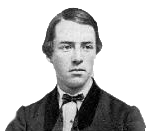
Friday, March 25. — We had a great deal to do in policing the camp, and towards evening it began to rain, putting a decidedly unpleasant aspect on things in general. We sent in a patrol to Annapolis and secured about a dozen of our men.
March 2014
Headquarters 56th Massachusetts Reg’t.
Camp Holmes, near Annapolis, March 25, 1864.
Dear Father, — We are now comfortably settled in tents about two miles from Annapolis, on the exact ground that the 24th Massachusetts were encamped two years ago. The ground is dry and easily drained, with water, etc., within convenient distance. The railroad runs within a fourth of a mile of our camp, making it very convenient for us to get our supplies.
We left camp, as you know, on Sunday morning, the men and officers being in the best of spirits, and with but few of the men, I am glad to say, drunk. The day before we left, over forty gallons of liquor were confiscated at General Peirce’s headquarters, being found on the persons of the soldiers’ friends, or rather enemies. We reached Groton at 3 P.M. without losing a man. At every place we stopped, the officers and guards got out, and prevented any civilians from having access to the men. In this way we managed to keep all liquor away from the soldiers. At Groton we shipped the regiment on board the Plymouth Rock and reached Jersey City by 2.30 AM., experiencing no trouble except from the boat-hands selling rum to the men. At Jersey City we had to wait until 10.30 A.M. before we could get the regiment on board the cars and started. We lost but two men here. We reached Camden at about 7 P.M. with all our men except one. At Newark a citizen was shot by one of the officers for refusing to go away from the cars, where he was selling liquor, and for throwing stones at the officer. I don’t know whether the man was mortally wounded or not. At Camden we took the ferry and crossed to Philadelphia, where we received a supper from the Union Association. I demolished a liquor shop in Philadelphia and took the proprietor prisoner. I had him hand-cuffed and taken on to Baltimore, where I had half his head and beard shaved and then turned him over to the provost marshal. At Philadelphia the colonel and quartermaster left us, and went on to Baltimore to provide transportation for the regiment, and therefore I had command. After taking our supper here, we marched to Philadelphia and Baltimore depot, where we took freight cars for Baltimore. We arrived there at 12 and found the colonel waiting for us. As a dinner was promised us here at the Union Rooms, we marched some two miles from the depot to the place, where we found that we had been taken in, for no dinner was ready, so like the king of old we marched down the hill again. We took the steamer Columbia at Baltimore about 2 P.M. and started for Annapolis, reaching there at 6.30 P.M. in a driving snow-storm. We disembarked as soon as possible, and marched to what are called the College Green Barracks, where the paroled prisoners are kept for the first day or two after their arrival. We found only four of the barracks empty, and had to pack our men in them, putting four hundred where two [hundred] are usually put. Still it was much better this way than without any shelter at all, for the night was bitter cold and the wind keen and sharp. In the morning we made arrangements with Major Chamberlain to provide our men with hot coffee and meat, until we could draw our rations. Major Chamberlain is in the 1st Massachusetts Cavalry and in charge of the parole camp. He was very kind and obliging to us, for without his aid we could have done nothing for our men, and should have been obliged to have seen them suffer a great deal. As it was, they had a pretty hard time of it. This same morning, that is, Wednesday, lots of our men got into the town, and drank much bad whiskey, besides bringing a lot more into camp. About noon camp began to be a perfect pandemonium, and as the colonel was away, the major and I sallied out to restore order. We put all the noisy drunkards in the guard-house, and soon quelled the disturbance outside. In the guardhouse, however, confusion reigned supreme for a long time. We tied up any number of men, and finally succeeded in getting quiet restored. One of the worst cases in the regiment, named Casey, I had tied up by the thumbs, and gagged. He then kicked an officer there, and I said to him, “Casey, I will shoot you if you do that again.” Another officer came by and he kicked him, and I drew that pistol Uncle Oliver gave me and fired at him twice. The first shot went through his arm, in the biceps, without touching the bone. The second hit the bayonet in his mouth by which he was gagged, and dropped into his stocking. The bayonet saved his life, for the shot would have gone through his head otherwise. I meant to kill him, and was very sorry I did not succeed. The shots had a wonderful effect in quieting the men, and I had very little trouble with them after that.
Yesterday morning we started for our camp outside the city and delighted (?) the Secesh citizens by playing “John Brown” as we marched through the town. We pitched all the tents before night and had the regiment comfortably housed and fed. Considering that some regiments that arrived over a week ago only managed to do the same thing in a week, I think we have every reason to be satisfied. . . .
My address is simply, 56th Mass. Vols., Annapolis, Md. I understand that we are the commencement of the 1st Brigade, 4th Division, 9th Army Corps, and that the corps badge is to be a cross with scalloped edges. Please ask Uncle Oliver to apply for our regiment, in case he takes any, on Burnside’s expedition. . . .
While we were in the College Green Barracks, a boatload of prisoners came in from Richmond. There were 500 in the lot that I saw. 500 of the worst cases had been sent to the hospital. Of the 500 selected as being in good health, I must say that I never saw a more horrible-looking set in my life. All ragged and filthy and thin, — it made one feel sick to see them. It was a good thing for the regiment, however, and I am glad that they saw them. The arrangements for these prisoners are very good indeed. They have a large bath-house for them, where they can take either warm or cold baths. I went in and saw some of them bathing. They looked more like skeletons than human beings. The rations for a day consist of one small piece of corn-bread. I saw Adjutant Cheever of the 17th Massachusetts, who said that Linus Comins was still in Richmond. . . .
You can’t tell how glad I am to get the regiment away from Massachusetts. It is a great relief to me, I assure you.
On Thursday, March 24, we left our barracks and marched out to the old camping-ground of the 24th Massachusetts, the ground being covered with snow about six inches deep. We received our tents here, and managed to have them all pitched before night. In the evening we had the band play, and what with delight at being away from Readville and finally settled in camp, I feel ready to pardon all past and future offences of the men. The regiment was in good spirits and everything seemed lovely.
Diary And Memoranda, 1864
Mar. 25th. I am a Veteran Volunteer and of course stuck for three years more! Going over after bounty and pay tomorrow. Do not intend to take my furlough till May. Three years more seems a long time but guess I am good for it.

Friday, 25th—I remained at home all day visiting and talking over some of my experiences. One change I find in myself, and that is the discomfort in sleeping in a warm room, as the custom in the homes is, for it is more than two and a half years since I have slept that way.
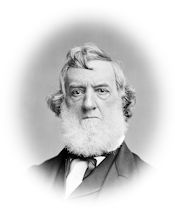
March 25, Friday. At Cabinet to-day, I brought up the subject of a scarcity of seamen. The President seemed concerned, and I have no doubt was. Stanton was more unconcerned than I wished, but did not object to my suggestions. I had commenced, but not completed, a letter to the President urging the importance and necessity of an immediate transfer of 12,000 men to the Navy. The army has by bounties got thousands of sailors and seamen who are experts. This letter I finished and had copied after my return. On reading it to Fox it stirred him up, and the prospect is certainly most unpromising.
Chase, who sat beside me when I first made mention of the difficulty we were experiencing from the effects of the enrollment act and the policy pursued by the War Department, remarked that nothing could be expected where there were no Cabinet consultations and no concerted action. Stanton and the President were in private consultation at the time in a corner of the room. This is no unfrequent occurrence between the two at our meetings, and is certainly inconsiderate and in exceeding bad taste. Chase was, I saw, annoyed and irritated.
Mr. Bates and others soon left. Usher sat quietly and intent, not listening perhaps to catch a word, but U. has great curiosity.
March 25. — Major-Generals Newton and Pleasanton, having been relieved of their commands in the army of the Potomac, issued general orders in accordance therewith.—Padccah, Kentucky, was attacked by the rebel forces under General Forrest—(Docs. 1, 127, and 139.)
—The steamer La Crosse was captured and burned by a party of rebel guerrillas, at a point on the Red River, below Alexandria; her crew was released, but the officers were carried off.

by John Beauchamp Jones
MARCH 25TH.—Raining moderately.
Yesterday Mr. Miles, member of Congress from South Carolina, received a dispatch from Charleston, signed by many of the leading citizens, protesting against the removal of 52 companies of cavalry from that department to Virginia. They say so few will be left that the railroads, plantations, and even the City of Charleston will be exposed to the easy capture of the enemy; and this is “approved” and signed by T. Jordan, Chief of Staff. It was given to the Secretary of War, who sent it to Gen. Bragg, assuring him that the citizens signing it were the most influential in the State, etc.
Gen. Bragg sent it back with an indignant note. He says the President gave the order, and it was a proper one. These companies of cavalry have not shared the hardships of the war, and have done no fighting; more cavalry has been held by Gen. Beauregard, in proportion to the number of his army, than by any other general; that skeleton regiments, which have gone through fire and blood, ought to be allowed to relieve them; and when recruited, would be ample for the defense of the coast, etc. Gen. Bragg concluded by saying that the offense of having the military orders of the commander-in-chief, etc. exposed to civilians, to be criticised and protested against—and “approved” by the Chief of Staff—at such a time as this, and in a matter of such grave importance—ought not to be suffered to pass without a merited rebuke. And I am sure poor Beauregard will get the rebuke; for all the military and civil functionaries near the government partake of something of a dislike of him.
And yet Beauregard was wrong to make any stir about it; and the President himself only acted in accordance with Gen. Lee’s suggestions, noted at the time in this Diary.
Gen. Polk writes from Dunapolis that he will have communications with Jackson restored in a few days, and that the injury to the railroads was not so great as the enemy represented.
Mr. Memminger, the Secretary of the Treasury, is in a black Dutch fury. It appears that his agent, C. C. Thayer, with $15,000,000 Treasury notes for disbursement in Texas, arrived at the mouth of the Rio Grande in December, when the enemy had possession of Brownsville, and when Matamoras was in revolution. He then conferred with Mr. Benjamin’s friend (and Confederate States secret agent) Mr. Quintero, and Quartermaster Russell, who advised him to deposit the treasure with P. Milmo & Co.—a house with which our agents have had large transactions, and Mr. M. being son-in-law to Gov. Vidurri—to be shipped to Eagle Pass via Monterey to San Antonio, etc.
But alas! and alas! P. Milmo & Co., upon being informed that fifteen millions were in their custody, notified our agents that they would seize it all, and hold it all, until certain alleged claims they held against the Confederate States Government were paid. Mr. Quintero, who sends this precious intelligence, says he thinks the money will soon be released—and so do I, when it is ascertained that it will be of no value to any of the parties there.
Mr. Memminger, however, wants Quartermaster Russell cashiered, and court-martialed, and, moreover, decapitated!
March 25th. Marching orders received to report at regimental headquarters, Camp Hill, Bolivar Heights, near Harper’s Ferry. A cold rain storm on at this time. On account of a hard cold, with a number of others, went to Harper’s Ferry by cars. There met by ambulance and rode to camp. My first ride in an ambulance. Bad getting around in camp on account of the deep mud. Harper’s Ferry is a side hill town. The Potomac and the Shenandoah on either side. Here the B. & O. R. R. crosses the Potomac into Maryland. Above Harper’s Ferry is located the Jefferson Rock, where one gets a fine view. The scenery at this point is grand. The mountains, rivers, and the valley, and also the great Maryland Heights.
Huntsville, Thursday, March 24. Weather warm and ground drying. We have a very pleasant ride every morning to the big spring in town to water our horses, and back, about two miles. Have to keep in the ranks, which is not as agreeable as if allowed to go as we pleased. Tommy gaining a little. Through the kindness of one of the boys’ lady acquaintances, he was supplied with a rocking chair in which he sat for some time. A new hospital tent is being put up on the hill right above us for the batteries, where he will be removed soon.

Thursday, 24th. After breakfast went to town. Forgot my belt. Had to go by Mr. Cobb’s three times. Felt sad as I breathed a goodbye. Sad sad, sad! Will times ever change? I am glad none of my friends can know the feelings of my heart. Fred and Will and Terrell went to the depot with me. Boys feeling well. Got off at 10. Reached Columbus at 7 P. M. Left at 10 P. M.


