
21st. Tuesday. Wrote home and to George’s people in Tenn. Saw Gen. Kautz. He came over to pay us a visit. It seemed good to shake his hand and talk with him once more. Hope that we can be transferred to his command. He encouraged us. Preparations for a big move tomorrow by the cavalry. May success attend us. Kautz thinks that Richmond is a certain capture. Very hot day. Maj. N. goes to hospital, best man in our Regt., brave, upright, modest, dignified and sound in principles and morals. Would the same could be said of more of our officers.
June 2014
June 21, Tuesday. The President being absent, there was no Cabinet-meeting to-day. Massachusetts Representatives are sensitive and sore concerning the arrest of the Smiths. I wrote Mr. Wilson not to be severe and to take bail.
by John Beauchamp Jones
JUNE 21ST.—Clear and warmer.
Gen. Beauregard has not been removed from his command,—it would be too great a shock to popular sentiment.
The iron-clads went out this morning and proceeded down the river, supported by Custis Lee’s brigade of local troops, including the Departmental Battalion, marching a dozen miles in the sun and dust. More will be on the sick list.
June 21, 1864.
No variation to report to-day. Heavy rain yesterday and to-day. Some 350 prisoners were sent in from the right yesterday, and about 80 more that I know of to-day. Figure that we have taken about 3,000 prisoners at this place. Since the army went into position here the right has advanced about six miles, the center two miles, and the left three and one-half to four miles. The musketry from dark last night until 11 p.m. was very busy in front of the 4th Corps, though it may have been only a heavy skirmish line. I hear to-day that the 4th Corps took a strong Rebel position last night while that firing was going on and held it.
Monday, 20th—It has been quite warm today with rain this evening. Things were quiet all along the line until in the afternoon, when there was heavy fighting in the center, and all our artillery opened upon the rebels, without response from their guns. The heaviest cannonading that we have had yet was from our center, and it lasted for two hours. The rebels have fallen back, but still hold Kenesaw mountain and have their heavy batteries planted on the very top, while our men are along the north side of the mountain, slowly ascending it. Our regiment moved to the front again this evening and two companies, I and H, are out on picket.
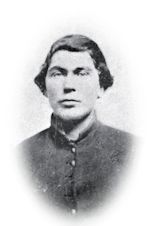
Huntsville, Monday, June 20. Quite warm. Health very good in camp. Seven patients in hospital, recruits, one dangerous. Johnson, raving with fever all night. Drilled from 7 to 9 A. M. Rode out to graze in a fruitful orchard. Marching orders once more received, “Move Wednesday morning”.
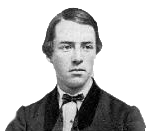
Dear Mother, — I saw the chaplain of the 3d Maryland Regt. the other day. His name is Breckman, or something of the sort. He knows Aunt Harriet, and seems to think everything of her, and wished me to send her his very kindest regards. He is a great Swedenborgian, and says that Aunt Harriet has given $100 a year for the support of his paper. I found him a very intelligent and highly educated man, and a very agreeable one, too. Please remember me to Aunt Harriet with my best wishes for her health, and tell her that I saw this gentleman.
I am in a horribly filthy condition. Our baggage we have not seen since the beginning of the campaign. It was put on board a scow at White House, and I suppose is lost by this time. I have a change of underclothes, which I carry in my saddle-bag, but am sorry to say that they are in as bad a condition as those I have on; viz., full of animals. I have them boiled every chance I get, but as the whole regiment is in the same condition that I am, it does not seem to do any good. I don’t get any chance to bathe all over, as I don’t dare to leave the regiment long enough to find a brook. On the whole, I shall be glad enough when this campaign is over.
Give my love to Henry and Arthur, and tell Henry that I am very sorry that he has broken his arm, and that I hope he will soon get well.
Headquarters 56th Mass. Vols., June 20,1864.
Dear Father, — I write to you again to-day, or rather again since yesterday, to let you know that I am still unhurt. We are in the reserve, and have been resting here for two days. A little way from here the spires of Petersburg can be plainly seen, within a mile of us. I hear that the papers report that we hold the city. That is incorrect, although I hope it will not be so long.
There has been no fighting so far to-day, except continual skirmishing. Our pickets are within a hundred yards of the rebels, which makes it rather dangerous to show one’s head there.
I saw Frank for the first time yesterday. He is very well, and seems to like his position very much. I saw him again to-day for a few minutes.
Give my love to Mother. I guess I will write her a few lines myself, however.
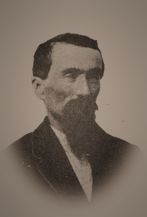
June 20— We renewed our march last night at two o’clock, and when we arrived within two miles of the White House we halted until daybreak, then moved within close range of the White House. Before we reached the fields near the White House the firing of both musketry and artillery had commenced. When we reached the hills west of the house the lowland along the river was still covered with immense wagon trains in park. We immediately put our guns in battery and opened a brisk fire on them with half of our battalion,— eight pieces,— which quickly stirred up a lively scene among the horses and teamsters, and a busy scramble ensued as to who could leave first.
The trains left under our fire and rushed across the Pamunkey on a pontoon bridge that spanned the river just above the White House. Our fire also waked up a lion in the shape of a well fortified Yankee battery near the river, which opened a rapid fire on us, and the thundering sound of booming cannon rolled in a roaring flood across the lowlands of the Pamunkey and the York.
Just then the sight was grand and impressive, and the scene inspiring. There before us lay the placid waters of the Pamunkey, glowing in the opening morning light like a band of silver, reflecting on its bosom the mellow tinge of a morning sky. The silvery water was marred by the darker track of the pontoon, crowded from shore to shore with fleeing wagons jammed close together, and all covered with white canvas, presenting the striking appearance of white water fowl gliding swiftly across the shimmering water. Beyond the pontoon and farther down the river toward the York a thin white morning mist hung over the water like a curtain of draping lace, under which the silent waters glided beyond our ken. When the bright lances of the morning sun shattered the veil of mist and melted the fragments into clear air, we discovered two Yankee gunboats on the river, which had been hidden in the folds of the mist and were then in plain view, and ready to open fire on us. This they did at first sight, and for one hour the artillery fire raged fiercely and in a business-like way on both sides, without the least lull, cessation, or break.
Among the armament of the gunboats was a thirty-two pounder, which the enemy fired at us frequently, and we soon learned that there was no virtue and less use for us to fool around such a war machine with our little three-inch rifle field pieces, and we ceased firing.
I saw several shell from the thirty-two pounder fly way above our heads, and they glittered in the sunlight like polished steel, and whizzed through the air with speed enough when they passed us to carry them a mile farther, and then have momentum enough left to dig a ditch that looks like a miniature railroad cut.
While we were firing, a shell from one of their gunboats exploded in front of my gun, and a half-pound fragment gave me a friendly call by striking me in the breast, just interesting enough to bruise severely, without drawing blood.
After we had ceased firing some four or five of us lay under a little apple tree, when one of the enemy’s thirty-two pound shell exploded at least two hundred feet above us,— I saw it explode,— yet a slug from it wounded one of our men that was lying under the tree close by my side. The Yanks were surely cutting close and trying to gather me in to-day, but I am still on the sunny side of the dead line this evening and ready for rations.
The Yankee gunboats shelled the country all around us after we ceased firing. This afternoon we withdrew our guns from under the fire of the gunboats and moved about a mile down the river and bivouacked for the night. The gunboats still lay in front of the White House when we left.
The White House is on the south side of the Pamunkey in New Kent County, about twenty-two miles a little northeast from Richmond and about thirteen miles from the head of York River. The confluence of the Mattapony and the Pamunkey forms the York at West Point, at the southeast corner of King William County.
The White House is noted as being the place where George Washington wooed, won, and wed his wife a little over a hundred years ago.


