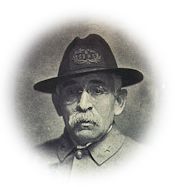
June 12—To-day, as the negro guard was relieved, two of them commenced playing with their guns and bayonets, sticking at one another. Fortunately one of their guns, by accident, went off and made a hole in the other one’s body, which killed him instantly. The other one kicked at him several times, telling him to get up as the rebels were laughing at him, but in a very short time he found out that he had killed his comrade and that we were laughing sure enough.
June 2014

by John Beauchamp Jones
JUNE 12TH.—Cold and cloudy.
Some firing again this morning, supposed to be merely an artillery duel.
Heard from Custis, in pencil mark on the back of envelope; and he has applied for and obtained a transfer from ordnance duty in the rear, back to his company in the front.
It is rumored that Sheridan has cut the road between Gordonsville and Charlottesville, and between that place and Lynchburg. If this be true, he will probably strike south for the Danville Road. Then we shall have confusion here, and the famine intensified. There seems to be no concert among the military commanders, and no unity of purpose among civil functionaries. They mistrust one another, and the people begin to mistrust them all. Meantime the President remains inflexible.
All has been quiet to-day. I suppose the enemy is fortifying, with an intention to move half his army to the south side of the river—distracting us by menacing the city and threatening our communications at the same time.
It is believed here by the croakers that Gen. Lee has lost much of his influence, from the moment Mr. Foote named him as Dictator in the event of one being declared.
Now, it would seem, if the plan of Beauregard, rejected by Bragg, had been adopted, our condition would have been better. It is the curse of Republics to be torn by the dissensions of rival chieftains in moments of public danger!
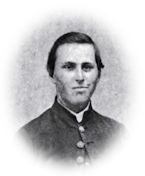
June 11th. Up and on the march by daylight. After a few hours marching, judging by the cannonading, there is hot work going on. We are pushing on for Lexington. Find the town is located on the south side of the James River. The enemy burned the bridge, delayed our crossing. The Engineer Corps provided a way for us to cross on the ruins of the bridge. The cavalry and artillery crossed at some other point. The Engineer Corps used lumber from nearby buildings to make the bridge safe for us to cross.
At this point we received a great surprise. A wagon train overtook us with supplies. Our rations at this time were very low. The enemy were run out of town. We go in camp on the east side. Lexington is a beautiful town. The scenery grand. Reported to us that the sound of Yankee guns had never been heard here before, or until today.
Stonewall Jackson and many prominent rebel officers lie buried here in the town’s cemetery. The Washington Military Institute is located here, the pride of old Virginia. Governor Letcher resides here. Many other fine residences are located here. The weather clear, but hot. Scouts are bringing in prisoners. Detailed for picket duty tonight.

11. Wrote to Fred Allen, and Watson Jones. Big mail came. Whole month. Big feast.

Saturday, 11th—Had a light shower yesterday, while today it rained nearly all day. We formed a line of battle this morning and moved forward. There was some sharp skirmishing, and our cannons were active, but the rebels did not reply. We advanced about a half mile and the rebels fell back inside of their rifle pits, a mile distant, at the foot of Kenesaw mountain. Each regiment then went to work throwing up its own rifle pits. There was some more sharp skirmishing, the rebels attempting to turn our left, but we drove them back. The railroad is now in operation up to our army, and the first train came in to Big Shanty1 today. News came that Lee had evacuated Richmond, but we could not believe the report.
__________________
1 This is the station where Andrews and his band captured an engine with tender one Sunday morning and started up North, but he and his men were all captured, and some of them were executed, while others were set at liberty, —A. G. D.
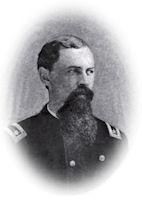
June 11, 1864.
Colonel Wright and I rode out to the front to-day. The Johnnies are about one and one-half miles from us, and occupying what looks like a very strong position. Rumor says that Sherman has said that he can force them to leave here any moment, but will wait for supplies and the roads to dry up. The cars got to Big Shanty about noon to-day, and indulged in a long and hilarious shriek. The Rebel locomotive about two miles further down the road answered with a yell of defiance.
I hear to-day that the 23d Corps took 2,000 prisoners and two cannon. I guess its yes. Rosencrans is actually coming, they say. I don’t think we need him. Sherman moves very cautiously, and everybody feels the utmost confidence in him. I saw him yesterday—seems to me he is getting fleshy. He don’t look as though he had anything more important than a 40-acre farm to attend to.
It has rained almost all day. You musn’t expect me to write anything but military now, for it is about all we think of.
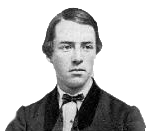
Saturday, June 11. — Day pleasant. Rode along picket line, and went out towards Mechanicsville road with Colonel Gould. Two women came in and reported the rebels advancing, which turned out to be untrue. Took a bath. Received a large mail to-day, with letters from Hannah, Jarves, Father, etc.
Huntsville, Saturday, June 11. Health very good. Eyes troublesome. Times dull. Weather wet and muddy. News of several desperate engagements reach us but none decisive, except Hunter in the Shenandoah Valley. A regiment of 100-day men passed this morning to Decatur, Alabama. Had a rich dish of raspberries for dinner, earliest of the season.
June 11 — Early this morning we moved down to Trevillian Station. The fields around the little station were destined to become the arena on which the mastership of the present raiding business was to be decided, and determine who is to be boss of the expedition.
When we arrived at Trevillian this morning the skirmishers had already commenced firing, and the enemy was advancing slowly and cautiously, yet in a businesslike shape and manner. After we were there a little while and the skirmish firing on both sides was getting warmish and interesting, the first section of our battery was detached to go with General Rosser’s brigade in the direction of Gordonsville, to guard and protect our left flank. We proceeded immediately, and moved with General Rosser’s cavalry about five miles from Trevillian in the direction of Gordonsville; there we halted for further developments. In the meantime a slow artillery fire between some of our artillery and the Yankee batteries was in progress right at Trevillian. The enemy did not appear in front of us, way out on the extreme left of General Hampton’s line, but made a fierce and stubborn onset right at Trevillian Station, and for a while they fought like fury, as if they intended to do something this time sure enough, and they came very near doing it.
The enemy’s object was to gain possession of the Charlottesville road, which leads direct from Trevillian to Charlottesville, but General Hampton, by adroit maneuvering and valiant fighting, blocked that game completely, by defeating and foiling the raiders in their first aggressive performance. While we were away with Rosser’s brigade the raiders made a gallant and desperate charge on General Hampton’s line, and for a while the conflict raged furiously; at one place the blue line swept over the field with such bold and fearless courage that some of our cavalry, under a heavy fire of the oncoming exultant foe, wavered and fell back in a regular mixed-up flinch.
The enemy had already pierced General Hampton’s line and captured two of our caissons and a goodly number of horses belonging to our dismounted sharpshooters and artillerymen when General Rosser, who had been hurriedly dispatched for, dashed on the field with gleaming saber at the head of his brigade of gallant and trusty veterans, all rushing to the rescue with naked sabers or drawn pistols, with set teeth and knit brow, determined to do or die. Then sabers clashed, pistols and carbines crashed, and for a while it looked like a free fight. The firing was quick and heavy for a short time; I heard the din of the conflict as we were hastening to the fray. The raiders fought well and gallantly, clinging tenaciously to the ground they had gained before the arrival of Rosser’s cavalry, but eventually the blue line yielded and broke under General Rosser’s vigorous and timely onslaught, and fell back discomfited from our line and position toward the base of their day’s operation, thwarted and baffled in their desperate effort to force our line and clear the Charlottesville road.
The timely arrival of General Rosser at the head of his brigade is all that saved our side from sustaining a disastrous defeat, for when he arrived on the field the Yankees had already broken our line and captured about half of the horses belonging to the Seventh Georgia Cavalry, some of our company’s horses, two of our caissons, and prisoners not a few, all of which were recaptured when General Rosser and his men rallied our line, repulsed and forced back the enemy. If General Rosser had been ten minutes longer in arriving, it would perhaps have been too late to retrieve the lost ground and all the concomitants of defeat and snatch from the enemy the victor’s palm with all its subsequent advantages and effects.
When we arrived on the field with the first section of our battery the fight was over, as we could not keep up with the cavalry after they sniffed the battle from afar and were cognizant of Rosser’s urgent dispatch to hasten to the rescue. This afternoon the first section of our battery was again detached, this time to go with the Eleventh Virginia Cavalry up the Charlottesville road, to watch and guard our rear. As the urgent requirements of successful work in attempting to finish up a raiding party demands prompt action under all circumstances, we immediately, after we received our orders, were on the march to the rear on the Charlottesville road, with the first section of our battery, following the Eleventh Virginia Cavalry.
We crossed the South Anna River near its head and put our guns in position on a commanding hill just south of the river in a section of beautiful and fertile country drained by the headwaters of the South Anna.
After the fight this morning nothing of any importance transpired during the remainder of the day. The sharpshooters have been firing along the front all afternoon in a desultory manner, without any serious effects, however, though now and then they drew blood. General Rosser was wounded this evening, and I think it was done by a sharpshooter. It is now dusk, and night is fast falling down on woods and fields, and we are still in position on the South Anna way in the rear of our line, yet fixing to sleep by our guns, in case the raiders should take a notion during the night to do
The sharpshooting along the front has died away, and from all appearances the day’s operations are over, and as yet there are no serious or important results observable on the surface of affairs concerning the final outcome of the expedition, only that the raid seems to be checked and the raiders are at bay.
The Yankee raiders are under the command of General Sheridan, and from the way the men in blue came up against General Hampton’s line to-day, without much preliminary maneuvering or flanking intentions, this Sheridan must be a regular butter, and a much better actor in tragedy than he is in strategy. I am no prophet, nor the son of a prophet, but if General Sheridan fights to-morrow on the same plan that he did to-day, by to-morrow evening he will be a defeated general. I do not know what forces or strength the enemy has,— it may be far superior to ours in numbers,— but if General Sheridan attacks to-morrow without some extensive flanking General Hampton will repulse and defeat him in bulk. The probability is that there will not be much flanking done by the enemy, as this makes twice that we have been on the flank-watching business to-day, and we have found no game yet, and, judging from to-day’s operations, we may expect nothing but sledge-hammer blows from the front to-morrow, as flanking in an actual battle does not seem to belong to General Sheridan’s tactics. In these latter days it seems that Uncle Sam is depending on, and putting his trust in, the might of numbers to grind the armies and the rebellious Southland down by sheer attrition and brute force; consequently the powers that be at Washington select the commanders for their butting qualities instead of strategetical capabilities.
Diary And Memoranda, 1864
June 11th. Pickets firing all day.


