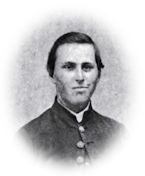
Staunton, June 8, 1864.
Dearest: — We reached the beautiful Valley of Virginia yesterday over North Mountain and entered this town this morning. General Hunter took the place after a very successful fight on the 6th. We seem to be clear of West Virginia for good. We shall probably move on soon.
Our march here over the mountains was very exciting. We visited all the favorite resorts of the chivalry on our route, White Sulphur, Blue Sulphur, Warm, and Hot Springs, etc., etc. Lovely places, some of them. I hope to visit some of them with you after the war is over.
We know nothing of Grant but conjecture that he must be doing well. We are now in Crook’s division, Hunter’s Army, I suppose. General Crook is the man of all others. I wish you could have seen the camps the night we got our last mail from home. It brought me two letters from you, one of [the] 26th. I told General Crook, Webb sent his love. “Yes,” said he, “Webb is a fine boy; he will make a soldier.”
We have enjoyed this campaign very much. I have no time to write particulars. It is said that the prisoners will be sent to Beverly tomorrow and that the men and officers of [the] Twenty-third whose time expires will go as guard. I shall perhaps send my sorrel horse by Carrington and if he can’t sell him for two hundred dollars to take him to Uncle Moses to do just what he pleases with him. If he can’t keep him he may give him away or shoot him. He is a fine horse and behaved admirably at Cloyd’s Mountain, but he is too fussy and noisy.
I feel the greatest sympathy for you during these long periods of entire ignorance of my whereabouts. I trust it will soon be so that I can hear from you and send news to you often.
[R. B. Hayes.]
Mrs. Hayes.
Staunton, Virginia, June 8, 1864.
Dear Uncle: — We have had another very fortunate campaign. Everything lucky — except Hunter got the victory instead of Crook. But that is all right, of course. The march, destruction of railroads and stores, so far, have made this a most useful expedition. We know nothing of Grant for many days, but we think he must be doing well.
We shall be at work immediately again. Now out of West Virginia for good, I suppose.
I had a letter from you the day we crossed the Allegheny Mountains. Nothing from Mother for more than a month.
Our march for five days has been in counties where Yankee soldiers were never seen before, Bath, Rockbridge, and Augusta. We have visited many watering-places, White Sulphur, Hot, and Warm Springs, etc., etc. An active campaign leaves little chance for writing or hearing. I think you had better direct hereafter to Crook’s Division, Hunter’s Army, via Martinsburg, Virginia.
[R. B. Hayes]
S. Birchard.
June 8. Wednesday. — Marched ten miles in a northeast direction to Staunton, a fine town of five thousand inhabitants or so. General Hunter here. He had a good victory.
Diary of a Tar Heel Confederate Soldier by Louis Léon
June 8—There is nothing new up to to-day, when I received a box of eatables, one or two shirts, and one pair of pants from home. The only way we can pass our time off is playing cards and chess. Six hundred prisoners came in to-day, with them a lady, who is an artillery sergeant. Being questioned by the provost marshal, she said she could straddle a horse, jump a fence and kill a Yankee as well as any rebel. As time in prison is very dull and always the same thing as the day preceding, I shall not mention each day, but only those days upon which something happened.
June 8, Wednesday. The President was renominated to-day at Baltimore. A contest took place in regard to Missouri, and the wrong delegates were admitted by an almost unanimous vote. A strange perversion. There was neither sense nor reason nor justice in the decision. Rogues, fanatics, hypocrites, and untruthful men secured and triumphed over good and true men. Prejudice overcame truth and reason. The Convention exhibited great stupidity and actually stultified itself in this matter.
When the vote of the Convention was taken on the nomination for President, it was found the Missouri delegation who had been admitted were not in harmony with the Convention. They would not vote for Mr. Lincoln. He had all the rest of the votes. There was much intrigue and much misconception in this thing.
On the question of Vice-President there was greater diversity of opinion at the beginning, but ultimately and soon all united on Andrew Johnson. Personally I did not regret this result, although I took no part in its accomplishment. The delegates and papers of my State generally have disapproved of Hamlin’s course towards me, and I have no doubt it contributed to their casting a united vote at the start for Johnson. Hamlin and his friends will give me credit for influence which I do not possess, and ascribe to me revenge for malevolence I have never felt. Without cause and because I would not extend undue favor to one of his friends by official abuse, he has treated me coldly, discourteously, and with bad temper, – so much so as to attract attention and inquiry, and lead to opposition to his renomination.
Wednesday, June 8th.
Discovered to my consternation that I was actually lousy. Lieut. Edmonston, whom I call “the Sheriff,” he having been a deputy sheriff of Ontario County, one of the neatest men I ever knew, indignantly repelled the insinuation as to himself when inquired of, and I turned the company over to him and went to the rear two or three miles to the hospital, and procured some camphor gum to hang in little bags about my neck and shoulders, and some mercurial ointment with which to “police” the seams of my clothing. On my return I saw that the gopher-hole tent which he and I occupied was closed, and creeping up quietly to the back of it, and peeping through the opening where the ridge-pole protruded, I saw “the Sheriff” sitting on the ground, naked as the day he was born, going up and down the seams of his trousers and diligently crushing the inhabitants and their eggs with the backs of his thumb nails. I could not but laugh heartily, but he saw no fun in the situation and kept on with his work until I divided my “hospital stores” with him. It had been quiet all day, but about 7 o’clock P. M. artillery fire was opened very briskly. Later Edmonston, with a detail from the company, was sent out to clear a way to the rear for the withdrawal of the artillery.
by John Beauchamp Jones
JUNE 8TH—Clouds and sunshine—cool.
No war news except what appears in the papers.
There was a rumor yesterday that several of the companies of the Departmental Battalion were captured on Monday, but it was not confirmed by later accounts.
Our battery of 49 guns was unmasked, and opened on the enemy, who had been firing over the heads of our young men (clerks). This was replied to by as many guns from the enemy. Thus both fires were over the heads of the infantry in the low ground between, and none were hurt, although the shell sometimes burst just over them.
A pontoon train passed down the river to-day, on this side, one captured from the United States, and brought from Gordonsville. If Grant crosses, Lee will cross, still holding the “inside track.”
Received a letter from Custis. He is at Gen. Custis Lee’s headquarters on ordnance duty. A pretty position, if a shell were to explode among the ammunition! He says he has plenty of bread and meat, and so we need not send any more. But he considers it a horrible life, and would rather be without his rations than his daily reading, etc. So I sent him reading enough for a week—all the newspapers I had; a pamphlet on the Bible Society in the South ; Report of the Judiciary Committee on the Suspension of the habeas corpus; and, finally, the last number of the Surgical Magazine, in which he will find every variety of gunshot wounds, operations, etc. etc. I had nothing else to send him.
June 7th. Called up very early this morning. After a light breakfast, ordered to fall into line. All sorts of reports are in circulation, that guerillas and bushwhackers infest this section. We are one hundred miles from our base of supplies, right in the enemy’s country. Our work today is to destroy the Virginia Central Railroad by burning bridges and other property. It is hard work, tearing up the track and ties. After being out on the line all day we did not see any armed rebs. A guerilla chief, known as Mudwall Jackson, is reported to be in this vicinity. Late this afternoon we returned to town and camp for the night. We put in a hard day’s work and were glad to have night come, for we needed the sleep and rest. The ground makes a good bed.
7th. Our wagons came up. Went down again to train. Took four mules to draw forge. Q. M. away, so failed. Have worked pretty faithfully for a forge but yet without success. Saw Col. of 2nd N. Y. this morning and borrowed a forge—temporarily. Got some clothing and shoeing tools.
Tuesday, 7th—The weather continues warm. Our corps drew fifteen days’ rations at Kingston this morning. We left the place at 10 o’clock, carrying five days’ rations, the balance to be hauled by the supply trains. We marched twelve miles to Cartersville and went into camp. Our troops control the railroad, which is in running order to this place, but the rebels burned the bridge just before evacuating the town. Our men will soon have it rebuilt, using the old piers, which are intact. It is three hundred feet long and one hundred feet above the water. The rebels were very strongly fortified here at Cartersville, but they left the place without fighting because of our troops flanking them. Cartersville will be used as a base of supply for Sherman’s army.