June 5. —Were again under orders to move, and did not get off until 6 P.M. We then moved to the rear, throwing back our right, as we form the extreme right of the army, the Fifth Corps moving to the left. Very heavy firing on our extreme left, some ten miles off, I should think. The enemy attacked the Eighteenth Corps a little after dusk, and were repulsed. Saw Ladd to-day.
June 2014
June 5 — Rained last night and this morning, but this afternoon and evening the sky is clear and the weather calm and delightful.
Diary And Memoranda, 1864
June 5th. Arrived in Washington.
June 5.—Our daughter-in-law, Mrs. Dr. ——, came from Charlottesville this evening. The regular communication being cut off, she went up to Lynchburg, taking that route to Richmond; but the Government having impressed the cars, she was obliged to take a freight-train, and was fortunate in finding a friend coming down in the same way, who acted as her escort. At Burkesville (shall I record it of a Virginia house of any degree?) she was treated with such inhospitality, that she was compelled to pass the night in a car filled with bags of corn, which the gentlemen fixed so carefully as to give her almost a comfortable resting-place. When she returned from her unsuccessful application for quarters, one of the soldiers said to her, (she was the only lady in the company,) “Lady, where are you from?” “The Valley of Virginia,” was her reply. He instantly sprang up: “Boys, we must burn that house!” he exclaimed; “they won’t take in this lady from the ‘Valley,’ where we have been treated so kindly.” Of course he had no idea of burning the house, though he seemed highly indignant. She came to us looking well after a three days’ journey, having borne her difficulties with great cheerfulness.
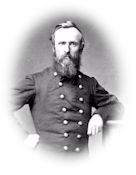
Sunday, [June] 5. — From three miles west of Millboro to one mile beyond Goshen; about thirteen to fourteen miles. Rained last night. Our march today impeded by a small body of Rebel cavalry. Rumors of Jackson, McCausland, and General Morgan, all hurrying to Staunton to oppose Hunter or our command. Perhaps both in detail. Bad strategy to propose to unite two forces in the enemy’s lines. Struck the Virginia Central one hundred and seventy-five [miles] from Richmond near Goshen. Our route through narrow valleys or canons where a small force can easily hold a large one.
Now (3 P. M.) we are waiting as rear brigade, on a pretty stream, for the leading brigade, Colonel White’s, to drive a party of Rebels through a narrow gap on railroad from Millboro to Goshen. They turn the position and we go on. We lose two or three slightly wounded and capture four or five Rebels and wound three others badly. Goshen a pretty place in the mountains. We cross no high mountain today.
by John Beauchamp Jones
JUNE 5TH.—Raining.
The sudden booming of artillery, shelling our department boys, intrenching at Bottom’s Bridge, was heard until bedtime. I have heard no results of yesterday’s operations.
All is quiet to-day, up to 9 A.M.
Received a letter from Custis. I have not heard whether he received the food and blanket sent him yesterday; the latter, he says, was wanted badly the night before. He charges Fanny, as usual, to be regular in feeding and watering Polly, his parrot; and never to leave the door of his cage open, for fear he may fly away.
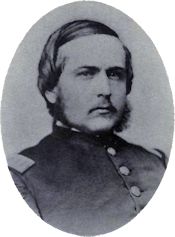
Saturday, June 4th.
Morning found us still at work on’ the redoubt, and after finishing that and assisting in building other earthworks rendered necessary because the enemy’s sharp- shooters prevented our using that one by picking off our cannoneers, I went to turn over to Lieut. Hamlink, our Battalion Adjutant, the shovels, axes and pick-axes with which we had been at work. The sharpshooters were very troublesome at that point also, and their missiles were constantly singing about our ears. Hamlink, rather ostentatiously as I thought, sat down upon a stump to count the tools while I stood just inside the end of a breast-work, and on my cautioning him that he was unnecessarily exposing himself, he replied, a little contemptuously, “Oh! the bullet isn’t run that is to hit me.” Scarcely were the words out of his mouth when a ball furrowed his cheek and barked his shoulder, thus contradicting his assertion, and he hurriedly left me to turn over my tools to somebody else. Shortly after this incident two men just to my left, who were incautiously looking over the breastworks, were shot in the face. One was killed instantly, and though the other received the ball between the eyes, it traversed his skull over the top of his head and beneath his scalp, and made its exit at the back of his neck, stunning him at first but not seriously interfering with his going to hospital without assistance five minutes afterwards.
About 1 P. M. my company returned to its gopher-hole camp and was permitted to remain there for the rest of the day making up for lost sleep.
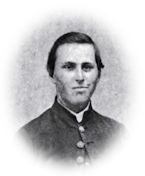
June 4th. Saturday morning. Up early and on the march, going on through the town. About ten miles up the pike is Mount Crawford, at which point the Shenandoah River crosses the pike. The enemy have the mount strongly fortified, a commanding position. About three miles out of Harrisonburg we file to the left over a dirt road. The intention seems to be to flank the mount. We are now making for Port Republic, near which we were obliged to cross the Shenandoah River. Owing to the recent heavy rains it was very high, running swift. A canvas pontoon bridge was made by drawing canvas over boat frames which had been made and brought along. The boats were made and placed in the river, when the bridge was completed like any pontoon bridge, except the canvas boats. (The first and only ones I ever saw, and was the only time I ever saw that one used.) It was a frail thing for an army to cross on. General Hunter sat on his horse very close to the frail bridge, anxiously watching us cross, and shouting, “Men, break step.” That would divide the weight while we were on the bridge. That seemed to be a duty that the General would not trust to any one else. (I well remember that scene.) As far as I know the army all passed over in safety. The cavalry crossed at some other point. A young cavalryman attempted to swim his horse across the river near the bridge, slipped or fell from his horse and was drowned. Many boys jumped in and dove for him. The high, swift running, dirty water was too much for them. The Shenandoah River was his grave, as it was the grave of many other Union soldiers. Some were members of our regiment, the 18th Connecticut. The enemy was driven out of Port Republic, losing a large wagon train filled with supplies, captured by our cavalry. The supplies were distributed to us. A number of packages of coffee came to our company, which gave to us a great surprise as they were put up in our home town by Selden & Willard, Norwich, Conn. Here we were, one hundred miles from our base of supplies, in the enemy’s country. It has often been reported that there are people in the North getting rich by running supplies through the blockade. These people are anxious to prolong the war when they should remember that every battle kills a soldier, and by the help they give to the foes. These soldier boys have dear friends at home. Passed on through Port Republic, camping near the town. Hunter forced the enemy to leave Mount Crawford and change front. Judging from what we can learn the enemy is in strong force in our front. Night sets in dark and raining.
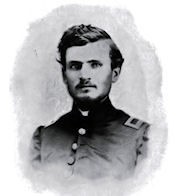
4th. Soon after daybreak Regt. moved up. Packs ordered up and breakfast got near the church. Regt. dismounted and put into the breastworks. Rebel cavalry charged and drove our boys from the first line of works, by flanking them. Soon column came up and rebs ran back. Had one killed and two or three wounded in their scrape. Tom came up in the evening, going back to the company, would like to go myself. About sundown the firing on Burnside’s right was the most terrific I ever heard and continued for nearly half an hour. It must have been an assault. Am anxious to hear the result. Gen. Torbert’s division of cavalry arrived. Regt. nearly all on duty.
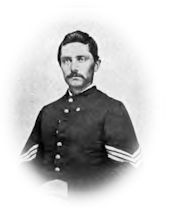
Saturday, 4th—We started at 8 o’clock and marched fifteen miles today. Have had rain for three days now, but late in the afternoon it cleared off. We had to wade a river, the water being only three or four feet deep, and the boys had great fun in trying to carry the powder on their heads to keep it dry. We were soaking wet from the rain so we did not mind wading the river. But the muddy roads make marching very hard, especially since we are kept on two-thirds rations when we might just as well have more. Large foraging parties were again sent out, but there isn’t anything in the country to be had, although we traversed a level country between two mountains the whole day.


