Following the American Civil War Sesquicentennial with day by day writings of the time, currently 1863.

July 2014

Near Stone Mountain, July 18, 1864.

Osterhaus (or his division, for I hear that he resigned and yesterday started for the North, en route for Mexico, where he formerly resided, and that he intends entering the Mexican Army to fight “Johnny Crapeau”) was ahead to-day, and only lost a dozen or 50 men. Our brigade has been train guard, and we did not get into camp until 11 p.m. This night marching hurts us more than the hottest day marching. We camp to-night near Stone Mountain, and the depot of the same name 16 miles from Atlanta. It is evident to me that the Army of the Tennessee is doing the “flanking them out” this time. The 1st Division cut the railroad effectually. A train came from the East while they were at it, but discovering the smoke, reversed the engine and escaped. The 17th Corps I hear is close behind us protecting the commissary trains and forming our rear guard.

by John Beauchamp Jones

            JULY 18TH.—Clear and dry.

            It is believed that a battery sent down opposite to Harrison’s Bar in theJames River sank two of the enemy’s transports, Saturday, and drove back five others to Grant.

            It is rumored that Gen. Johnston has been relieved atAtlanta, and Lieut.-Gen. Hood placed in command. I doubt.

            It is said Mr. Trenholm, firm of Fraser, Trenholm d Co., bankers,Charleston, has been appointed Secretary of the Treasury. Mr. Seddon holds on to the office he occupies.

            A letter from Gen. Lee (“Headquarters Army Northern Virginia”) says Gen. Early has recrossed thePotomac, and is at Leesburg, safe, —I hope with his captured supplies.

            The following is a synopsis of Gen. Kirby Smith’s brilliant campaign of 1864; official report. Enemy’s losses.

            InLouisiana, 5000 killed and wounded, 4000 prisoners, 21 pieces artillery, 200 wagons, 1 gun-boat, 3 transports.

            InArkansas, 1400 killed, 2000 wounded, 1500 prisoners, 13 pieces of artillery, 900 wagons,

            Confederate losses, 3000 killed, wounded, and missing.

            Enemy’s losses, 14,000.

            Confederate strength, 15,000.

            Enemy’s strength, 47,000.

            InGeorgia, 35,000. InArkansas, 12,000.

Etowah Bridge, Monday, July 18. All well. Morning passed off in usual way. Grazing, etc. Great scarcity of news. For variety we went out on blackberry hunt in the afternoon with Corporal Evans. Went five miles, picked dishes full. Visited the ruins of rolling mills, called on several secesh women, returned by sundown, had a gay time and good supper.

Monday, 18th—The weather is quite pleasant. There is nothing of any importance. All is quiet.

Sunday, July 17. — Rode over to see General Barlow and General Hayes. Also saw John Perry. In the evening Tom Sherwin, Frank Weld, Captain Phillips and Captain Davis came over to see me. About nine o’clock we were moved to the second line, as it was reported that the enemy were massing in our front, and were going to attack us in the morning. No attack was made, however.

17th. Spent the day very quietly in camp, over Independents and other papers. Wrote home and to Lucy Randall Campbell.

Sunday, July 17.—I went down to the train to see Miss W. off. After she left we were informed that there was a raid near West Point, and that Miss W. will reach there in time to meet it. It is useless to think of going any place and getting rid of the enemy, as they seem to have it in their power to overrun the whole country.

Miss W. and I have agreed that, if either should lose our clothes, the one spared would share with the other. The enemy have a particular liking for ladies’ wardrobes. I presume they send them to their lady-loves in the North. I wonder how they feel in their stolen finery!

I do not suppose that the men would rob us as they do if they were not incited by the importunities of their women. Many letters, taken from dead Federals on the battle-fields, contain petitions from the women to send them valuables from the South. One says she wants a silk dress; another, a watch; and one writer told her husband that now was the time to get a piano, as they could not afford to buy one. “O shame, where is thy blush!” What a commentary on the society of “the best government the world ever saw!” Would we had the pen of a Thackeray to delineate the angelic and supereminent virtues of this great people!

On my return I met a friend from Mobile, Dr. Henderson, the surgeon of a hospital in that place. He brought me a letter from home, which was gladly received. He has been visiting the army, and intends remaining here till the expected great battle comes off. He is an Englishman, and came out from England last fall. On his arrival he received a commission in our army.

This afternoon we went to a funeral in the Methodist Church. Dr. Adams officiated, as the deceased was an Episcopalian— young Colston of Louisville. He was the color-bearer of a Kentucky regiment, and a gallant soldier. He was buried with the full honors of war. The day was very lovely. We walked round that sacred spot, the soldiers’ graveyard, and I saw many a familiar name on the head-boards of the graves—the occupants now calmly sleeping, heedless of the cannon’s roar, and the peal of musketry:


“The boast of heraldry, the pomp of power,

And all the beauty, all that wealth o’er gave,

Await alike the inevitable hour,—

The paths of glory lead but to the grave.”


Though no towering monument is there to mark their last resting-place, it matters little, Nature shall adorn them with her choicest sweets:


“And oft upon the midnight air

Shall viewless harps be murmuring there.”
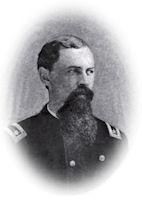
July 17th. Sunday morning. Late last night we were ordered to march. Estimated we marched about five miles, when we came to a halt in a wooded field. Fine large trees. During the night we heard the rattling of the wheels of artillery and wagons, being driven very rapid, going south. This morning report reached us that it was the enemy’s guns and wagons. No doubt there is hard work before us. Don’t just know our present location except that we are somewhere in the Loudon Valley, Virginia. Orders for Sunday morning inspection. It won’t be a very clean one. After that duty was performed we rested and slept. Large stacks of grain were burned in this vicinity to prevent the enemy from getting. It made a hot fire and a great loss. It will no doubt cause much suffering among the people. Women and children in these parts must suffer by the war which is a cruel thing. I am sorry for them. As soon as they hear the reports of the guns, they take to the cellars for protection. Shot and shell go through many houses that are in range of the guns. I have seen many houses that were damaged by the field guns. This Sunday night finds us in the woods, cool and good air, while the sun was red hot, out in the open.

July 17 — We were relieved from picket this evening, and returned to our camp on the Nottoway.

June 17, 1864.

After erecting some good works at Roswell (the best we have yet built), capable of holding at least 25,000 men, we were provided with three days’ rations and cartridges “ad libitum,” for another of what an Augusta paper calls “Sherman leap-frog-like advance.” Our corps is the extreme left of the army. We moved out this morning, our brigade in advance of our division, and Osterhaus and Smith’s Divisions following on the Decatur road. Did I tell you in my last among the “locals,” that these Roswell factories have been turning out 35,000 yards per day of jeans, etc., for the Confederate Army, that there is the greatest abundance of blackberries and whortleberries here, that one of the 48th Illinois was drowned in the Chattahoochie while bathing, and that of several hundred factory girls I have seen, hardly one who is passably handsome? Some fine fat ones, and a few neat feet, but they are not “clipper built,” and lack “get up” and “figure heads.”

We moved six miles without meeting a Rebel, and then only a squadron of cavalry that lacked a devilish sight of being “chivalry,” for they more than ran without just cause. We only went two miles farther and then bivouacked. Our brigade was thrown half a mile in front and across the road. We put up a rail barricade across the road and a temporary rail-work along our front, and then abandoned ourselves to the longings of our breadbaskets, and desisted not until every man was in himself a miniature blackberry patch. The boys brought me pint after pint of great black fellows they had picked in the shade of dense woods or on a steep bank, and I assure you they disappeared without an exception. This road, the last 10 days, has been filled with refugee citizens running from the Yankees. An old gentleman in whose yard the reserve pickets have stacked their arms, told me that all the men of his acquaintance over 45 years old are, and always have been, Unionists, and are to-day ready and willing to give up slavery for our cause. I have been a deluded believer in the hoax of fine “Georgia plantations,” but I assure you I am now thoroughly convalescent. I haven’t seen five farm houses equal to Mrs. James—, and only one that showed evidences of taste. That was where I saw the Rebel General Iverson dead among the flowers. The country is all hilly, and the soil, where there is any, is only fit for turnips. The timber is all scrub oak and pine, and some more viney bushes peculiar to the climate.

I notice some of the white moss hanging from the trees, like that there was so much of at Black river. The 16th Corps is on our right moving on a parallel road, and the 23d joins them. I don’t know whether our other corps have crossed yet or not.