
Monday, July 11. — Court finished case of Lieutenant Knickerbocker, and then adjourned till Wednesday. Rode over to General Griffin’s headquarters, and then to General Meade’s. Dined with Bache, and saw General Meade and had a pleasant chat with him. Rained on the way home, the first we have had for a long time. Had a very pleasant time. The regiment moved to the second line.
July 2014
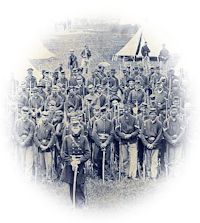
City Point, July 11th, 1864.
Two days have passed since I made the last entry in this journal, an unusual occurrence of late. The reason is, I have changed my employment, and my time has been occupied in learning the details of my new business. I am now with the Christian Commission. All the sick and wounded, except forty convalescents, have been removed from my ward.
I accompanied the last detachment to Alexandria. There are now here about one hundred delegates to the Christian Commission. Mr. Collier has been cooking for them since the hospital was established at this place. In his department all went smoothly, he being a good cook and a man of energy. Not so in the dining room. There, three wild young soldiers and two “colored people” rioted uncontrolled. The table was never set in time, and seldom washed. Spreads are not in use. Dishes, knives and forks are not properly cleaned; in fact, disorder reigns. A head was wanted; Mr. Collier naturally thought of his old tent mate and friend; he recommended me to the agent as “reliable;” agent desired an interview; it was granted; he looked me over, talked with me, “sized me up,” and here I am, running an eating house, with full powers to have my own way in everything. What will my little wife think—for I can call her little in comparison, as I weigh 190 pounds—at this strange business for such as me? I can only judge of my success by what I hear, for I have had no previous experience. Delegates mark the change with evident pleasure. The agent, an aristocratic member from New York City, compliments me on the change I have wrought. Today he expressed himself as “very pleased” with my arrangements.
“Act well your part,” is my adopted motto. I have already formed some agreeable acquaintances with delegates—have often been mistaken for one, myself. I am not ashamed to correct the mistake and acknowledge myself a private soldier. In a sense I am one of them, for I have worked in the same cause, the last two years, with all the strength that God has given me, and done a soldier’s duty, too.
July 11th. Called up early this morning. Orders to march. Left Back Creek. After a slow march of about seven miles we came to Martinsburg. We call this our home town, having served in this section of the Shenandoah Valley for two years. Marched through the town, meeting a few old friends. Camped on the south side, near the Winchester Pike. The enemy left town early this morning. Our knapsacks, with extra clothing, left here when we began our march up the valley in May, were taken by the rebs, so we lost our clothing that we expected to find here on our return. On picket. Strict orders for tonight, as the enemy is reported a short distance south. Keep a sharp lookout.

July 11th. Layed in the same place over night and next day. Moved at 12 midnight to the left, encamped in a field. [18th birthday.]

by John Beauchamp Jones
JULY 11TH.—Hot and dry, and the famine continues.
The Secretary of War intimated on Saturday that if the clerks of the bureaus would raise a fund and send an agent South to buy provisions, he would insure them transportation, etc. To-day he denies that he made the promise, and refuses to aid them.
The government now proposes to increase its schedule of prices from 300 to 500 per cent., thus depreciating its own credit. Before harvest the impressing agents allowed about $40 per barrel for flour; now, that we have a good harvest, about $130 will be paid, thus raising the price everywhere. The transportation is the expensive item.
A dispatch from Gen. Johnston, atAtlanta, says the enemy having flanked him with his cavalry, he has fallen back across theChattahoochee.
Dispatches from Gen. S. D. Lee, Tupelo, state that a column of the enemy, 20,000 strong, is about marching from New Orleans against Mobile, and he fears he cannot spare men to resist them. The reserve class is not ready. Also that 15,000 of the enemy are marching from Lagrange, and he will have to dismount some of Forrest’s cavalry. Gen. E. K. Smith will not cross theMississippi to assist in repelling the foe without orders. Orders have been sent from the Secretary of War—I fear too late!
Northern papers of the 8th inst. indicate a state of high excitement. Some there believe we have an army of 60,000 pouring intoPennsylvania. Gold was $2.65 for one.
There is some commotion in Grant’s army, and it is believed by some that he is about to retire down the river.
It is rumored that the prisoners heretofore confined at Point Lookout have been removed by the Federal Government.
At 7 P.M. we had a gentle shower, lasting more than an hour.
Kingston, Monday, July 11. Evie took my team out to graze. Spencer and I built, lower in park, shebang with table, etc. Boys hard at work putting up houses, sheds. 4 P. M. on detail hauling brush for sheds. Orders received to march 3 A. M. in the morning. All work on quarters ceased in an instant, our dreams of cool shade and easy time gone in a moment. Hurriedly washed dirty shirt in the stream, and prepared for the moving. Received a letter this evening. Health good. Expect to go to the front.
Colonel Lyon’s Letters.
Claysville, Ala., July 11, 1864.—Yesterday I was in the saddle all day visiting my command on the river.
I rode about 16 miles on Saturday; the day before, eight miles. Tomorrow I start on a trip to visit Companies F and D, down the river, and shall be absent about three days. I take a company of home scouts I am organizing here, as an escort, although there is no enemy on our route that we know of. Still, in this country we always go prepared for emergencies.
You ask me if I am not in a great deal of danger here. I don’t know. If only a moderate sized force of the enemy attacks us, no; if a large force, yes. We are building strong fortifications on the river, and expect to have three or four gunboats patrolling it in a few weeks; and if Sherman is successful in defeating Johnson, I do not think that we shall have any trouble. I have a good deal of business here with citizens. As there is no civil law or courts, I am judge, jury, arbitrator, and guardian for the whole country. An old woman is talking to me now, boring me to death with a long story about another old woman, her neighbor, who, she thinks is a rebel and a very dangerous character. I write this, with her talking persistently. I say ‘yes,’ and ‘really,’ occasionally, and that satisfies her. The most of the people here are well disposed, and many of them, particularly the poor class, are truly loyal. The old lady has finished her story, and so have I.
Monday, 11th—A train load of the sick and wounded left today over the railroad for Rome, Georgia, where they are to go into the hospital. I stayed here at Marietta all day.[1] The general quartermaster has his headquarters here now since the railroad is in running order to this point. The supplies for the army are being taken from here by wagon trains and distributed along the lines as needed. A great many citizens are coming into Marietta for the purpose of going North to get away from the war region.
[1] Mr. Downing thought that his fever was broken and that he might Boon rejoin his company, yet he feared that he would have to go to Rome. There was some danger in going to Rome, because of a possible attack, and then he dreaded the thought of being confined in the general hospital.—Ed.
10th. Took the inspected horses to Quartermaster Stone and turned them in—79 to be receipted for by Lt. Spangler. Had a good bath. Read several articles in the Atlantic. My eyes are occasioning me considerable trouble. Have thought of home a good deal today. Many of the officers are thinking of going home when their three years’ term expires. Of course it would be pleasant to go home as soon as possible, but many officers promised their men that they would remain with them. I don’t know what I shall do. I could not go to Oberlin to stay and I have no desire to go elsewhere and I think for the present every man able should bear arms.
Sunday, July 10 — Jones took breakfast [with me], and then we started with Captain Sealy for Point of Rocks. We rode by General Smith’s headquarters, and reached the Appomattox. The country we passed through was very fertile indeed. We could see Petersburg and the batteries on both sides of the Appomattox. Crossed the Appomattox at Point of Rocks on a pontoon bridge, and went to the Tenth Corps headquarters, where we met Captain Hutchings. With him we went to Jones’s Landing on the James River, where we found Quartermaster Thompson. Had a pleasant time here, and then went out on a tug to the gunboat Mackinaw, which was anchored off Aiken’s Landing. We met Captain Beaumont here, and dined with him, and then rowed across to Aiken’s Point. This was the place where I was exchanged two years ago. After remaining here a little while, we went back to Thompson’s, and from there rode home. Day very warm. Roads very dusty. Regiment moved to the rear.


