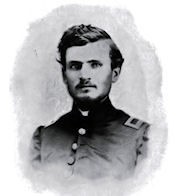
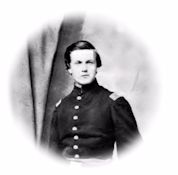
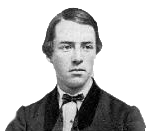
Charles Francis Adams, Jr., to his father
H.Q. Cav’y Escort, A. of P.
Before Petersburg, August 5, 1864
Physically, since I last wrote, I’m glad to say I have picked up amazingly. I have at last shaken off my jaundice and have recovered a white man’s looks, my appetite is amazing and I am building up. In fact I have weathered my danger and do not look for any further trouble. Ward Frothingham too has been sent home. His regiment was smashed all to pieces in the assault the other day. The Colonel, Gould, had a thigh shattered, the Lieutenant Colonel killed, and so on. As for Ward, it was the hardest kind of work helping him, for he could n’t help himself. Finally however he was sent down to City Point and there gave Dalton my note, and Dalton had him shipped to New York before he could make up his mind as to whether he wanted to go there or not. So he’s safe and at home.
Here since I last wrote, too, Burnside has exploded his mine and we have again just failed to take Petersburg. The papers, I see, are full of that mishap and every one is blaming every one, just as though it did any good to cry and quarrel over spilled milk. I did not see the mine exploded, though most of my officers did and they describe it as a most beautiful and striking spectacle — an immense column of debris, mixed with smoke and flame, shooting up in the form of a wheat sheaf some hundred and fifty feet, and then instantly followed by the roar of artillery. At first, and until ten o’clock, rumors came in very favorably — we had carried this and that and were advancing. At about ten I rode out to see what was going on. The fight then was pretty much over. I rode up to the parallels and dismounted and went towards the front. The heat was intense and they were bringing in the wounded, mostly blacks, in great numbers. Very little firing was going on, though occasionally shot went zipping by. Very speedily I began to be suspicious of our success. Our soldiers did n’t look or act to my mind like men who had won a victory. There was none of that elation and excitement among the wounded, none of that communicative spirit among the uninjured which always marks a success. I was very soon satisfied of this and so, after walking myself into a tremendous heat and seeing nothing but a train of wounded men, I concluded that I did n’t like the sound of bullets and so came home.
My suspicions proved correct. As you know we had been repulsed. How was it? In the papers you’ll see all kinds of stories and all descriptions of reasons, but here all seem to have settled down to certain results on which all agree, and certain others on which all quarrel. It is agreed that the thing was a perfect success, except that it did not succeed; and the only reason it did not succeed was that our troops behaved shamefully. They advanced to the crater made by the explosion and rushed into it for cover and nothing could get them out of it. These points being agreed on then begins the bickering. All who dislike black troops shoulder the blame onto them — not that I can find with any show of cause. They seem to have behaved just as well and as badly as the rest and to have suffered more severely. This Division, too, never had really been under fire before, and it was a rough breaking in for green troops of any color. The 9th Corps and Burnside came in for a good share of hard sayings, and, in fact, all round is heard moaning and wrath, and a scape-goat is wanted.
Meanwhile, as I see it, one person alone has any right to complain and that person is Grant. I should think his heart would break. He had out-generaled Lee so, he so thoroughly deserved success, and then to fail because his soldiers would n’t fight! It was too bad. All the movements I mentioned in my last turned out to be mere feints and as such completely successful. Deceived by Grant’s movement towards Malvern Hill, Lee had massed all his troops in that vicinity, so that when the mine exploded, the rebels had but three Divisions in front of the whole Army of the Potomac. Grant ordered a rapid countermarch of his cavalry from Malvern Hill to the extreme left, to outflank and attack the enemy at daylight, simultaneously with the assault in front. The cavalry did not reach here until the assault had failed. The march was difficult, but it was possible and it was not accomplished. Whose fault was this? Then came the assault, which was no assault, and once more Lee, completely outgeneraled, surprised and nearly lost, was saved by the bad behavior of our troops as in June, and on the same ground and under the same circumstances, he was almost miraculously saved by the stubborn bravery of his own. I find but one satisfaction in the whole thing. Here now, as before in June, whether he got it or no, Grant deserved success, and, where this is the case, in spite of fortune, he must ultimately win it. Twice Lee has been saved in spite of himself. Let him look to it, for men are not always lucky.
If you are curious to know where I myself place the blame, I must freely say on Burnside, and add, that in my own opinion I don’t know anything about it. For the whole thing, Burnside’s motions and activities deserve great credit. While others were lying idle, he was actively stirring round to see what he could do. The mine was his idea and his work, and he carried it through; no one but himself had any faith in it. So far all was to his credit. Then came the assault. Grant did his part of the work and deceived Lee. Burnside organized his storming column and, apparently, he could n’t have organized it worse. They say the leading brigade was chosen by lot. If so, what greater blunder could have been committed? At any rate a white brigade was put in to lead which could not have been depended on to follow. This being so, the result was what might have been expected. In such a case everything depended on the storming party; for, if they would lead, the column would follow. Volunteers might have been called for, a picked regiment might have been designated; but, no, Burnside sent in a motley crowd of white and black, heavy artillery and dismounted cavalry, and they would n’t come up to the scratch. So endeth the second lesson before Petersburg.
As to the future, expect no light from me. I do not expect that anything will be done here for six weeks to come. Grant must hold his own, defend Washington and see what Sherman can accomplish, before he really attempts anything heavy here. The news from Sherman is so good, and Hood seems so completely to be playing our game that I think the rebel strength in that region bids fair to be used up. Lee can hold us in check, but, unless we blunder egregiously, he cannot replenish his ranks, and by autumn Grant can resume operations with deadly effect from this base. This I fear is the best view which can be taken of the present attitude of affairs. We have been so unfortunate here and our military lights about Washington — Hunter, Wallace, Halleck, Sigel and the rest — have made such a mess of our affairs in their region, that I don’t see but what the army here must, for the present, be reduced to one purely of observation. . . .
As to my new regiment, I see myself gazetted but have as yet received no commission or official announcement. Meanwhile I am maturing my plans for the regiment and shall develop them in a somewhat stately paper distinguished by unusual ability even for me and addressed to Governor Andrew, the which I shall tackle as soon as I have disposed of you. For the rest, I wait here and kill time. There is nothing more for me to do here. This squadron is as contented, as well disciplined and in as good order as I know how to put it, and accordingly I must move or stand still. . . .