Following the American Civil War Sesquicentennial with day by day writings of the time, currently 1863.

A Rebel War Clerk’s Diary at the Confederate States Capital, By John Beauchamp Jones

by John Beauchamp Jones

MAY 19TH.—A dispatch from Gen. Johnston says a battle has been fought between Pemberton and Grant, between Jackson and Vicksburg, Mississippi, which lasted nine hours. Pemberton was forced back. This is all we know yet.

Another letter, from Hon. W. Porcher Miles, remonstrating against the withdrawal of Beauregard’s troops, was received to-day. He apprehends the worst consequences.

The government is buying 5000 bales of cotton for the Crenshaw scheme. Jas. R. Crenshaw, of this city, is at Charleston on this business. Why not arrange with Lamar?

Gov. Shorter forwards another strongly written memorial from Mobile, against the traffic of cotton with the enemy, and, indeed, against all blockade-running.

Gov. Jno. Milton, of Florida, also writes a powerful denunciation of the illicit traffic, which it seems the policy of the government has been to encourage. They all say this traffic is doing the work of subjugation more effectually than the arms of the enemy.

The President is too ill again to come to the Executive Office. His messenger, who brought me some papers this morning, says he is in a “decline.” I think he has been ill every day for several years, but this has been his most serious attack. No doubt he is also worried at the dark aspects in his own State—Mississippi.

If Vicksburg falls, and the Valley be held by the enemy, then the Confederacy will be curtailed of half its dimensions. Texas, Louisiana, Mississippi, Arkansas, Missouri, Arizona, New Mexico, all the Indian country, Kentucky, half of Tennessee, one-third of Virginia, Eastern North Carolina, and sundry islands, etc. of South Carolina, Georgia, and Florida, will be wrested from us. What will remain of the Confederacy? Two-thirds of Virginia, half of Tennessee, the greater part of North Carolina, South Carolina, Georgia, and the whole of Alabama,—less than six States! But still the war will go on, as long as we have brave armies and great generals, whether the President lives or dies.
by John Beauchamp Jones

MAY 17TH.—The last few days have been cool and dry; fine weather for campaigning. And yet we hear of no demonstrations apparently, though I believe Lee’s army is moving.

Mr. Lamar, of Savannah (formerly president of the Bank of the Republic, New York), writes that he and others are organizing an Exporting and Importing Company, and desires the government to take an interest in it. So far the heads of bureaus decline, and of course the Secretary will do nothing. But the Secretary has already engaged with Mr. Crenshaw in a similar enterprise, and so informed Mr. Mason, at London.

About 10 A.M., some 2500 men of all arms arrived at “double quick,” having left Ashland, eighteen miles distant, at 5 o’clock this morning. That was brisk marching. The guns were sent down on the railroad. The government has information that Gen. Keyes, with a full division of infantry and a brigade of cavalry, had marched up to West Point, to threaten Richmond. The troops, however, which arrived from Ashland, had been taken from the batteries here, and did not belong to Gen. Lee’s army.

Messrs. Davenport & Co., Mobile, charge Gen. Buckner with permitting 1000 bales of cotton to be shipped to New Orleans.

The president of the Fredericksburg Road states, in a letter to the Secretary, that, after the battle, by military authority, the cars were appropriated by the Federal officers (prisoners), while our wounded soldiers had to remain and await the return of the trains.

Hon. Mr. Dargin, of Alabama, writes to the Secretary, to procure from the President a disavowal of the “organship” of the Enquirer, as that paper, under the belief that it speaks for the government, is likely to inflict much mischief on the country. He alluded to the bitter articles against the Democrats and peace men of the North, who would soon have been able to embarrass, if not to check the operations of the Republican war party. He says now, that they will write against us, and deal destruction wherever they penetrate the land.

by John Beauchamp Jones

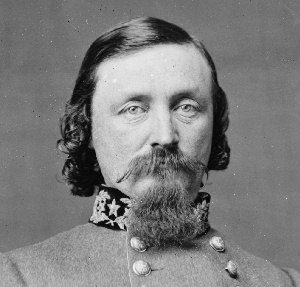
Gen. George E. Pickett, C.S.A.MAY 16TH.—It appears, after the consultation of the generals and the President yesterday, it was resolved not to send Pickett’s division to Mississippi, and this morning early the long column march through the city northward. Gen. Lee is now stronger than he was before the battle. Gen. Pickett himself, with his long, black ringlets, accompanied his division, his troops looking like fighting veterans, as they are. And two fine regiments of cavalry, the 2d and 59th North Carolina Regiments, passed through the city this morning likewise.

A letter was received from Gen. Beauregard to-day, again protesting against the movement of so many of his troops to Mississippi; 5000 on the 5th, and more than 5000 on the 10th instant. He makes an exhibit of the forces remaining in South Carolina and Georgia—about 4000 infantry, 5000 cavalry, and 6000 artillery, some 15,000 in all. He says the enemy is still on the coast, in the rivers, and on the islands, and may easily cut his communications with Savannah; and they have sufficient numbers to take Charleston, in all probability, without passing the forts. He says information of his weakness is sure to be communicated to the enemy—and I think so too, judging from the number of passports “allowed” by Judge Campbell and Mr. Benjamin!

There is some purpose on the part of Gen. Lee to have a raid in the enemy’s country, surpassing all other raids. If he can organize two columns of cavalry, 5000 each, to move in parallel lines, they may penetrate to the Hudson River; and then the North will discover that it has more to lose by such expeditions than the South. Philadelphia, even, may be taken.

To-day, the regular train on the Fredericksburg road came back to the city, the conductor being in a terrible fright, and reporting that the enemy were again at Ashland. But it turned out that the troops there were our men! It is not probable the enemy’s cavalry will soon approach Richmond again.

(Note: Photo of Gen. George E. Pickett, C.S.A., is from Library of Congress, Prints and Photographs Division)

by John Beauchamp Jones

MAY 15TH.—The Tredegar Iron Works and Crenshou’s woolen factory were mostly destroyed by fire last night! This is a calamity.

We have also intelligence of the occupation of Jackson, Miss., by the enemy. Thus they cut off communication with Vicksburg, and that city may be doomed to fall at last. The President is at work again at the Executive Office, but is not fully himself yet.

The Secretary of War dispatched Gen. Lee a day or two ago, desiring that a portion of his army, Pickett’s division, might be sent to Mississippi. Gen. Lee responds that it is a dangerous and doubtful expedient; it is a question between Virginia and Mississippi; he will send the division off without delay, if still deemed necessary. The President, in sending this response to the Secretary, says it is just such an answer as he expected from Lee, and he approves it. Virginia will not be abandoned.

Gens. Lee, Stuart, and French were all at the War Department to-day. Lee looked thinner, and a little pale. Subsequently he and the Secretary of War were long closeted with the President.

Gen. Schenck (Federal) has notified Gen. W. E. Jones, that our men taken dressed in Federal uniform will not be treated as prisoners of war, but will be tried and punished as spies, etc. The President directed the Secretary of War to-day to require Gen. Lee to send an order to the commander of the Federal army, that accouterments and clothing will be deemed subjects of capture, and if our men are treated differently than prisoners of war, when taken, we will retaliate on the prisoners in our possession. [click to continue…]

by John Beauchamp Jones

MAY 14TH.—We have been beaten in an engagement near Jackson, Miss., 4000 retiring before 10,000. This is a dark cloud over the hopes of patriots, for Vicksburg is seriously endangered. Its fall would be the worst blow we have yet received.

Papers from New York and Philadelphia assert most positively, and with circumstantiality, that Hooker recrossed the Rappahannock since the battle, and is driving Lee toward Richmond, with which his communications have been interrupted. But this is not all: they say Gen. Keyes marched a column up the Peninsula, and took Richmond itself, over the Capitol of which the Union flag is now flying.” These groundless statements will go out to Europe, and may possibly delay our recognition. If so, what may be the consequences when the falsehood is exposed? I doubt the policy of any species of dishonesty.

Gov. Shorter, of Alabama, demands the officers of Forrest’s captives for State trial, as they incited the slaves to insurrection.

Mr. S. D. Allen writes from Alexandria, La., that the people despair of defending the MississippiValley with such men as Pemberton and other hybrid Yankees in command. He denounces the action also of quartermasters and commissaries in the Southwest.

A letter from Hon. W. Porcher Miles to the Secretary of War gives an extract from a communication written him by Gen. Beauregard, to the effect that Charleston must at last fall into the hands of the enemy, if an order which has been sent there, for nearly all his troops to proceed to Vicksburg, be not revoked. There are to be left for the defense of Charleston only 100 exclusive of the garrisons!

by John Beauchamp Jones

MAY 13TH.—Col. Gorgas, Chief of the Bureau of Ordnance, sent in to-day a report of the arms captured in the recent battle. It appears from his statement that, so far, only eight guns have been found, taken from the enemy, while we lost ten. Thus, it would appear, our papers have been “lying,” in regard to that item, as well as the Northern papers about the number of prisoners lost and taken. But, so far, we have collected 12,000 of the enemy’s small arms left upon the field, and 8000 of our own, indicating the number of our killed and wounded. But the New York journals say we captured only 1700 prisoners; whereas, up to this time, more than 6000 have arrived in Richmond; 5000 of whom leave to-day, paroled until exchanged. I doubt whether we lost 2000 prisoners in the battle.

The Philadelphia Press, just received, charges the government at Washington with circulating false reports, and is now convinced Hooker met with a most crushing defeat.

It is rumored the enemy are disembarking troops at the White House, York River. If this be so, it is to prevent reinforcements being sent to Lee.

The Governor of Alabama declares that Mobile is neglected, and says he will continue to protest against the failure of the government to make adequate preparations for the defense of the city.

I saw Gen. Wise to-day. He seems weather-beaten, but hardy.

by John Beauchamp Jones

MAY 12TH.—The departments and all places of business are still closed in honor of Gen. Jackson, whose funeral will take place to-day. The remains will be placed in state at the Capitol, where the people will be permitted to see him. The grief is universal, and the victory involving such a loss is regarded as a calamity.

The day is bright and excessively hot; and so was yesterday.

Many letters are coming in from the counties in which the enemy’s cavalry replenished their horses. It appears that the government has sent out agents to collect the worn-down horses left by the enemy; and this is bitterly objected to by the farmers. It is the corn-planting season, and without horses, they say, they can raise no crops. Some of these writers are almost menacing in their remarks, and intimate that they are about as harshly used, in this war, by one side as the other.

To-day I observed the clerks coming out of the departments with chagrin and mortification. Seventy-five per cent. of them ought to be in the army, for they are young able-bodied men. This applies also to the chiefs of bureaus.

The funeral was very solemn and imposing, because the mourning was sincere and heartfelt. There was no vain ostentation. The pall bearers were generals. The President followed near the hearse in a carriage, looking thin and frail in health. The heads of departments, two and two, followed on foot—Benjamin and Seddon first—at the head of the column of young clerks (who ought to be in the field), the State authorities, municipal authorities, and thousands of soldiers and citizens. The war-horse was led by the general’s servant, and flags and black feathers abounded.

Arrived at the Capitol, the whole multitude passed the bier, and gazed upon the hero’s face, seen through a glass in the coffin.

Just previous to the melancholy ceremony, a very large body of prisoners (I think 3500) arrived, and were marched through Main Street, to the grated buildings allotted them. But these attracted slight attention,—Jackson, the great hero, was the absorbing thought. Yet there are other Jacksons in the army, who will win victories,—no one doubts it.

The following is Gen. Lee’s order to the army after the intelli­gence of Gen. Jackson’s death : [click to continue…]

by John Beauchamp Jones

MAY 11TH.—Lieut.-Gen. J. T. Jackson died at 3 P.M. yesterday. His remains will arrive in the city at 5 P.M. this afternoon. The flags are at half-mast, and all the government offices and even places of business are closed. A multitude of people, mostly women and children, are standing silently in the streets, awaiting the arrival of the hero, destined never again to defend their homes and honor.

A letter from Gen. Lee says, emphatically, that if cavalry be not brought from North Carolina and the South, the enemy’s cavalry will be enabled to make raids almost anywhere without molestation. I recollect distinctly how he urged the Secretary of War (Randolph), months ago, to send to Texas for horses, but it was not attended to—and now we see the consequences.

The exchanged prisoners here, taken at Arkansas Post, are ordered to the Mississippi. Gen. Longstreet urged the Secretary to send them off, if that were their destination, without a moment’s delay, several days ago—else they would be too late to participate in the campaign.

Northern papers set down Hooker’s loss at 20,000, a modest figure, subject to revision.

The Federal Secretary of War has issued a statement to mollify the panic. He is bound to acknowledge that, whereas Hooker advanced upon Lee across the river, he is now, after the battle, back again, where he started from. But he says not more than a third of the army was engaged ; and as 30,000 reinforcements have been sent from Washington, and as many from Suffolk, the army will soon be as strong as ever, and in condition for another advance—and defeat.

But what credit can we attach to such statements, since McClellan, under oath, said that he had ninety odd thousand men at the battle of Sharpsburg, 75,000 of whom only were actually engaged, while Lee had 100,000? We know that he did [click to continue…]

by John Beauchamp Jones

MAY 10TH.—Detachments of Federal troops are now marching into the city every few hours, guarded by (mostly) South Carolinians, dressed in home-spun, died yellow with the bark of the butternut-tree. Yesterday evening, at 7 o’clock, a body of 2000 arrived, being marched in by way of the Brooke Pike, near to my residence. Only 200 Butternuts had them in charge, and a less number would have sufficed, for they were extremely weary. Some of them, however, attempted to be humorous.

A young officer asked one of the spectators if the “Libby” (the prison) was the best house in the city to put up at. He was answered that it was the best he would find.

Another passed some compliment on a mulatto wench, who replied: “Go long, you nasty Abolition Yankee.”

One of our soldiers taken at Arkansas Post, just exchanged, walked along with the column, and kept repeating these words: “Now you know how we felt when you marched us through your cities.”

But generally a deep silence was maintained, and neither insult nor indignity offered the fallen foe. Other columns are on the way—and how they are to be subsisted is a vexatious question.

The Washington papers of the day preceding the first battle contain Hooker’s address to his army—how different from Lee’s! It is short, though: [click to continue…]

by John Beauchamp Jones

MAY 9TH.—The papers contain the following order from Gen. Lee :

“HEADQUARTERS ARMY NORTHERN VIRGINIA,
“May 7th, 1863.

“GENERAL ORDERS No. 59.

“With heartfelt gratification, the General Commanding expresses to the army his sense of the heroic conduct displayed by officers and men, during the arduous operations in which they have just been engaged.

“Under trying vicissitudes of heat and storm, you attacked the enemy, strongly intrenched in the depths of a tangled wilderness, and again on the hills of Fredericksburg, fifteen miles distant, and by the valor that has triumphed on so many fields, forced him once more to seek safety beyond the Rappahannock. While this glorious victory entitles you to the praise and gratitude of the nation, we are especially called upon to return our grateful thanks to the only Giver of victory for the signal deliverance He has wrought.

“It is, therefore, earnestly recommended that the troops unite on Sunday next in ascribing to the Lord of hosts the glory due unto His name.

“Let us not forget in our rejoicing the brave soldiers who have fallen in defense of their country; and while we mourn their loss, let us resolve to emulate their noble example.

“The army and the country alike lament the absence for a time of one to whose bravery, energy, and skill they are so much indebted for success.

“The following letter from the President of the Confederate States is communicated to the army as an expression of his appreciation of its success: [click to continue…]