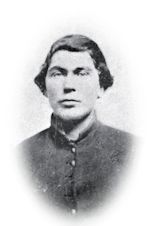
Corinth, Friday, Oct. 17. Resolutions relative to those who fell in battle on the 4th inst. were offered by H. S. Keene and unanimously adopted by the camp on roll call P. M.
An Artilleryman’s Diary–Jenkin Lloyd Jones, 6th Battery, Wisconsin Artillery.
Corinth, Thursday, Oct. 16. I joined my Platoon, went into tent with E. W. Evans and T. J. Hungerford as before. Owing to my weakness I was not put on full duty immediately, being excused from mounted drill, etc.
Corinth, Tuesday, Oct. 14. Having learned the locality of our Battery, it being encamped on the south side of the town, the wounded men were removed to the general hospital, and the sick were taken to the Battery, with the exception of N. B. Hood and Byron Babcock.
Corinth, Monday, Oct. 13. The troops on the outskirts of the town were all moved in, among which were the 6th Battery. They passed our encampment at about 8 A. M.; their designation was unknown but supposed not to be far. Quartermaster Sergeant Simpson brought new clothing to camp in the afternoon. I drew one jacket, pair of pants and a hat.
Corinth, Sunday, Oct. 12. To-day it was a little warmer, the rain of the last two days having cleared. My anxiety to visit the Battery was such that I was induced to start out on foot in order to see them. The walk was rather fatiguing as it was rather warm, but we found them at last on a ridge in a shady grove. But it did not look much like the camp of the 6th Battery, as they had no tents pitched and were quartered in brush bivouacs or under tarpaulins; I found them all well but somewhat reduced by the march. I remained with them for an hour, then retraced my steps alone through the solitary woods. I enjoyed pleasant thoughts of the good times to come. I reached camp by sunset well pleased with my walk and not as fatigued as I expected.
Corinth, Tuesday, Oct. 7. The doctor came to take our names to be sent to a Northern hospital as they had no room for us [in the general hospital]. I asked permission to join the Company hospital, which was granted, so in the afternoon we joined our comrades; found the wounded all in good spirits.
Corinth, Miss., Sunday, Oct. 5. As it is seen from the last date, I have not written any for some time and I must write of the past from memory. Not getting any better, I went to the Company hospital on September 24 and there was treated for fever of which I had but a very slight touch. On the morning of October 1 every man that could not join his platoon was to be sent to Corinth as the Battery was going to move, so I and four others were put in the ambulance and driven to the depot, but the cars did not come till 2 P. M. When they came, they loaded all the commissary stores in the rooms. E. R. Hungerford and myself were lucky enough to get into the box car. We got to Corinth in about two hours, and after waiting an hour we were taken in a mule wagon to the Seminary Hospital situated on a hill about one mile and a half from Corinth.
We were put in a comfortable tent and lay there unmolested until the 3rd, when early in the morning heavy firing was heard and continued all day. We learned that the cannon had been attacked by the rebels consisting of Price, Breckinridge, Van Dorn and one other commander. In the afternoon we had to move down under the hill, we being right in the range of the guns should they open fire in that direction at night. We were ordered to have everything packed so as to leave at a moment’s notice. At about 12 o’clock at night we were ordered out on the road, while the tents were struck and cots piled. Presently the teams began driving in and loading men and cots. At last our turn came, but not until the rebs had opened fire on the town with three guns throwing shells. We had to pass under the fire. The shells whistled over our heads in every direction, while off went the mules as fast as they could trot. It certainly was a rough ride. They drove us through town and left us on the east of it about ½ mile. By this time it was nearly day-light and the guns used by the rebs throwing shells were taken. About 9 o’clock the engagement became general. The noise of the musketry, occasionally broken in upon by the loud peal of artillery, made it truly terrific. The fight lasted about three hours, when the rebs were obliged to skedaddle.
All of this time we had heard nothing from the Battery. We supposed that it had been engaged, when at 12 o’clock Dr. Miller came around and told us that the Battery had been engaged that morning, and had been taken and retaken, but he could not give us a list of the casualties. We heard nothing more from the Battery until to-day, G. M. Spencer came with a list of casualties. He informed us that the sick and wounded were gathered in a company hospital about a quarter of a mile to the south. We remained in the general hospital until…
Rienzi, Tuesday, Sept. 23. To-day I felt but a little better, got some milk and corn bread. With the secesh [women] had an encounter before I left.
Rienzi, Monday, Sept. 22. To-day I felt very weak, there was no local pain, but a general debility.
Rienzi, Sunday, Sept. 21. Was another repetition of that a week ago only on a little larger scale. The horses were harnessed at 1 A. M. and we went out on the Ripley road three quarters of a mile, laid there half an hour waiting for the enemy, then filed left on our drilling ground, drilled half an hour, then came home and unharnessed. Received new gun carriages and caissons in the afternoon. Report of another great battle at Iuka in which 1000 of our men were killed in twenty-five minutes. Colonel Murphy of the 8th put under arrest for withdrawing his men. Stood guard duty.


