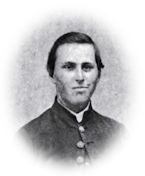
April 23d. Early this morning the Johnnie Rebs made an attack on the outposts on the Charlestown Pike. A hot fire was kept up. Our pickets holding them in check while our regiment was ordered out, double quick. We made a forced march out about two miles but the enemy had left. It was thought to be a scouting party, who came near the outposts. Our scouts reported the enemy going up the valley. Our regiment returned to camp. Two large field guns were mounted in our camp, pointed towards the Loudon Heights. Can be seen by the enemy. They are ready for work at any moment Weather permitting drill and dress parade are kept up. Spare time devoted to reading and writing letters and discussing the war question. Wondering what the outcome will be and when the end will come. All is quiet in our camp.
Civil War Diary of Charles H. Lynch, 18th Conn. Vol’s.
March 31st. Norwich, Connecticut. It is good to be home once more among friends. Wishing the war was over. I am afraid that many more of the 18th Regiment must fall before the end comes. Some will never see home again. These are dark, sad days, but we are trying to enjoy our visit at home, visiting relations and friends. The cemeteries in the cities and the country fighting had taken place in this vicinity but now quiet and peaceful. Battles are liable to take place here most any day. I always felt that Pleasant Valley, Maryland, was rightly named, for it is a beautiful country.
March 30th. After an all-night’s ride on a slow train we reached Jersey City at eight o’clock this morning. We were due in Connecticut this morning in time for the men to register, so they could vote, this being the last day. At Jersey City marched on board a small transport. By the time half of the regiment was on board, the old craft began to sink. Not fit to take us around New York, and surely not through Long Island Sound. We returned to the dock. Informed the officers we were ready to pay our fares home by cars, as we would not risk our lives on that frail craft. After waiting awhile orders came to fall in. Then marched on board a Cortlandt Street ferry-boat for New York, thence through Cortlandt Street to Broadway, on up to 14th Street, then up 4th Avenue to 27th Street, to the station, to the New York, New Haven, and Hartford R. R. Going on board train we were soon bound for Connecticut. Passed on through New Haven, out on the Shore Line road. The train was often side-tracked, making the journey a tedious one. Nothing important happened during the journey until we reached the Connecticut River. Up to this time cheers and congratulations had been shouted for good old Connecticut. It was believed that the managers of the railroad were in sympathy with the South and were copper-heads. The crossing of the Connecticut River was by ferry-boat. It was obliged to make two trips in order to get the regiment over. The river was very high and very swift, owing to the spring freshet. Our company went over in the first load with safety. The second boat-load was carried out into the Sound. Great anxiety was felt for those on board as the boat struggled in the swift current to make the dock. After making slow progress the boat finally reached the dock, after a long time. It began to grow dark before the train started again. After many delays the train arrived in Norwich about midnight, in a cold rain-storm. Forming in line we marched to Treadway’s Hall on Water Street, a good lunch having been provided. Many people were out, waiting to greet the regiment. After the reception at the hall many made their way home. Those from out of town remained in the hall until morning. All were happy, being home once more. Pretty well tired out. Not much sleep for the past three days and nights on the cars, homeward bound. My home was with an aunt on Franklin Street, where I received a hearty welcome.
March 29th. Arrived in Baltimore early this morning. Nothing happened to mar the pleasure of the journey. All were soon out of the cars, line quickly formed, ready to march from the Camden Street station to the Philadelphia R. R. station, on the east side. Our march led through Pratt Street, the scene of the attack on the 6th Massachusetts regiment in April, 1861, by the Baltimore toughs, who claimed to be in sympathy with the South.
March 29th. At the Philadelphia station a train was soon made ready for us, which we quickly boarded, and were soon under way, passing the scenes of our first soldier life, Camp Emory and Fort Marshall. These were points of interest to us, and very pleasant recollections. After an uneventful trip we arrived in Philadelphia late this P. M. Ordered out of the cars, line formed for marching, stopping at a place known as the Cooper Shop, where a good dinner was served by the ladies of Philadelphia. It was a very pleasant occasion in our lives, never to be forgotten. Again journeying on towards New York. Our train being special was often side-tracked and we were forced to wait.
March 28th. Camp Hill, Bolivar Heights. Early this morning received orders to prepare three days’ rations. Reported we are to go up the valley, scouting. Waiting for orders. At noontime rumors began to circulate that the regiment was ordered home to vote. The news seemed too good to be true. Orders came to detail two men from each company to remain as camp guard. Those who were detailed to remain felt very badly. All were anxious to see home. At this time the anti-war party was very strong in Connecticut, which may seem very strange. They were called copper-heads. Late in the afternoon orders came to fall in. A gay and happy crowd, marching and singing as we go down through Harper’s Ferry, where a train was in waiting. Did not take us long to board the train, which soon got under way, bound for Baltimore. Singing, cheering, making merry as the train began to move, on over the Potomac River into Maryland.
March 25th. Marching orders received to report at regimental headquarters, Camp Hill, Bolivar Heights, near Harper’s Ferry. A cold rain storm on at this time. On account of a hard cold, with a number of others, went to Harper’s Ferry by cars. There met by ambulance and rode to camp. My first ride in an ambulance. Bad getting around in camp on account of the deep mud. Harper’s Ferry is a side hill town. The Potomac and the Shenandoah on either side. Here the B. & O. R. R. crosses the Potomac into Maryland. Above Harper’s Ferry is located the Jefferson Rock, where one gets a fine view. The scenery at this point is grand. The mountains, rivers, and the valley, and also the great Maryland Heights.
March 20th. Sunday. Detailed for picket duty. Posted about two miles up the river, between the river and the canal, on the tow path. Our company, C, and the Loudon Rangers ordered to ford the river for a scout into Virginia. Returned quite late. Nothing important obtained. Bad time of the year to ford rivers. Snow squalls still greet us. It doesn’t last very long, but helps to increase the circulation of the mud. Campfire burning all the time. We often burn our clothes by keeping too close to it. We live close to the earth. In warm weather we have a better show to keep clean, bathe, and wash our clothes.
March 19th. L. A. Manning and I off duty. Weather being fine, we decided to take a long walk out into the country. Passed a few farm houses. Came to a small school house where we heard the music of a violin. Looking at the building and listening to the music, a gentleman came out and invited us in. He was the teacher. It being Saturday there was no school. He was practising on the violin. A fine looking young man. Inclined to ask us many questions, which we avoided answering. His sympathy was with the South all right We were about four miles from camp. Returned very much pleased with our tramp. Maryland is a fine country. We had passed through different sections of it.
March 18th. Nothing important has taken place during the past few days. Weather very good, but very cold nights along the Potomac. Out among the farmers buying straw for our tents. Ground too cold to sleep on. Try to keep comfortable, large campfires kept burning nights and days. When too cold to sleep sit around the fire.
March 14th. Cold, disagreeable morning. All quiet along the Potomac at this place. Received a number of letters from friends at home. These letters bring much comfort to a fellow. Some of our boys are being appointed officers in the colored regiments. These regiments must have white commissioned officers. L. A. Manning and I, of Company C, climbed to the top of the Point of Rocks, where we had a fine view of Maryland and Virginia, and for miles down the Potomac. From this point the river appeared to be running up hill. We enjoyed the scenery and the quietness of the surrounding country. Not far away battles were being fought. War is liable to break out at this point almost any day. At times rebel scouts and guerillas can be seen across the river, causing us to keep a good lookout and be on the alert. We very seldom exchange shots across the river.


