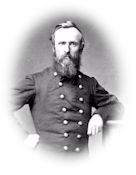
October 31— On the 28th General Kelley reviewed the Third Brigade, [and] General Duffie’s cavalry. A beautiful day; a fine spectacle. I had only nine companies of the Twenty-third here — a small affair. General Kelley is a gentlemanly man of fifty to sixty; not an educated man — nothing particularly noticeable about him. [The] 29th, the three generals with their young ladies, Miss Jones, Miss Scammon, and Miss Smith and staffs went to Fayette. I [am] left in command here at Charleston. [The] 29th, got into new quarters — wall-tents on boards.
Diary and Letters of Rutherford Birchard Hayes
Charleston, October 30, 1863.
Dearest: — General Kelley was here and reviewed the troops on Wednesday. General Duffie’s review was a beautiful and interesting sight. Generals Kelley, Scammon, and Duffie with their staffs have gone to Fayette — Miss Scammon, Miss Jones and Miss Smith with them. I am now in command of their troops here pro tern., and Avery and I run the machine on the town side.
We have got the regiment and brigade tents on stockade for winter weather. They look well and will be comfortable. Mrs. Comly is in the house, and Mrs. Graves will vacate the rest in a day or two. It now looks favorably for our family arrangements to be carried out as we planned them. Can tell certainly after General Kelley leaves.
Uncle is so urgent for Birtie’s staying longer with him that I wish to consent unless you are very anxious to the contrary. Birch says he would like to see us all but prefers to stay longer at Fremont. — Love to all.
Affectionately,
R. B. Hayes.
Mrs. Hayes.
Camp White, October 25, (Sunday), 1863.
Dear Mother: — I received your letter of the 19th last evening. We have been very busy here the last week, worrying the Rebels in our front to prevent their sending reinforcing the Rebels who are opposing General Burnside, and getting ready for apprehended attacks from them. It is now quiet again and the rain and snow in the mountains are fortifications getting stronger every day.
We are not allowed to build winter quarters yet, but the men are fixing up all sorts of shelters and fireplaces to find comfort these cold nights.
I heard from Lucy after she was well on her way to Chillicothe. … I think it almost certain that she will come back to stay in a fortnight or so.
I hope you will stand the cold winter well. — Love to all.
Affectionately, your son,
Rutherford.
Mrs. Sophia Hayes.
Camp White, West Virginia, October 21, 1863.
Dear Mother: — I received your letter of the 17th this morning. Our soldiers rejoice over the result of the Ohio election as much or more than the good people at home. They felt afraid last winter that the people were getting disheartened and that there was danger that the war would be abandoned just as we were about to succeed. They saw, too, how much the Rebels were encouraged by our divisions in the North. The men of my regiment and my brigade were both unanimous for the Union ticket. The brigade cast over eight hundred votes all one way. I have seen no account of any equal body of troops who did as well. . . .
It is very uncertain what our movements this winter will be, but I think I shall be able to come and see you by midwinter. The time of mustering out my regiment is approaching and we shall perhaps be sent home to recruit. At any rate I think I shall see you this winter. — Love to all.
Affectionately,
R. B. Hayes.
Mrs. Sophia Hayes.
Camp White, October 21, 1863.
Dear Uncle: — I received yours of the 17th this morning; also one from mother of the 16th. Lucy left for home this morning with Dr. Joe. She will rent our house in Cincinnati, and return with our family two or three weeks hence, if things remain as now. I gave her a letter to send for the pony, as well as Birch, if agreeable to you. I am now entitled to two more horses than I am keeping, and if we remain here, would like the pony both for Birch and myself. I find little horses, if they are stout, much better for the mountains. My sorrell stallion I want to sell, because he is troublesome sometimes. He is a beauty and good stock; worth two hundred or three hundred dollars.
Sincerely,
R. B. Hayes.
S. Birchard.
October 21.— General Duffie with about one thousand men, cavalry, and two guns of Simmonds’ off last night; supposed to be after the railroad bridge again.
Lee followed Meade until he was near the defenses of Washington, when Lee is reported retiring again.
Camp White, October 19, 1863.
Dear Uncle: — You are a prophet. Brough’s majority is “glorious to behold.” It is worth a big victory in the field. It is decisive as to the disposition of the people to prosecute the war to the end. My regiment and brigade were both unanimous for Brough.
Lucy will go to Chillicothe and home this week. She will fix up matters, gather the chickens, and return in two or three weeks, if all things look well, for the winter. She will, in that case, rent the house in Cincinnati. Love to Birch.
Sincerely,
R. B. Hayes.
S. Birchard.
October 15, [1863]. — No rise of water on account of the rain of the 7th. — A fine time, election day (13th). The Twenty-third — five hundred and fourteen — unanimous for Brough. I went to bed like a Christian at 9 P. M. McKinley waked me at eleven with the first news — all good and conclusive. My brigade unanimous for Brough; Twelfth Regiment, ditto. A few traitors in [the] Thirty-fourth. McMullen’s Battery, one for Vallandigham. State forty or fifty thousand on home vote. A victory equal to a triumph of arms in an important battle. It shows persistent determination, willingness to pay taxes, to wait, to be patient.
Camp White, October 10, 1863.
Dear Mother: — I have just received your good long letter from Delaware on [of] the 3d. . . . There was no time for Lucy to stop at Delaware on her way here. We were likely to be sent South immediately after the battle in Georgia, and I telegraphed her to come at once if she wished to see me. Our going was not ordered as expected, and now we are more likely to go to Ohio to recruit this winter than South. The Twenty-third was the first original three-year regiment and its time will be out in a few months. The men are re-enlisting for another three years and there is a fair prospect of continuing the regiment if we can get a little while at home this winter.
In the present uncertainty as to our winter campaign, I can make no arrangements for my family. In the meantime Lucy is enjoying a visit here. We have a number of agreeable ladies in camp, and are making pleasant acquaintances among the citizens. Charleston was a fine town before the war, and had a very cultivated society. The war broke it up, but now the town is gaining again and will ultimately recover its former prosperity. Give my love to friends.
Affectionately,
R.
Mrs. Sophia Hayes.
Camp White, October 7, 1863.
Dear Uncle: — I am very glad to hear that you are having so little trouble with Birchie. He is of an affectionate disposition, conscientious and truthful. His natural sense of duty is, I think, unusually strong. … I much prefer that he should work or ride or hunt in the open air than read in the house or go to school. I do not care if he is far behind other boys of his age in what is taught in schools. If he has health enough to become a scholar or prepare himself for a learned profession at sixteen, he will have enough time to do it then. If he hasn’t a constitution that will bear a sedentary life, there is more reason for trying to build it up now by work and exercise in the open air.
Lucy is well and enjoys our camp life as well as she could be expected to do away from her boys. In about a week from now I shall probably be able to settle the question as to our winter quarters and as to whether it will be worth while to send for the boys. It looks as if the coming winter would be one of active operations, and if so any plan I may form is likely to be interrupted before spring. Indeed, is liable to be interrupted at any time. In any event, I think we shall stay here watching the gaps in front of us for six or eight weeks longer. After that I think a somewhat smaller force will suffice to defend this region, and we may be sent elsewhere. I think there is no danger of our being seriously disturbed here. . . .
Sincerely,
R. B. Hayes.
S. Birchard.


