Following the American Civil War Sesquicentennial with day by day writings of the time, currently 1863.

Diary and Letters of Rutherford Birchard Hayes

Camp White, May 2, 1863.

Dearest L—: — Yours and the monthlies were handed me last night. No hurry about the “duds.” As for shoulder-straps, it would make no difference how it’s done if it’s according to custom or regulations. I don’t want to start a new fashion. Regulations require straps of a certain size, color, etc., a silver eagle, etc., etc. I would sooner have simply the eagle than a strap twice as big as the rule, but of no importance. Glad to get the monthlies.

We are fortifying, partly to occupy time, partly to be safe. Will [shall] be at it some time.

Uncle talks of coming up. If he does, you may bring one or more of the boys if you can do so conveniently, and if he asks you. . . .

Affectionately,

R.

Mrs. Hayes.

Camp White, West Virginia, April 30, 1863.

Dear Uncle: — I have received yours of the 25th. I am not surprised to hear you are going into business under Governor Chase’s Bank Law. I thought of suggesting it, but knew so little about it that I could form no intelligent opinion1 . . .

You can come here well enough. There is of course a possibility of being cut off, but very small probability of it. I do not doubt that the Rebels will get in below us, but we shall certainly hear of it in time to ship off all who are not ready to stay. Lucy would like to come with you, but you will not bring her unless you find it quite convenient to do so.

Sincerely,

R. B. Hayes.

S. Birchard.


1 Mr. Birchard was promptly taking steps to convert his bank into a national bank under the new law. It became the First National Bank of Fremont, and was the fifth bank in the country to be chartered by the Government.

Camp White, April 22, 1863.

Dear Uncle: — We have a pleasant camp, just enough for men to do to keep them out of mischief. About as easy soldiering as we ever had. You can stay on the opposite side of the river at a fair hotel for seven dollars per week, or on this side in a comfortable tent, better grub, for nothing. If you can do better at home, we can make up the difference in novelty. So come soon. We shall have a superior foe driving us out or worrying us badly in a month or two, and at your time of life that might be uncomfortable. I think we shall be let alone now until after the first of June. General Jenkins learned that a small force had no fun coming in here and a large force can’t live here until the first of June or after.

I hope we shall soon see the drafting begin. It ought not to be delayed a day now.

Sincerely,

R. B. Hayes.

S. BIRCHARD.

Wednesday, [April] 22. — A good spell of weather just ended. Drilling, boating, ball-playing, and the like make the time pass pleasantly. Last Sunday had a Mr. Little preach to us on the bank of the river. Several young ladies, a good audience of soldiers, and a good sermon. Mr. Little brought a sort of hand organ and was the chief musician — an eccentric, witty man, capable and zealous.

Camp White, April 19, 1863.

Dear Mother: — I received the letter written on your birthday yesterday. It found me very well and pleasantly employed.

Today is Sunday. We had a meeting this morning which you would have enjoyed. We had the first sermon to the soldiers we have heard in many months. A Presbyterian clergyman, educated at Granville and Hudson, named Little, a man well adapted to talk to soldiers, preached, sang, etc., etc., most acceptably to a fine audience of troops. He dined with me and promises to come often. He belongs to one of the regiments under my command, posted about forty miles from here.

My eyes are perfectly good — my arm good enough for my use. — The weather here is beautiful — rather too hot. Health good with us generally. — Love to all.

Affectionately, your son,

Rutherford.

Mrs. Sophia Hayes.

Camp White, April 19, 1863.

Dear Mother: — I received the letter written on your birthday yesterday. It found me very well and pleasantly employed.

Today is Sunday. We had a meeting this morning which you would have enjoyed. We had the first sermon to the soldiers we have heard in many months. A Presbyterian clergyman, educated at Granville and Hudson, named Little, a man well adapted to talk to soldiers, preached, sang, etc., etc., most acceptably to a fine audience of troops. He dined with me and promises to come often. He belongs to one of the regiments under my command, posted about forty miles from here.

My eyes are perfectly good — my arm good enough for my use. — The weather here is beautiful — rather too hot. Health good with us generally. — Love to all.

Affectionately, your son,

Rutherford.

Mrs. Sophia Hayes.


Camp White, April 15, Evening.

Dearest: — Your short business letter came this afternoon. I do not yet know about your coming here during the campaigning season. If we fortify, probably all right; if not, I don’t know.

Lieutenant Ellen is married. His wife sent me a fine big wedding cake and two cans of fruit. Good wife, I guess, by the proofs sent me.

You speak of Jim Ware. What does he think of the prospects? I understand Jim in a letter to Dr. Joe says Dr. Ware gives it up. Is this so?

I send you more photographs. The major’s resignation was not accepted and he is now taking hold of things with energy.

We are having further disasters, I suspect, at Charleston and in North Carolina. But they are not vital. The small results (adverse results, I mean,) likely to follow are further proofs of our growing strength.

What a capital speech Everett has made. He quite redeems himself.

Always say something about the boys — their sayings and doings.

Affectionately ever,

R.

Mrs. Hayes.

Camp White, April 10, 1863.

Dearest: — Your most welcome letter reached me this morning. Tell Webby the little rooster is in fine feather. He has had a good many fights with a big rooster belonging to the family near our camp, but holds his own very bravely.

Yes, a coat of course. I am afraid about pants — they should be long and wide in the legs for riding if you get them. No vest is wanted. — Did the cash come to hand?

Our large flag at home would look well flying over this camp if you will send it by Mr. Forbes. As for the new regimental flag, you shall get it some day if you wish to do it.

The fine weather of a few days past has brought us out. We are very happy here again.

Colonel Matthews is perfectly right. He no doubt leaves the army on account of the impossibility of serving in the field. He was barely able to get through his first campaign. . . .

I am as glad as anybody that the Union ticket [in Cincinnati] was carried. The soldiers all feel happy over the recent indications at home. A few victories over the Rebels now would lift us on amazingly. — Yes, “cut off” sounds badly, but it was a very jolly time.

I have Captain Gilmore and Lieutenant Austin and two rifled guns camped here, besides four howitzers with gun squads on the steamboats. General Jenkins and about eight hundred men left the railroad at Marion, Smith County, southwestern Virginia, and crossed the mountains to the head waters of Sandy River and so across towards the mouth of Kanawha. They reached our outpost twenty-four miles from here and demanded a surrender. Captain Johnson with four companies of [the] Thirteenth Virginia declined to surrender and, after a good fight, repulsed General Jenkins. He then crossed Kanawha twenty miles from the mouth or less and attacked Point Pleasant at the mouth. Captain Carter and one company of [the] Thirteenth Virginia occupied the court-house. They could not keep the whole town clear of Rebels but defended themselves gallantly until relieved from Gallipolis. General Jenkins then retreated. Colonel Paxton and Captain Gilmore followed by different routes, worrying him badly and getting about forty prisoners.

Does Birch remember Captain Waller, a cavalry captain who took care of Colonel Paxton and sat opposite us at table often? Perhaps he recollects his little boy. Well he, the boy, rode with his father in the pursuit and captured two armed men himself!

Captain Stevens and all the others are commissioned. Naughton is wroth at Dr. Webb and me! . . . More photographs. Preserve with the war archives, and be sure of one thing, I love you so much.

As ever,

R.

Mrs. Hayes.
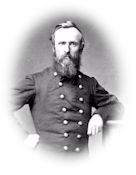
Camp White, April 9, 1863.

Dear Uncle: — Yours of the 3rd received. Yes, Jenkins made a dash into Point Pleasant, but he dashed out before doing much mischief with a loss of seventy-five killed and prisoners. He attacked one other post garrisoned by men under my command but was repulsed. His raid was a failure. He lost about one hundred and fifty men while in this region and accomplished nothing. But we expect repetitions of this thing, and with our present force we shall probably suffer more another time.

I do not look for an end of the war for a long time yet. I am glad the late elections show the second sober thought to be right. We can worry them out if we keep at it without flagging.

Come on, it will be good weather in a few weeks.

I send you a soldier’s photograph of our log-cabin camp near Gauley. It is not good. You can see the falls beyond the camp and the high cliffs on the opposite side of the Kanawha. My quarters were at the long-roofed cabin running across the street towards the back and right of the picture.

Sincerely,

R. B. Hayes.

S. Birchard.

Camp White, April 5, 1863.

Dearest: — The weather is good, our camp dry, and everybody happy. Joe has got a sail rigged on his large skiff and he enjoys sailing on the river. It is pleasant to be able to make use of these otherwise disagreeable spring winds to do our rowing.

Visited the hospital (it being Sunday) over in town this morning. It is clean, airy, and cheerful-looking. We have only a few there — mostly very old cases.

Comly heard a couple of ladies singing Secesh songs, as if for his ear, in a fine dwelling in town. Joe has got his revenge by obtaining an order to use three rooms for hospital patients. The announcement caused grief and dismay — they fear smallpox (a case has appeared). I think Joe repents his victory now.

Enclosed photographs, except Comly’s, are all taken by a Company B man who is turning a number of honest pennies by the means — Charlie Smith, Birch will recollect as Captain Avery’s orderly.

Five companies of the Twenty-third had a hard race after Jenkins. They got his stragglers. Colonel Paxton and Gilmore are after him with their cavalry. General Jenkins has had bad luck with this raid. He came in with seven hundred to eight hundred men. He will get off with four hundred to five hundred, badly used up, and nothing to pay for his losses. We lost half a dozen killed. They murdered one citizen of Point Pleasant, an old veteran of 1812, aged eight-four. They will run us out in a month or two, I suspect, unless we are strengthened, or they weakened. General Scammon is prepared to destroy salt and salt-works if he does have to leave.

I think of you and the boys oftener than ever. Love to ’em and oceans for yourself.

Affectionately ever,

R.

P. S. — I sent by express three hundred and fifty dollars in a package with two hundred dollars of Joe’s. It ought to reach Mother Webb in a day or two after this letter. Write if it doesn’t or does.

Mrs. Hayes.