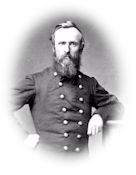
Monday, [March] 23. — Rained during the night. Rained 19th and 20th all day; looks like rain all day today. This is a beautiful valley from Piatt down to its mouth. Make west Virginia a free State and Charleston ought to be a sort of Pittsburgh.
P. M. Warm and bright until 6 P. M. An April shower. Camp getting into order; gravel walks building, streets making. Muddy now, but it is a loose porous soil and will turn out well.
Camp White, Near Charleston, March 22, 1863.
Dear Mother: — One week ago today we started bag and baggage for this place. We are within five or six hours’ travel by steamboat from Ohio (Gallipolis). Steamers pass our camp daily two or three times for home. We are within fifteen hours of Cincinnati and the communication frequent and regular. . . .
We shall remain here probably a good while. The Twenty-third is the only regiment in the vicinity. My command is stretched from Gauley to the Kentucky line. I make my headquarters here but shall go in both directions often. Quite likely, if present arrangements continue, I may run up to Columbus in a month or two. . . . Love to all.
Affectionately, your son,
R. B. Hayes.
Mrs. Sophia Hayes.
Camp White, Near Charleston, Virginia, March 22, 1863.
Dear Uncle: — We came out of the wilderness a week ago today. We are now pleasantly located on the left bank of the Kanawha, just below (opposite) Charleston. We are almost at home, and can expect to see anxious friends soon. You would, I think, enjoy a trip up here in a few weeks. You can get on a steamer at Cincinnati and land at our camp, and be safely and comfortably housed here. Lucy and the boys, after a most happy time, went home yesterday. We shall expect to see them again while we are here.
We seem intended for a permanent garrison here. We shall probably be visited by the Rebels while here. Our force is small but will perhaps do. My command is Twenty-third Ohio, Fifth and Thirteenth Virginia, three companies of cavalry, and a fine battery. I have some of the best, and I suspect some of about the poorest troops in service. They are scattered from Gauley to the mouth of Sandy on the Kentucky line. They are well posted to keep down bushwhacking and the like, but would be of small account against an invading force. We have three weak, but very good regiments, Twenty-third, Twelfth, and Thirty-fourth Ohio, some, a small amount, of good cavalry and good artillery, and about three or four regiments of indifferent infantry. So we shall probably see fun, if the enemy thinks it worth while to come in. Come and see me.
Sincerely,
R. B. Hayes.
S. Birchard.
Camp White, Near Charleston, Virginia, March 22, 1863.
Dear Uncle: — We came out of the wilderness a week ago today. We are now pleasantly located on the left bank of the Kanawha, just below (opposite) Charleston. We are almost at home, and can expect to see anxious friends soon. You would, I think, enjoy a trip up here in a few weeks. You can get on a steamer at Cincinnati and land at our camp, and be safely and comfortably housed here. Lucy and the boys, after a most happy time, went home yesterday. We shall expect to see them again while we are here.
We seem intended for a permanent garrison here. We shall probably be visited by the Rebels while here. Our force is small but will perhaps do. My command is Twenty-third Ohio, Fifth and Thirteenth Virginia, three companies of cavalry, and a fine battery. I have some of the best, and I suspect some of about the poorest troops in service. They are scattered from Gauley to the mouth of Sandy on the Kentucky line. They are well posted to keep down bushwhacking and the like, but would be of small account against an invading force. We have three weak, but very good regiments, Twenty-third, Twelfth, and Thirty-fourth Ohio, some, a small amount, of good cavalry and good artillery, and about three or four regiments of indifferent infantry. So we shall probably see fun, if the enemy thinks it worth while to come in. Come and see me.
Sincerely,
R. B. Hayes.
S. Birchard.
Sunday, March 22, 1863. — Have gone into camp. My headquarters here. My brigade is Twenty-third Ohio, Fifth Virginia, Colonel Ziegler, Thirteenth Virginia Cavalry, Colonel Brown, Captain Gilmore’s Cavalry, Lieutenant Gonseman’s ditto, and Lieutenant ——;also Captain Simmond’s Battery. Gonseman at Loup and Tompkins Farm. Gilmore, here. Battery at Gauley Bridge; Twenty-third here. Thirteenth at Coal’s Mouth and Hurricane Bridge; Fifth at Ceredo.
The boys will never forget their visit to papa and the Twenty-third. It will be a romatic memory. Webb was a greater favorite than Birch. Mischievous but kind-hearted and affectionate. Birch more scholarly and more commanding. Dear boys, how I love them! They were with me nearly two months in my log cabin camp. Great happiness in log cabins.
Camp White, March 21, 1863.
Dearest: — You left this morning. Don’t think I am going daft after you. I am in my tent facing the parade between the captains and companies. McKinley is in his. The doctor, Avery, and [the] major will come over tomorrow. I shall sleep in a tent tonight for the first time since the night before South Mountain — over six months ago. . . .
Did you see us crossing in our boats before your steamer passed? I saw you and swung my hat, but whether you saw me I could not tell.
Our house flag must come out to go on a high pole near headquarters if it is militarily proper, and I think it is. . . . Goodbye, darling.
As ever,
R.
Mrs. Hayes.
Saturday 21. — Lucy and boys on the Allen Collier home.
March 18-19, [1863]. — Went into Camp White (after Colonel White of the Twelfth), opposite the mouth of the Elk.
March 13, 1863. — Left our log-cabin camp at the Falls of the Kanawha. Camp Reynolds was a happy abiding place. Lucy came with Birch and Webb on the 24th of January. They rowed skiffs, fished, built dams, sailed little ships, played cards, and enjoyed camp life generally. We reached Charleston at dark [this] Sunday evening. The men went to the churches to stay.
Camp Reynolds, March 9, 1863.
Dear Uncle: — Yours of last Sunday came to hand yesterday. Wife and boys still here — very happy. They fish and row skiff and ride horseback. They can all row. Webb and Birch rowed a large load of soldiers across the river and back — a large roaring river, almost like the Ohio in a fair fresh. They will go home in a week or two probably. We shall remain here two or three weeks and then probably go to Charleston.
The new conscript act strikes me as the best thing yet, if it is only used. I would only call enough men to recruit up weakened regiments, and compel the return of the shirks and deserters. Make our commanders give more time to drill and discipline; make the armies regulars — effectives; stand on the defensive except when we can attack in superior numbers; send no more regiments or gunboats to be gobbled up one at a time. Mass our forces and we shall surely conquer.
Sincerely,
R. B. Hayes.
S. BIRCHARD.