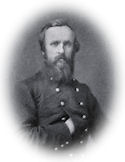
Following the American Civil War Sesquicentennial with day by day writings of the time, currently 1863.

Diary and Letters of Rutherford Birchard Hayes

August 18. Sunday.—Last night, about ten or eleven, five companies of Colonel Moor’s (Second German Regiment) Twenty-eighth Regiment arrived from Clarksburg under Lieutenant-Colonel Becker. My partner, L. Markbreit, is sergeant-major. This morning, raining hard. Exciting rumors and news. A Tennessee regiment and force coming through the mountains east of Sutton—a battery of four guns, one thirty-two-pounder!! What an anchor to drag through the hills! Absurd! Danger of all provisions below here with vast stores being taken by the enemy. We are ordered to cook three days’ rations and be ready to move at a moment’s warning, with forty rounds of ammunition. All trains on the route to Sutton are ordered back or to take the way to Buchanan [Buckhannon] via Frenchtown. Eighty thousand rations are ordered to same place from here. All is war. I pack my portmanteau and prepare to move. Oh, for a horse which wouldn’t founder, or get lame, or stumble! At night no order to move yet.

_______

HEADQUARTERS, 23D REG’T, O. V. INF., U. S. A.,

August 17, 1861.

DEAREST:—Your letter to Dr. Joe did me much good. Bless the boys. I love to read your talk about them.

I had just started this letter when a dispatch came from Captain Zimmerman. He had a little brush with some guerrillas in the mountains twenty-five miles from here and had three men wounded. This is the first blood of our regiment shed in fight. He scattered the rascals without difficulty, making some prisoners. We have had a picquet wounded on guard and accidental wounding but no fighting blood-letting before. This is the expedition I expected to go with when I wrote you last, but the accounts of the enemy not justifying the sending of more than one company, I was not sent.

There is a general rising among the Rebels. They rob and murder the Union men, and the latter come to us for help. We meet numbers of most excellent people. We have out all the time from two to six parties of from ten to seventy-five or one hundred men on scouting duty. There are some bloody deeds done in these hills, and not all on one side. We are made happy today by the arrival of Captain McMullen with an excellent company of artillery—four mountain howitzers and complete equipments. They will be exceedingly useful. Lieutenant-Colonel Matthews is nearly one hundred miles south of us with Colonel Tyler and others. The road between here and there is so infested with “bushwhackers” that we have no communication with him except by way of Gallipolis in Ohio. He has been ordered to return here but deems it unsafe to attempt it.

Colonel Scammon has fallen in love with Joe. He says if his qualities were known he would get a high place in the Regular Army medical staff, and brags on him perpetually. We have very few of our own men sick, but numbers in the hospital of other regiments.

My new horse doesn’t turn out any tougher than the other. But Captain McMullen says he has one which I am to try tonight. I shall get a “Webby” that can stand hard work and poor fare one of these days.

How about the pants? If they are reasonably good blue, put a light blue stripe down the outside seam and send them to me when you have a chance. I don’t care about the color. The blue stripe is enough uniform for this latitude. Hard service for duds. I am well supplied—rather too much of most things.

August I8. Sunday P.M.—Since writing the above we have received word that the enemy in force is coming towards us through the mountains to the southeast, and have been ordered to prepare three days’ rations and to be ready to march at a moment’s notice to attack the enemy. I am all ready. My little knapsack contains a flannel shirt, one of those you gave me, two pairs of socks, a pair of drawers, a towel, the what-you-may-call-it you made for me to hold scissors, etc., etc. This is enough. We are to go without tents or cooking utensils. A part of Colonel Moor’s Second German Regiment are to go with us. Markbreit is among them. They reached here last night.

It will be a stirring time if we go, and the result of it all by no means clear. I feel no apprehension—no presentiment of evil, but at any rate you know how I love you and the dear boys and Grandma and all will take care that I am not forgotten. You will know by telegraph long before this reaches you what comes of the anticipated movements. I suspect we are misinformed. At any rate, good-bye, darling. Kisses for all.

Affectionately,

R.

MRS. HAYES.

August 17. Saturday.—Dispatches came last [night] from Colonel Matthews. He can’t return as ordered for fear of losing his command between Summersville and Sutton; rumors of Wise, etc., etc. Colonels Tyler and Smith go with him nine miles back towards Gauley Bridge to fortify. The colonel thinks this is a mistake of judgment and is disgusted with it. I think Colonel Scammon is right.

Lieutenant Rice’s men report that three men named Stout were taken near Jacksonville by some of Captain Gaines’ men and part of his command and that afterwards Gaines’ men killed them, alleging orders of Captain Gaines, etc., etc. This is too bad. If any of my men kill prisoners, I’ll kill them.

Captain McMullen with four mountain howitzers arrived this morning—12-pounders. Good! My horse, not Webb first but Webb second, by hard riding foundered or stiffened. Mem.:— Lend no horse; see always that your horse is properly cared for, especially after a hard ride.

_______

HEADQUARTERS 23D REG’T, O. V. INF., U. S. A.,

August 17, 1861.

DEAR UNCLE:—We are kept very busy, hunting up guerrillas, escorting trains, etc., etc. Attacking parties are constantly met on the roads in the mountains, and small stations are surrounded and penned up. We send daily parties of from ten to one hundred on these expeditions, distances of from ten to forty miles. Union men persecuted for opinion’s sake are the informers. The Secessionists in this region are the wealthy and educated, who do nothing openly, and the vagabonds, criminals, and ignorant barbarians of the country; while the Union men are the middle classes—the law-and-order, well-behaved folks. Persecutions are common, killings not rare, robberies an every-day occurrence.

Some bands of Rebels are so strong that we are really in doubt whether they are guerrillas or parts of Wise’s army coming in to drive us out. The Secessionists are boastful, telling of great forces which are coming. Altogether, it is stirring times just now. Lieutenant-Colonel Matthews is nearly one hundred miles south of us with half our regiment, and is not strong enough to risk returning to us. With Colonels Tyler and Smith, he will fortify near Gauley Bridge on [the] Kanawha.

Dr. Rice is here sick in charge of Dr. Joe. He got in safely from a post that was invested about thirty miles west. He will get well, but has been very sick. This is the healthiest country in the world. I have not been in such robust health for a great while. My horse is not tough enough for this service. I had better have taken Ned Jr., I suspect, although there is no telling. The strongest horses seem to fail frequently when rackabones stand it well. The Government has a good many horses, and I use them at pleasure. When I find one that will do, I shall keep it. . . .

Sincerely,

R. B. HAYES.

S. BIRCHARD.

_______

WESTON, VIRGINIA, August 17, 1861.

DEAR MOTHER:—Nothing new to tell you. We are kept more busy than heretofore with watching and hunting after the robbers who are plundering the Union men in our neighborhood. We have rumors of invading forces from eastern Virginia strong enough to drive us out, but we know nothing definite about them. Captain McMullen arrived safely with my box. His company of artillery is a great addition to our strength.

Our men are very healthy and busy enough to keep them out of mischief. Dr. Joe finds a number of old ladies who do all in their power to make our sick soldiers comfortable. One poor fellow who was thought to be gone with consumption is picking up under their nursing and strengthening food, and will, perhaps, get well. None of our regiment are seriously ill. We were never in so healthy a country. . . . .

The war brings out the good and evil of Virginia. Some of the best and some of the worst characters I ever heard of, have come under our notice during the last fortnight. It is not likely that we shall move from here for some weeks. We are required to send expeditions to protect Union neighborhoods and wagon trains, and to drive off scamps almost every day. We are probably doing some good to the better sort of people in this country, besides the general good which we are supposed to be doing in the cause of the country.

My love to all.—Affectionately,

R. B. HAYES.

MRS. SOPHIA HAYES.

August 16. Friday.—A morning of small excitements. A wagon train stopped on its way towards Sutton to search for arms or ammunition concealed in boxes of provisions. . . . Drake, Captain, and Woodward search train in vain for contraband.

August 15. Thursday.—A bright, lovely day and the prettiest evening of the month. The bright moonlight exhibits the landscape enough to show its loveliness and the lights and shadows. The hills and woods are very picturesque. It makes me long for wife and boys and friends behind. How Lute would enjoy roaming with me through camp tonight.

More rumors of attacks by guerrillas, or “bushwhackers” as they are here called, on our couriers and trains. A courier and captain and some wagoners are reported killed or taken below Sutton.

My box containing pistols and sash, etc., by mistake sent from Clarksburg to Buckhannon. Made arrangements to send Lieutenant Richardson and two men with ambulance after it.

WESTON, VIRGINIA, August 15, 1861.

Thursday Morning.

DEAREST L—:—We had four days of rain ending yesterday morning—such rain as this country of hills and mountains can afford. It was gloomy and uncomfortable but no harm was done. It cleared off beautifully yesterday morning and the weather has been most delicious since. This is a healthful region. Nobody seriously sick and almost everybody outrageously healthy. I never was better. It is a luxury to breathe. Dr. Joe—but don’t he go into the corn? He has it three times a day, reminding me of Northampton a year ago and your order for supper on our return from Mount Holyoke.

Our regiment has had divers duties which keep up excitement enough to prevent us from stagnating. Colonel Matthews and right wing is fifty miles south. Captain Drake and Captain Woodward, with their companies, spent the four rainy days scouring the steepest hills and deepest gullies for the rascals who waylay our couriers and wagon trains. They captured three or four of the underlings, but the leaders and main party dodged them. Captain Zimmerman and his company have gone west forty miles to escort provisions to Colonel Moor (Second German Regiment of Cincinnati in which Markbreit is Lieutenant) and to clean out an infected neighborhood between here and there. A sergeant and six men are at Clarksburg escorting a prisoner destined for Columbus. Lieutenant Rice and twenty men are escorting cattle for Colonel Tyler’s command south of here. A part of our cavalry are gone west to escort a captain and the surgeon of the Tenth to Glenville, thirty-seven miles west. On Saturday I go with Captain Drake’s company to meet Captain Zimmerman’s company returning from the west, and with the two companies, to go into the hills to the south to hunt for a guerrilla band who are annoying Union men in that vicinity. I shall be gone almost a week so you will not hear from me for some time. The telegraph is now extended south to a station near where I am going to operate, so that we are in reach of humanity by telegraph but not by mail.

Dr. Joe has got the hospital in good condition. A church (Methodist South) in place of the court-house for the merely comfortable, and a private house for the very sick. None of our regiment are seriously ill. The sick are devolved upon us from other regiments—chiefly lung complaints developed by marching, measles, or exposure. Very few, if any, taken here. Divers humane old ladies furnish knickknacks to the hospital and make glad the poor fellows with such comforts as women can best provide.

We find plenty of good Union men, and most of our expeditions are aided by them. They show a good spirit in our behalf. A large part of our friends in the mountains are the well-to-do people of their neighborhoods and usually are Methodists or other orderly citizens.

Good-bye, dearest. I love you very much. Kiss the boys and love to all. Tell Webby that during the rain the other night, dark as pitch, my horse, Webb, fell down the hill back of the camp into the river. Swam over to the opposite shore, and at daylight we saw him frisking about in great excitement trying to get back to his companion Birch. When we got him he was not hurt or scratched even. He stumbles a little, which doesn’t do for a riding horse, so I have taken a government horse which looks very much like him; same color and size but not quite so pretty, and given Webb to Uncle Joe for an ambulance horse. I shall call my new horse Webb, so there are to be two Webbys in the regiment. My next horse I shall call Ruddy. Love to Grandma.

Affectionately,

R.

MRS. HAYES.

August 14. Wednesday.—The weather has changed to cool, and although the sky is still clouded I hope this long rain is now over. Our prisoners turn out to be Hezekiah and Granville Bennett, cousins of the notorious James and William Bennett, aged forty-nine and twenty-two, father and son, and Moss and George W. Brothers, aged fifty-eight and forty-eight. Our information is not definite as to their conduct. One or more of them belonged to the Southern army, and all are accused by their Union neighbors with divers acts of violence against law-and-order citizens.

Last evening Lieutenant Milroy came over from Glenville reporting that Captain R. B. Moore feared an attack from three companies of well armed Secessionists in the region west of them, say Spencer, and was fortifying himself. The people immediately around him are friendly, he having conducted himself with great prudence and good sense and by kindness and justice made friends of the people of all parties.

August 13.—Still rain. My horse hitched to a tree on the brow of a hill very near my tent broke loose during the night, and, it is said, rolled down the steep hill and swam the river. This morning he was seen trotting about in high feather on the opposite side of the river. He was caught and brought back unhurt, to the surprise of all who saw the place he must have gone down. Our right wing has been sent for to return to Bulltown. Captains Drake and Woodward who are out guerrilla hunting are still absent and not heard from for twenty-four hours.—P. M. Still raining. Captains Drake and Woodward have returned. They caught two of the pickets of the guerrilla party they were after but failed in surprising them, owing to a boy who gave information of their coming. They found a few good Union men; the mass of the people most ignorant. [They] describe the country in the edge of Webster County as precipitous and difficult; the people timid but cunning. They also brought two other prisoners, men who have been in the secession army.

August 12. Monday.—Showery all day. Sent to Clarksburg H. T. Martin. He will probably be sent to Columbus for safe keeping. I gave him a letter to my brother-in-law to insure him attention there in case he should need. It is impossible to avoid mistakes in these cases. Union men may make charges merely to gratify personal animosity, knowing that in the nature of things a full investigation is impossible.

During Monday night a squad of the Tenth Regiment returned from the Buckhannon road with the body of one of the wild men of the mountains found in this country. He followed their regiment, shooting at them from the hills. They took him in the Bulltown region. He wore neither hat nor shoes, was of gigantic size—weighing two hundred and thirty pounds; had long hooked toes, fitted to climb—a very monster. They probably killed him after taking him prisoner in cold blood—perhaps after a sort of trial. They say he was attempting to escape.

_______

WESTON, VIRGINIA, August 12, 1861.

DEAR UNCLE:—We are still getting on nicely. We have a good deal more excitement now than usual. Wagon and cattle trains and small parties are fired on by guerrillas from the hills on two of the roads leading from here. Dr. Joe has about eight or ten in charge who have been wounded in this way. Two only have been killed. None in our regiment. The men all laugh at “squirrel guns” and the wounds they make. Several would have been killed if shot in the same part by the conical balls of our military guns. The “deadly rifle” of olden times shoots too small a bullet, and is too short in its range; but as Cassio says, it is often “sufficient.” We send out parties who bring in prisoners— sometimes the right men, sometimes not. All this keeps up a stir. In a week or two we shall get up a regular system of scouring the country to get rid of these rascals. The Union men here hate and fear them more than our men.

The threatened invasion by Lee from eastern Virginia hangs fire. They will hardly venture in, unless they come in a few days, as we are daily getting stronger. I hope you are still getting better.

Good-bye,

R. B. HAYES.

S. BIRCHARD.

August 11. Sunday.—Raining this morning, very warm. Arrested, on complaint of a Union man, H. T. Martin, a secession editor, who is charged with holding communication with James and William Bennett, leaders of a guerrilla party. He was formerly from Ohio. Is a Southern state’s-right Democrat in talk, and makes a merit of holding secession opinions. Having been engaged in getting up troops for the Southern army, the colonel will probably send him to Ohio.

Colonel Lytle’s men fired on near Bulltown; one killed, four wounded; guerrilla party in the hills out of reach. Our regiment did not destroy records. We have sent two captains and eighty men after the guerrillas.

August 10. Saturday.—Rained a good part of the night. We learned that while the right wing of our regiment occupied the court-house at Sutton, many records, etc., etc., were torn up. It is said the old clerk cried when he saw what had been done. Disgraceful! What a stigma on our regiment if true! We have had and deserved to have a good name for our orderly conduct, respect for rights of citizens, etc., etc. I hope nothing has been done to forfeit our place.

August 9, Friday.—The colonel is out of humor with Lieutenant Rice for letting men on guard go to their tents to sleep and scolds him severely in the presence of his men. A little less grumbling and more instruction would improve the regiment faster. The men are disconcerted whenever the colonel approaches; they expect to be pitched into about something. A good man, but impatient and fault-finding; in short, he is out of health, nervous system out of order. Would he had sound health, and all would go well. He gives no instruction either in drill or other military duties but fritters away his time on little details which properly belong to clerks and inferior officers.— Begun to rain at noon, refreshing rather.

Our men returning from Sutton report our right wing under Lieutenant-Colonel Matthews gone on to Summersville. Also that a party in ambush fired on two companies of Colonel Lytle’s regiment, killing one and wounding four. This sort of murder must be stopped. The colonel is busy issuing passes to citizens, the patrol or picquets having been ordered to stop all persons travelling on the roads without passes. This must be a great annoyance to the inhabitants. Is there enough benefit to be gained for all the hate we shall stir up by it?

The mother of our adjutant at Camp Chase seeing a boy walking up and down on his sentinel’s beat took pity on him, sent him out a glass of wine and a piece of cake with a stool to sit on while he ate and drank. She told him not to keep walking so, to sit down and rest! She also advised him to resign!

More rumors of the approach of Lee with fifteen thousand men to attack our forces at Buchanan [Buckhannon]. Lieutenant Reichenbach with his party of twenty men marched yesterday twenty-eight miles and today, by noon, fifteen miles.

Joe Holt¹ makes the best war speeches of any man in the land. It always braces my nerves and stirs my heart when I read them. At Camp Joe Holt, near Louisville, he said: “Since the sword flamed over the portals of Paradise until now, it has been drawn in no holier cause than that in which you are engaged.”

_______

CAMP NEAR WESTON, VIRGINIA, August 9, 1861.

Friday Afternoon.

DEAREST:—I have just read your letter postmarked the 5th at Kingston. Right pleased with you. Very happy to get your good letter. It has been bright, warm (hot) weather since Sunday, but today at noon a fine rain began to fall, and this afternoon I was loafing about in the tents, hard up for occupation. Lying alone in my tent, your letter came in with one from Uncle written Sunday. Wasn’t it so lucky? I’ve nothing to tell you, I believe. Dr. Joe is well—perfectly—again; busy changing his hospital from the court-house and jail to a secession church which doesn’t run now. The colonel is busy giving passes to citizens wishing to travel roads guarded by our picquets.

Colonel Matthews under Colonel Tyler has gone to Summersville about seventy miles south of this. They are looking for Wise. In the meantime we have rumors that General Lee is marching over the mountains to push the Union forces in this region out of the State, and to seize the stores so abundantly gathered hereabouts. We have no means of knowing the truth here; if there is anything in it, we shall be called to Buchanan [Buckhannon], sixteen miles east, where the first attack is expected. There is a little more activity among the enemy in this quarter since these rumors became rife. Our party from the south, returning today, report that an attack was made up the road on two companies of Colonel Lytle’s men by a party in ambush, who fired one volley and ran off into the hills. One man killed and four wounded. Captain Gaines (our prosecutor) called to see me last night. His company is detached from his regiment, guarding a party putting up telegraph wires. Mr. Schooley returned from Cincinnati with late news last night. He says, it [was] so lonely he really wished to get back to camp. I am sorry to have Colonel Matthews and the right wing gone, but except that we are doing nicely. Colonel Scammon is in better health and things go on very smoothly.

The soldiers fare very well here, and stand in little need of sympathy, but when I have an opportunity to smooth matters for them, I try to do it, always remembering how you would wish it done. What a good heart you have, darling. I shall try to be as good as you would like me to be.

Young Jewett got safely home. He is likely to have a long and serious time getting well, but will probably be very slightly, if at all, crippled. Colonel Ammen is at Clarksburg. If we have any force sent against us, we shall be with him; otherwise, not at present.

I am glad you are visiting at Aunt Margaret’s this hot weather. Do you recollect when we were up [the] Saguenay a year ago at this time? Here Colonel Scammon came in full of pleasant gossip, feeling happy with letters from his wife and daughters. No more chance to write in time for tonight’s mail. Continue to address me at Clarksburg until I direct otherwise. Love to all at Elmwood. Kiss the boys all around.

Affectionately,

R. B. HAYES.

MRS. HAYES.

_______

¹Joseph Holt, born in Breckinridge County, Kentucky, January 6, 1807; died in Washington, August 1, 1894. Famous as a jurist and an orator. He was Postmaster-General in Buchanan’s Cabinet for a time and in 1860, when John B. Flood resigned, he became Secretary of War. He was a vigorous Union man, urging his fellow Kentuckians “to fly to the rescue of their country before it is everlastingly too late.” In September, 1862, President Lincoln appointed him Judge-Advocate General of the army, in which capacity he served long with great distinction.