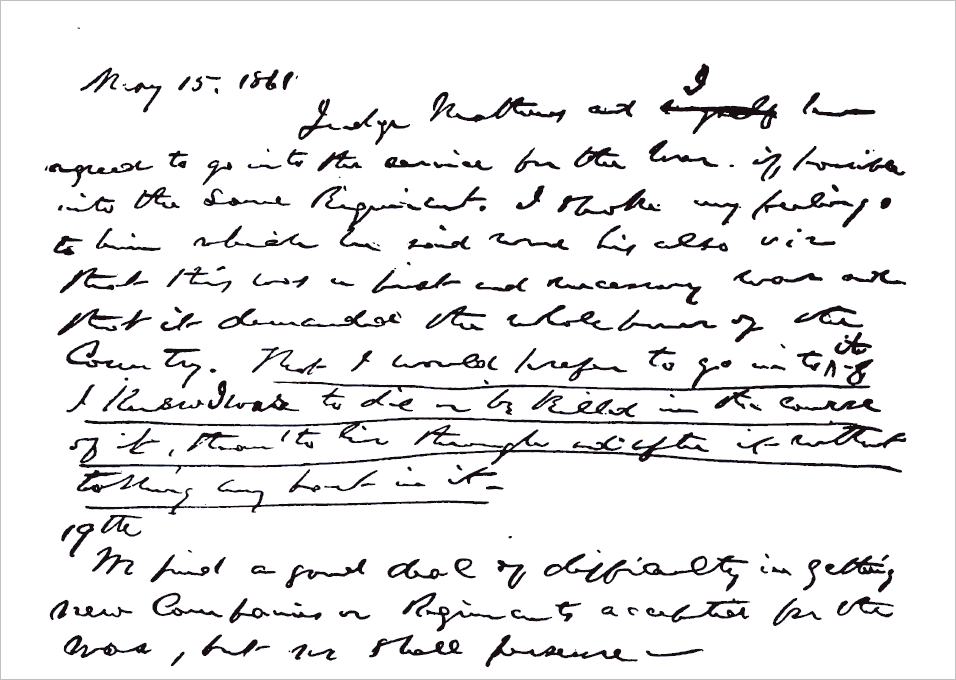
May 15, 1861.—Judge Matthews and I have agreed to go into the service for the war,—if possible into the same regiment. I spoke my feelings to him, which he said were his also, viz., that this was a just and necessary war and that it demanded the whole power of the country; that I would prefer to go into it if I knew I was to die or be killed in the course of it, than to live through and after it without taking any part in it.
Diary and Letters of Rutherford Birchard Hayes
CINCINNATI, May 12, 1861.
DEAR UNCLE:—. . . The St. Louis and other news revives the war talk. We are likely, I think, to have a great deal of it before the thing is ended. Bryan writes me a long friendly secession letter, one-sided and partial, but earnest and honest. Perhaps he would say the same of my reply to it. I wish I could have a good talk with you about these days. I may be carried off by the war fever, and would like to hear you on it. Of course, I mean to take part, if there seems a real necessity for it, but I am tempted to do so, notwithstanding my unmilitary education and habits, on general enthusiasm and glittering generalities. But for some pretty decided obstacles, I should have done so before now.
All well at home. Lucy hates to leave the city in these stirring times. We hear that some of the Fremont men are at the camp near Milford. I shall see them one of these days, if this is so.
Sincerely,
R.B. HAYES.
S. BIRCHARD.
May 10, 1861.—Great events the last month. April 12 and 13, Fort Sumter [was] attacked and taken by the South Carolina troops by order of the Government of the Confederate States at Montgomery. Sunday evening, April 14, news of Lincoln’s call for 75,000 men [was] received here with unbounded enthusiasm. How relieved we were to have a Government again! I shall never forget the strong emotions, the wild and joyous excitement of that Sunday evening. Staid and sober church members thronged the newspaper offices, full of the general joy and enthusiasm. Great meetings were held. I wrote the resolutions of the main one,—to be seen in the Intelligencer of the next week. Then the rally of troops, the flags floating from every house, the liberality, harmony, forgetfulness of party and self—all good. Let what evils may follow, I shall not soon cease to rejoice over this event.
The resolutions referred to were published in the Gazette of the 16th [of] April and in the Intelligencer of the 18th.
[The resolutions were as follows:
“Resolved, That the people of Cincinnati, assembled without distinction of party, are unanimously of opinion that the authority of the United States, as against the rebellious citizens of the seceding and disloyal States, ought to be asserted and maintained, and that whatever men or means may be necessary to accomplish that object the patriotic people of the loyal States will promptly and cheerfully furnish.
“Resolved, That the citizens of Cincinnati will, to the utmost of their ability, sustain the general Government in maintaining its authority, in enforcing the laws, and in upholding the flag of the Union.”]
“We shall, of course, not agree about the war. We shall, I am sure, remain friends.”—Rutherford B. Hayes
CINCINNATI, May 8, 1861.
DEAR GUY:—I have just received and read your letter of the 27th ult. It does me good to hear from you again. I have thought of you often since these troubles began. Curiously enough, having a bad cold and a slight fever, I dreamed of many things last night. Among others I dreamed of seeing you at the Burnet House; that you wore on your cap some sort of secession emblem and that you were in danger of getting into difficulty with some soldiers who were in the rotunda, and that it was after some effort that I succeeded in getting you rid of them. I should have written you soon even if I had not heard from you.
Your predictions as to the course of things have indeed been very exactly fulfilled. I can recollect distinctly many conversations had twelve, perhaps even fifteen, years ago in which you pointed out the probable result of the agitation of slavery. I have hoped that we could live together notwithstanding slavery, but for some time past the hope has been a faint one. I now have next to no hope of a restoration of the old Union. If you are correct in your view of the facts, there is no hope whatever. In such case, a continued union is not desirable were it possible. I do not differ widely from you as to the possibility of conquering the South, nor as to the expediency of doing it even if it were practicable. If it is the settled and final judgment of any slave State that she cannot live in the Union, I should not think it wise or desirable to retain her by force, even if it could be done.
But am I, therefore, to oppose the war? If it were a war of conquest merely, certainly I should oppose it, and on the grounds you urge. But the war is forced on us. We cannot escape it. While in your State, and in others, perhaps in all the cotton-growing States, a decided and controlling public judgment has deliberately declared against remaining in the Union, it is quite certain that in several States rebellious citizens are bent on forcing out of the Union States whose people are not in favor of secession; that the general Government is assailed, its property taken, its authority defied in places and in a way not supported by any fairly expressed popular verdict. Undoubtedly the design to capture Washington is entertained by the Government of the Southern Confederacy. Undoubtedly that Confederacy has not by its acts sought a peaceful separation. Everything has been done by force. If force had been employed to meet force, I believe several States now out of the Union would have remained in it. We have an example before us. Two weeks ago Maryland was fast going out; now, aided by the power of the general Government, the Union men seem again to be in the ascendant. The same is true of Delaware, Kentucky, Missouri, and western Virginia, with perhaps allowances in some quarters.
I do not, of course, undertake to predict what will be the ultimate object of the war. I trust it will not be merely the conquest of unwilling peoples. Its present object, and its obvious present effect, is to defend the rights of the Union, and to strengthen the Union men in the doubtful States. We were becoming a disgraced, demoralized people. We are now united and strong.
If peaceful separation were to be attempted, it would fail. We should fight about the terms of it. The question of boundary alone would compel a war. After a war we shall make peace. It will henceforth be known that a State disappointed in an election can’t secede, except at the risk of fearful war. What is left to us will be ours. The war for the purposes indicated— viz., for the defence of the capital, for the maintenance of the authority of the Government and the rights of the United States, I think is necessary, wise, and just. I know you honestly differ from me. I know that thousands—the great body of the people in some States, perhaps,—agree with you, and if we were only dealing with you and such as you, there would be no war between us. But if Kentucky, Virginia, and other States similarly situated leave the Union, it will be because they are forced or dragged out; and our Government ought not to permit it, if it can be prevented even by war.
I read your letter to Judge Matthews. We agree in the main respecting these questions. I shall be pleased to read it to George [Jones] when we meet. He has two brothers who have volunteered and gone to Washington. Lorin Andrews, President of Kenyon, our classmate, is colonel of a regiment. My brother- in-law, Dr. [James D.] Webb, has gone as a surgeon. I shall not take any active part, probably, unless Kentucky goes out. If so the war will be brought to our own doors and I shall be in it. If I felt I had any peculiar military capacity I should probably have gone to Washington with the rest. I trust the war will be short and that in terms, just to all, peace will be restored. I apprehend, and it is, I think, generally thought, that the war will [not] be a long one. Our whole people are in it. Your acquaintances Pugh, Pendleton, and Groesbeck, are all for prosecuting it with the utmost vigor. Vallandigham is silent, the only man I have heard of in any party. He has not been mobbed and is in no danger of it. I will try to send you Bishop McIlvaine’s address on the war. It will give you our side of the matter.
We shall, of course, not agree about the war. We shall, I am sure, remain friends. There are good points about all such wars. People forget self. The virtues of magnanimity, courage, patriotism, etc., etc., are called into life. People are more generous, more sympathetic, better, than when engaged in the more selfish pursuits of peace. The same exhibition of virtue is witnessed on your side. May there be as much of this, the better side of war, enjoyed on both sides, and as little of the horrors of war suffered, as possible, and may we soon have an honorable and enduring peace!
My regards to your wife and boy. Lucy and the boys send much love.
As ever,
R.B. HAYES.
P.S.—My eldest thinks God will be sorely puzzled what to do. He hears prayers for our side at church, and his grandmother tells him that there are good people praying for the other side, and he asks: “How can He answer the prayers of both?”
GUY M. BRYAN,
Texas.
CINCINNATI, April 30, 1861.
DEAR UNCLE:—Your frequent letters are very acceptable. I am sorry, however, to be compelled to think that we are indebted to your ill health for the favor. Lucy says, “Why don’t Uncle come down and make us a visit? If the house has a roof and floors, it is finished enough for war times and needs no further attention.” You will find it almost as quiet as your own town. About five thousand men have left, and our streets show that even that number missing is noticeable. If any war news comes, we shall be lively enough soon. The first ten days of the war was as jolly and exciting as you could wish.
Sincerely,
R. B. HAYES.
S. BIRCHARD.
“If a secession measure is passed we shall expect lively times here immediately afterwards.”—Rutherford B. Hayes
CINCINNATI, April 25, 1861.
DEAR UNCLE:— We are glad to hear from you often. I have written almost daily, and am surprised you do not hear from me more regularly. Your letters reach me in good time.
The point of interest here now is as to Kentucky. Her Legislature meets on the 6th of May. If a secession measure is passed we shall expect lively times here immediately afterwards. The chances are about equal in my opinion. If they were armed and ready they would go beyond all question; but their helpless condition will possibly hold them. Our people generally are quite willing to see them go. They prefer open enmity to a deceptive armed neutrality.
Sincerely,
R. B. HAYES.
P.S.—My company drills at 10 A. M. today—Sunday! I have two clergymen and the sons of two others in the ranks. I suspect they will not answer at roll-call.
S. BIRCHARD.
The following statement in Hayes’s handwriting, evidently prepared about this time, shows what plans the citizens of Cincinnati were making to defend the city against possible attack from Kentucky.
To be ready on the day that Kentucky secedes to take possession of the hills on the Kentucky side which command Cincinnati, or the approaches to it, and prepare to hold them against any force.
a. Regiments ready to cross on short notice with arms; ammunition, provisions, tools, etc., for entrenching; cannon, boats, and all essentials.
b. Cut off telegraphic communication south from Covington and Newport.
c. Also railroad communication.
d. Take all boats; fortify all hills, etc.
e. The prevention of raids to rob banks, etc.
Spies to Frankfort with passwords for dispatches, etc.
CINCINNATI, April 23, 1861.
DEAR UNCLE:—No doubt the accounts sent abroad as to the danger we are in from Kentucky are much exaggerated. Kentucky is in no condition to go out immediately. If the war goes on, as I think it ought, it is probable that she will leave us, and that we shall be greatly exposed, but she has no arms, and almost no military organization. Even their secession governor is not prepared to precipitate matters under these circumstances. We are rapidly preparing for war, and shall be on a war footing long before Kentucky has decided what to do.
Lucy dislikes to leave here just now. She enjoys the excitement and wishes to be near her mother and the rest of us; but as for camping down in Spiegel Grove and roughing it, she thinks that will be jolly enough, and as soon as we are quiet here, she will be very happy to go into quarters with you. . . .
A great many gentlemen of your years are in for the war. One old fellow was rejected on account of his gray hair and whiskers. He hurried down street and had them colored black, and passed muster in another company.
Sincerely,
R.B. HAYES.
[Later.]—Yours of the 22nd just received. Fremont has done well. We are sending about four thousand [volunteers] from here, if all are accepted, besides [having] eight thousand more stay-at-homes. I am acting captain of our crack rifle company. I shall go into the ranks as a private in a week or two.
S. BIRCHARD.
“People who furnish for the war will make money, but others will have a time of it.”—Rutherford B. Hayes
CINCINNATI, April 20, 1860 [1861].
DEAR UNCLE:—. . . I have joined a volunteer home company to learn drill. It is chiefly composed of the Literary Club. Includes Stephenson, Meline, John Groesbeck, Judge James, McLaughlin, Beard, and most of my cronies. We wish to learn how to “eyes right and left,” if nothing more. A great state of things for Christian people, and then to have old gentlemen say, as you do, “I am glad we have got to fighting at last.” Judge Swan and Mr. Andrews and the whole Methodist clergy all say the same. Shocking! One thing: Don’t spend much on your house or furniture henceforth. Save, save, is the motto now. People who furnish for the war will make money, but others will have a time of it.
Mother thinks it is a judgment on us for our sins. Henry Ward Beecher, who is now here, says it is divine work, that the Almighty is visibly in it.
Sincerely,
R. B. HAYES.
S. BIRCHARD.
COLUMBUS, April 19, 1861.
DEAR UNCLE:—I came up last night to help Dr. James Webb get a place as surgeon, and for other purposes not war- like. The doctor left for the East as assistant surgeon of [the] Second Regiment with the soldiers this morning. I shall return home on [the] next train.
At the first, I put down my foot that I would not think of going into this first movement. This, of course, I shall stick to; but if this war is [to] go on, it is obvious that sooner or later thousands will be dragged into it who would now not contemplate doing so. Platt enjoys it hugely. So do all the old-style people who like a strong government. It took a great many delicate youngsters from our neighborhood; almost every other family on our street sent somebody—Wilson Woodrow, Wright, Schooley, of our near neighbors. I saw them in their tents last night—cold as Halifax, and compelled to get up at 2:30 this morning to go East. A sharp experience for tenderly reared boys.
Come down and see us. All well here.
Sincerely,
R. B. HAYES.
S. BIRCHARD.