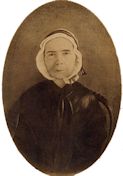
“Mountain View,” September 22.—Came down here with Mr. _____, a few days ago. Spent this day not quite so profitably as I desired. The ride to the “old chapel,” where we had service, is so long, that we spent a great deal of time upon the road. Bishop Meade delivered a most interesting address. He mentioned with great feeling the death of Mr. John A. “Washington, of Mount Vernon, who fell at “Cheat Mountain” a few days ago, while, with some other officers, he was observing the movements of Rosecranz. It is heart-rending to hear of the number of valuable lives which are lost in this cruel war.
Diary of a Southern Refugee During the War by Judith White McGuire
Sept. 18th.—I have been greatly interested in a letter, which has been sent me, written by my nephew, Lt. W. B. N., to his wife, the day after the battle of Manassas. I copy it here because I want his little relations, for whom I am writing this diary, to have a graphic description of the fight, and to know what their family and friends suffered for the great cause.
“Centreville, July 22,1861.
“My dear _____:—For the last four days we have never been longer than two hours in any one place, have slept upon the ground in good weather and bad, eaten nothing but crackers and fried bacon, and rested little at any time; for all of which privations and a thousand others we have been more than compensated (thanks to the just God who governs the councils of history and decrees the destiny of nations) in the glorious results of yesterday. On the morning of the 17th, we had received reliable information that the enemy was advancing, over 50,000 strong, and were not surprised, at five o’clock in the morning, to hear the fire of our pickets, who were slowly retiring before the advancing foe. The order was given to pack. In ten minutes baggage was packed, tents struck, and the wagons driven to the rear; and the whole command forward to line of battle. In a few minutes the glittering bayonets of the enemy lined the neighbouring hills. From the heavy signal-guns being fired at intervals along our line—commencing at Germantown and stretching along to Fairfax Court-House—it was evident that the enemy was endeavouring to surround our little band; but our “Little Trump,” as the men call Beauregard, was not to be taken by any such game. Every preparation was made to deceive the enemy, by inducing him to believe that we meditated a vigorous resistance. Meantime our column defiled through a densely wooded road, and was far on the way to Centreville when the enemy discovered his mistake. He followed on very cautiously. To our troop, with Kemper’s Battery, was assigned the post of honour, and charged with the duty of covering the retreat. We were the last to leave the village, and as we went out at one end of the street, his column appeared at the other. We halted at this place about four o’clock in the afternoon, and again made show of battle—slept until twelve o’clock at the heads of our horses. We silently left the place, the enemy’s pickets being within hailing distance of our own. At daybreak we were across Bull Run, having marched very slowly to keep pace with the infantry. We found beds of leaves in the woods, wrapped ourselves in our blankets, and slept for an hour or two, until we were aroused by the roar of the enemy’s guns as he opened his batteries upon our lines. For two mortal hours shot and shell flew thick along our whole line. This day’s work was evidently intended only to draw the fire of our artillery, and show where our batteries were, in consequence of which our gunners were ordered not to fire a single shot, unless within point-blank range. After thus opening the ball, two dense masses of infantry were sent to defile to the right and left, to make two separate attacks. It was indeed a beautiful sight as they came down in perfect order, and with the stealthy step of veterans. They came nearer and yet nearer, and yet no shot from our guns. Our men began to mutter, and say that we were preparing for another retreat. But in a few moments the appointed time arrived. A single shot from the Washington Artillery gave the signal of death, and for half an hour there was nothing but a continuous sheet of flame along the right of our lines. The enemy fell back, rallied, and charged again, with a like result. Again they rested, and rushed forward, but old Virginia was true to herself, and the gallant Seventeenth and Eighteenth Regiments charged them with the bayonet, and drove them back in utter confusion. The cavalry were held in reserve, and although within range of the artillery, and constantly experiencing the sensation which men may be supposed to indulge, who know there is a hidden danger hovering in the air, without knowing where it is to light, took no part in the action. Our time came yesterday, however. Our troop was for four hours in the hottest of the fight, and every man in it won the applause and approbation of the whole camp. The action commenced at eight o’clock on the sweet Sabbath morning. The enemy commenced with quite a heavy cannonade upon our right, which proved to be a mere feint, to distract our attention, as his main attack was directed to our left wing. At ten o’clock the enemy had crossed the river on our left, and then the fighting commenced in earnest. From the hill on which we stood, we could see, from the smoke and dust, though at the distance of several miles, how the fight was waging on our left. Some thought the enemy was retreating; others that our men had fallen back. It was an hour of painful interest. At eleven o’clock an aid-de-camp rode up in a gallop, and said our men were retiring—the cavalry was ordered to the left. We were temporarily attached to Radford’s regiment—ours was the first company, and mine was the first platoon. On we dashed in a gallop, and as we passed within range of a battery of rifled cannon a ball was fired at us which passed between Wickham and myself, knocking up a cloud of dust. Without wavering in their ranks, the men and horses dashed forward at a gallop. As we reached the scene of action the sight was discouraging in the extreme. The enemy had at first the advantage of every attacking party. He had concentrated his forces for an attack upon one point. The First Louisiana Regiment and the Fourth Alabama, attacked in flank and centre by 30,000 men, were literally cut to pieces. They refused to surrender, but retired slowly, disputing every inch of ground. As we rode up we could meet parts of companies which had been utterly overwhelmed—the men wounded, their arms broken, while some of them were carrying off their dead in blankets. Everything looked like retreat. We were ordered up to within five hundred yards of the enemy’s artillery, behind a hill which afforded some protection against their destructive fire. For one hour the fire raged with incessant fury. A ball passed over the hill and through our ranks, grazing one of our men. A shell exploded just under Radford’s horse, and every minute shot and shell were continually whistling by us. I can give you no conception of that awful hour. Not a man shrank from his post. Two of our men were taken exceedingly sick, one fainting from the heat and excitement. Such calmness and composure I never witnessed. To make the matter worse, despondency, if not despair, was fast writing itself upon every face. The fire was evidently approaching us. Our friends were retiring, and the whispered rumour passed from lip to lip that our artillery ammunition was running low. In a moment, however, a cloud of dust in our rear showed the approach of our wagons, coming up at a dashing rate, with a fresh supply. Our reinforcements now commenced pouring in. Georgia, South Carolina, Alabama, Mississippi, and Tennessee swept by in their glittering array with the calm light of battle on their faces, and their bayonets gleaming in the quiet Sabbath sunshine. No man faltered, no man lagged behind. Neither the groans of the dying nor the shrieks of the wounded, as they passed by in crowded ambulances, seemed to produce any impression except to fix the determination upon the countenances of all, to win or to die upon the field. The tide now seemed to ebb, just enough to keep us from despair. The firing did not advance, although the explosion of their shells was terrific in the extreme. A gleam of hope, too, gradually broke in upon us, when Kemper’s Battery, which had been posted in our centre, galloped up and opened a destructive fire upon our extreme left. The advance was evidently checked, when a loud cheer in the front told us that something unusual had happened. What was it? Was it the triumph of our enemies over our poor stricken friends; or was it some advantage gained by courage in defence of right? The suspense was awful. Men stood straight in their stirrups and stretched their eyes as if they could pierce the rugged bosom of the barren hill which raised its scarred front between them, An aid passed up. His message is written on his face, and before he speaks a word a wild shout breaks from the throats of thousands. When he speaks, another, another and another round of cheers told the story to our hitherto sinking hearts. The Fourth Virginia Regiment had taken Sprague’s Rhode Island Battery of six pieces, at the point of the bayonet. Scarcely had the echo of our cheers died away when again the noise of shouting broke upon the air. What was it? Had the enemy rallied and retaken the guns? Fear struggled with hope. But no: the gallant Twenty-seventh, envious of the glorious achievement of the Fourth, at a single dash had charged a regiment of regulars, swept them from the field, and taken every gun in Sherman’s Battery. The firing of musketry and the rattling of bayonets was now terrible beyond description. For one hour there was an incessant cracking of rifles, without a single moment’s pause. The enemy were evidently retiring, and unless reinforced from the left and centre, the day was ours.
“To prevent this, our field telegraph had already given the signal for movement upon our own right, and a heavy fire of musketry and artillery told us that Bonham’s Brigade, to which we had been attached in the morning, had crossed the run and were pouring it into the enemy’s centre. The South Carolina boys dashed up the hill in face of a murderous fire, bayoneted their gunners, and took quiet possession of their central battery. It was three o’clock, and the day was ours. The Washington Artillery galloped up the hill on which we were posted, and opened a perfect Vesuvius of shot and shell upon the receding foe. Colonel Lay then rode up and told us that the time for us to act had arrived. Our whole body of cavalry, 2,700 strong, now rushed like the wind to the front. It was indeed a brilliant spectacle, as, with slackened rein and sabres drawn, the whole command dashed past. The whole line resounded with continued cheering. The force was divided into different detachments. Colonel Radford, with six companies, was ordered to cross a short distance below the enemy’s extreme right, and intercept his column. Our company was in front, and I was riding in front of my platoon, when, after crossing the swamp, we came suddenly on a detachment of the enemy concealed in the bushes, with their pieces levelled. The Colonel ordered the charge, and our boys rushed on. Poor B. F. was at my side when we rode over two of them, and they grounded their arms to E. W., who was just in our rear. We galloped on in pursuit of the rest, who retreated across a field, towards the road on which the enemy was retreating. Fontaine was just behind me. Saunders, a fine young fellow, just twenty-four years of age, and splendidly mounted, dashed by us. The enemy had concealed themselves behind a fence; we rode up, and I demanded their surrender; they made no reply. I ordered Saunders to fire; before he levelled his carbine the whole squad poured in a volley. Saunders fell dead at my feet, and Edmund Fontaine reeled in his saddle, exclaiming, “Save me, boys; I am killed!” He was caught in the arms of his cousin, who was just in my rear. Three of my platoon fired, and the two who had shot Fontaine and Saunders fell dead in their tracks. We were now in full view of the enemy’s columns, passing in rapid and disorderly retreat along the road, with two pieces of artillery, a large number of baggage-wagons, and some officers’ carriages. Colonel Radford, who is a soldier of experience, knew the strength of the enemy and ordered a halt, commanding the men to form. But such a thing was utterly impossible. The men seemed perfectly delirious with excitement, and with a wild shout of, “The guns, the guns !” our whole company rushed pell-mell upon the battery, which proved to be another detachment of the Rhode Island Artillery. Such a scene of wild excitement I never witnessed. My platoon had been detached from the company, and the company from the regiment. There were two caissons and two guns; the guns behind the caissons. My platoon, which was furthest down the road, rushed upon the men who guarded them. One fellow was standing on the caisson, whipping the horses to make them run; they had become so much alarmed that they stood perfectly still, and trembled. I made a blow at him with my sabre, knocked him off the caisson, and he was shot twice before he reached the ground. Meantime W. (who behaved admirably), with the main body, crossed the road higher up, and when the main body of the regiment came up, our company, with some of the Alexandria cavalry, had killed and wounded every man at the guns, and driven the infantry supports in rapid retreat. When we left we expected to be supported by infantry and artillery, and you may imagine our astonishment when, with not quite 300 men, we found that we had nearly cut into the enemy’s column, and upon looking one hundred yards down the road, we found them preparing to open on us with two guns supported by six regiments of infantry. The Colonel at once ordered a retreat, so we shot the horses to the caissons, so as to block up the road, and retreated, not, however, before they had poured in upon us four rounds of grape and canister at one hundred and fifty yards’ distance. How we escaped a perfect massacre I cannot say. Had they not been so close to us the slaughter would have been terrible. Four of our men were killed. Captain Radford, brother of the Colonel, was literally blown to pieces. I escaped without a scratch, (as did all the rest of the officers,) excepting quite a severe bruise caused by my horse having pressed my leg against the wheel to the gun-carriage. We brought off several prisoners, a great many pistols, and several horses. Just ahead of the guns was a very handsome open carriage. As soon as they saw us, such a rush! It is suspected, or rather hoped, that Wilson, of Massachusetts, (who was, it is known, on the field,) was in it. One of our men, Linkey by name, took it into his head that General Scott was in it, pursued and overtook it, but at the distance of thirty steps fired his musketine, with eighteen buck-shot, right into the back window.
“As we returned, a melancholy mistake occurred. Bowles, our second lieutenant, who was carrying poor Fontaine to the hospital, with one or two others, met a detachment of four of the Appomattox cavalry, who hailed him. It is said that, instead of giving the signal agreed upon in our camp, by raising the hand to the top of the head, he took them for the enemy, and answered “Federal troops.” They fired and he fell dead. Our company received, upon its return, the congratulations of every officer on General Bonham’s staff, to whom Colonel R. had spoken of the conduct of our men. To-day it has been raining incessantly. Our column pushed on this morning to this place. Our company was assigned the advance-guard, and this morning at ten o’clock, I had the honor of occupying the city of Centreville. The citizens tell us that about twelve o’clock last night the cry passed through the camp that the Virginia horsemen were upon them, when they left in wild confusion. Our triumph has been complete. In two days our noble army has driven them back to Alexandria, captured forty-two guns, many colors, and how many prisoners I will not venture to say. After we reached this place, we were ordered to explore the surrounding country in quest of fugitives. We took eighteen prisoners, and got back just at night, very wet. You never saw such a collection of property as was left in their flight. Hundreds of muskets, gun carriages, wagon horses; thousands of knapsacks, oil-cloths and blankets, hogsheads of sugar, barrels of pork, beans, etc.; in short, every thing you can conceive. We found to-day over five hundred splendid army overcoats.
“The men are amusing themselves to-night reading letters, of which there were thousands left on the field. Some of them were directed to Mr. So-and-So, expected at Manassas Junction. Some asked for a piece of the floor of the house in which Ellsworth was killed, with blood on it; while others confidently express the belief that Beauregard’s scalp was to be carried to Washington. When I tell you that we supped to-night on Yankee crackers, Yankee coffee, and a nice beef-tongue, actually left on the hearth of one of the officers’ quarters, in a kettle, ready to be set on the fire— that this is written with a Yankee pencil, given me by one of the men, and on Yankee paper, taken from their wagons, and that I am sitting on a Yankee camp-stool, and writing by a Yankee candle, you can form some idea of the utter rout. I have a pincushion for L., picked up on the field, a needle-case for K., and a sword taken from a Vermont volunteer, for W. Our troops occupy Fairfax Courthouse to-day. I will try and see you soon. Good-night. God bless and protect you. I feel that he has protected me in the last few days, in answer to the prayers of a pious wife. I hope that I feel grateful for my preservation.”
Sept. 16th.—Just returned from Annfield, where we have spent a charming day, with most delightful society. The papers brought us news of success in the West, General Floyd having overcome Rosecranz on Gauley River. This gave us great satisfaction, as we are peculiarly anxious about that part of Virginia. We passed the time in talking over the feats of our heroes, as well as in enjoying the elegancies by which we were surrounded.
Sept. 12th.—Yesterday was the wedding of our dear _____. The marriage of a child is always melancholy when it involves separation, but particularly so under such circumstances. But surely never were refugees so blessed with friends. Our plan was to have the ceremony in the church, and then to proceed to Winchester, where the bridal party would take the stage for Strasburg, and thence by the cars to Richmond; but we were overruled by Mr. P., who invited his and our friends for the evening, and a beautiful entertainment was prepared for them. We all exercised our taste in arranging the table, which, with its ices, jellies, and the usual etceteras of an elegant bridal supper, made us forget that we were in a blockaded country. A pyramid of the most luscious grapes, from Bishop Meade’s garden, graced the centre of the table. The bridesmaids were three, and groomsman one, and he, poor fellow, had to go off in the storm of last night, because his furlough lasted but forty-eight hours, and his station is Culpepper Court-House. The groom had a furlough of but three days, to come from and return to Richmond. The Bishop and Mrs. J. arrived in the morning. The party consisted of ladies, and gentlemen too old for the service. Bishop J. performed the ceremony. Bishop Meade professed to be too old for such occasions, and declined coming. We feel very lonely this morning, and turn to the newspapers more than we have done for some time.
I saw a young soldier the other day, who told me he could see the top of our house distinctly from “Munson’s Hill.” Oh, that I could know what is going on within those walls, all encompassed by armies as it is. With my mind’s eye I look into first one room and then another, with all the associations of the past; the old family Bible, the family pictures, the library, containing the collection of forty years, and so many things which seemed a part of ourselves. What will become of them? Who are now using or abusing them?
“The Briars,” Sept. 6.—We returned home, as we are wont to call this sweet place, yesterday, and are just now taken up with family matters of deep interest. The army in Virginia seems quiet; but our arms had a severe reverse on Thursday. Fort Hatteras was bombarded and taken by Federal vessels. They also secured many prisoners.
General Floyd, in Western Virginia, had a severe skirmish with the enemy, about a week ago, and drove them off with considerable loss. Our loss was small.
Norwood, Near Berryville, August 26.—On a visit of a few days to our relative, Dr. M. The people of this neighbourhood occupied as they are in the one I left. All hearts and hands seem open to our army. Four heavily laden wagons have left Berryville within a few days, for the hospitals below. We are all anxious about Western Virginia, of which we can hear so little. General Lee and General Floyd are there, and if they can only have men and ammunition enough we have nothing to fear.
The army in Fairfax seems quiet. Colonel Stuart, with his cavalry, has driven the enemy back, and taken possession of “Chestnut Hill” as head-quarters. There they are overlooking Washington, Georgetown, and our neighbourhood, all bristling with cannon, to prevent their nearer approach. Some of those young men can almost point from the hills on which they are encamped, to chimneys of their own firesides, the portals of their own homes. The woods are cleared away for miles; even the yard trees are gone, leaving the houses in bold relief, with nothing to shade, nothing to obscure them. I do pity those who were obliged to stay in Southern homes, with Southern hearts, surrounded by bitter and suspicious enemies. My old friend Mrs. D. is sometimes in their lines, sometimes in ours. When our men are near her, they are fed from her table, and receive all manner of kindness from her hands. Some of my nephews have been invited to her table, and treated as her relations. When they entered her house she advanced towards them with outstretched hands. “You don’t know me, but I knew your mother, father, and all your relations; and besides, I am connected with you, and you must come to my house while near me, as to that of an old friend.” Nothing could be more grateful to a soldier far away from home and friends. But these were her bright moments. She has had many trials while in the enemy’s lines. Her husband and grown son are in the Confederate service; she has sent her two young daughters to her friends in the lower country, and has remained as the protector of her property, with her two sons of eight and ten, as her companions. On one occasion her servant was driving the cows from her yard to be milked; from very loneliness she called to the servant to remain and milk them where they were; the very tinkling of the cow-bell was pleasant to her. It was scarcely done when a posse of soldiers came with their bayonets gleaming in the moonlight, and demanded, “Why did you have a bell rung in your yard this evening?” “Do you mean, why did the cow-bell ring? Because the cow shook her head while she was being milked.” “But you don’t have the cows milked in the yard every evening. It was a signal to the rebels—you know it was—and your house shall be burnt for it.” She then had to plead her innocence to save her house, which they pretended not to believe until the servants were called up to prove her statements. They then, with threats and curses, went off. Another night she carried a candle from room to room to seek some missing article. In a short time several soldiers were seen running to her house with lighted torches, yelling “Burn it, bum it to the ground!” She ran to the yard to know the cause; instantly this lonely woman was surrounded by a lawless, shouting soldiery, each with a burning torch, revealing, by its lurid and fitful light, a countenance almost demoniac. They seemed perfectly lawless, and without a leader, for each screamed out, “We are ordered to burn your house.” “Why?” said she. “Because you have signal-lights at your windows for the d__d rebels.” She immediately suspected that no such order had been given, and summoning firmness of voice and manner to her aid, she ordered them off, saying that she should send for an officer. They did go, uttering imprecations on her defenceless head. But a still more trying scene occurred a short time ago. Our soldiers were surrounding her house, when Colonel Stuart sent off a raiding party. During that night the Yankees advanced, and our men retired. The Yankees at once heard that the raiders were out; but in what direction was the question. They came up to her house, and knowing the mother too well to attempt to extort any thing from her, ordered the little boys to tell them in what direction Colonel Stuart had gone. The boys told them that they could tell nothing. Threats followed; finally handcuffs and irons for the ankles were brought. Still those little heroes stood, the one as pale as ashes, the other with his teeth clenched over his under lip, until the blood was ready to gush out, but not one word could be extorted, until, with a feeling of hopelessness in their efforts, they went off, calling them cursed little rebels, etc. The mother saw all this, and stood it unflinchingly—poor thing! It is harrowing to think of her sufferings. Yet, if she comes away, her house will be sacked, and perhaps burnt.
We are sometimes alarmed by reports that the enemy is advancing upon Winchester; but are enabled to possess our souls in patience, and hope that all may be well. I see that they are encroaching upon the Northern Neck. I trust they may be repulsed from that fair land.
August 20.—We are rejoicing over a victory at Springfield, Missouri—General Lyon killed and his troops routed. Our loss represented large. I have only seen the Northern account.
No news from home, and nothing good from that quarter anticipated. We are among dear, kind friends, and have the home feeling which only such genuine and generous hospitality can give; but it sometimes overpowers me, when I allow myself to think of our uncertain future.
12th.—Still nothing from the army. We go on here quietly and happily—as happily as the state of the country will allow. The household peaceful and pleasant. The ladies—all of us collect in one room—work, while one reads some pleasant book. We are mercifully dealt with, and I hope we are grateful for such blessings.
The Northern papers tell us that General Patterson has withdrawn from the Northern army. The reason thereof is not mentioned; but we shrewdly suspect that the powers at Washington are not entirely satisfied that he was so completely foiled by General Johnston. General Johnston was fighting the battle of Manassas before General P. knew that he had left the Valley. The rumour that he had gone to join McDowell was unfounded. For many days there was no intercourse between the section occupied by the Federal army and that occupied by ours; pickets were placed on every road, to prevent any one from passing towards General P. Gentlemen who had come to Winchester and Berryville on business for a few hours, were not allowed to return home for days. So how could the poor man know what was going on? We only fear that his place may be supplied by one more vigilant. General Scott, too, has been almost superseded by General McClellan, who seems just now to be the idol of the North. The Philadelphia papers give a glowing description of his reception in that city. It was his luck, for it seems to me, with his disciplined and large command, it required no skill to overcome and kill the gallant General Garnett at Rich Mountain. For this he is feted and caressed, lionized and heroized to the greatest degree. I only hope that, like McDowell and Patterson, he may disappoint their expectations.
The Briars, August 10.—Nothing new from the army. All seems quiet; no startling rumours within the past week. The family somewhat scattered: M. P. has gone to the “Hot Springs,” J. to Capon Springs, both in quest of health; E. P. and E. M. are at “Long Branch” (Mr. H. N’s) on a visit to a young friend.
J. P. has just called, having resigned his commission in the United States Navy, and received one in the Confederate; he is on his way to Richmond for orders. He tells me that my dear W. B. P. has come in from Kentucky, with the first Kentucky Regiment, which is stationed near Centreville. It is right he should come; and I am glad he has, though it is another source of painful anxiety to me.
August 1.—This whole neighbourhood is busy to-day, loading a wagon with comforts for the hospital at Fairfax Court-House. They send it down once a week, under the care of a gentleman, who, being too old for the service, does this for the sick and wounded. The hospitals at Centreville and the Court-House are filled with those who are too severely wounded to be taken to Richmond, Charlottesville, and the larger hospitals. They are supplied, to a very great degree, by private contributions. It is beautiful to see the self-denying efforts of these patriotic people. Everybody sends contributions on the appointed day to Millwood, where the wagon is filled to overflowing with garments, brandy, wine, nice bread, biscuit, sponge cake, butter, fresh vegetables, fruit, etc. Being thoroughly packed, it goes off for a journey of fifty miles.


