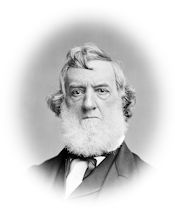
Following the American Civil War Sesquicentennial with day by day writings of the time, currently 1863.

Diary of Gideon Welles

September 16. Chase called on me this morning. Wishes a secret concerted attack on Richmond. Says Stanton will furnish 10,000 men. Told him we would do all that could be expected of the Navy in a sudden movement, but doubted if a military expedition could be improvised as speedily and decisively as he supposed. He thought it could certainly be effected in six days. I told him to try. We would have a naval force ready in that time, though not so large and powerful as I would wish; but we would do our part.

Chase tells me that Harrington, Assistant Secretary of the Treasury, was at Fortress Monroe last Thursday and heard Bankhead, who commands the Minnesota, say that the Government was a poor affair, that the Administration was inefficient, that it is time the politicians were cleared out of Washington and the army in power. Harrington called subsequently and confirmed the statement,—less strong perhaps in words but about as offensive. I requested him to reduce his statement to writing.

At the Executive Mansion, the Secretary of State informed us there was to be no Cabinet-meeting. He was authorized by the President to communicate the fact. Smith said it would be as well, perhaps, to postpone the Cabinet-meetings altogether and indefinitely, — there seemed no use latterly for our coming together. Others expressed corresponding opinions. Seward turned off, a little annoyed.

An unfavorable impression is getting abroad in regard to the President and the Administration, not without reason, perhaps, which prompted Smith and others to express their minds freely. There is really very little of a government here at this time, so far as most of the Cabinet are concerned; certainly but little consultation in this important period. Seward, when in Washington, spends more or less of each day with the President, absorbs his attention, and I fear to an extent influences his action not always wisely. The President has good sense, intelligence, and an excellent heart, but is sadly perplexed and distressed by events. He, to an extent, distrusts his own administrative ability and experience. Seward, instead of strengthening and fortifying him, encourages this self-distrust, but is not backward in giving his own judgment and experience, which are often defective expedients, to guide the Executive. A conviction of this state of things stirred up Smith to make his remarks. The President has, I believe, sincere respect and regard for each and every member of the Cabinet, but Seward seeks, and has at times, influence, which is sometimes harmful. The President would often do better without him, were he to follow his own instincts, or were he to consult all his advisers in council. He would find his own opinions confirmed and be convinced that Seward’s suggestions are frequently unwise and weak and temporizing. No one attempts to obtrude himself, or warn the President, or even to suggest to him that others than S. should be consulted on some of the important measures of the Government. In fact, they are not informed of some of the measures which are of general interest until they see them in operation, or hear of them from others. Chase is much chafed by these things, and endeavors, and to some extent succeeds, in also getting beside the President, and obtaining information of what is going forward. But this only excites and stimulates Seward, who has the inside track and means to keep it. The President is unsuspicious, or apparently so; readily gives his ear to suggestions from any one. Only one of his Cabinet, however, has manifested a disposition to monopolize his attention; but the discussion of important measures is sometimes checked almost as soon as introduced, and, without any consultation, or without being again brought forward, they are disposed of, the Secretary of State alone having had sometimes certainly a view, or car, or eye in the matter. He alone has abbreviated general consultation in many cases. With greater leisure than most of the Cabinet officers, unless it be Smith of the Interior, he runs to the President two or three times a day, gets his ear, gives him his tongue, makes himself interesting by anecdotes, and artfully contrives with Stanton’s aid to dispose of measures without action or give them direction independent of his associates. Under the circumstances, I perhaps am, latterly, as little interfered with as any one, though the duties of the State and Navy Departments run together; yet I am sometimes excessively annoyed and embarrassed by meddlesome intrusions and inconsiderate and unauthorized action by the Secretary of State. The Navy Department has, necessarily, greater intimacy, or connection, with the State Department than any other, for, besides international questions growing out of the blockade, our squadrons and commanders abroad come in contact with our ministers, consuls, and commercial agents, and each has intercourse with the Governments and representatives of other nations. Mutual understanding and cooperation are therefore essential and indispensable. But while I never attempt to direct the agents of the State Department, or think of it, or to meddle with affairs in the appropriate sphere of the Secretary of State, an entirely different course is pursued by him as regards the Navy and naval operations. He is anxious to direct, to be the Premier, the real Executive, and give away national rights as a favor. Since our first conflict, however, when he secretly interfered with the Sumter expedition and got up an enterprise to Pensacola, we have had no similar encounter; yet there has been an itching propensity on his part to have a controlling voice in naval matters with which he has no business, — which he really does not understand, — and he sometimes improperly interferes as in the disposition of mails on captured vessels. The Attorney-General has experienced similar improper interference, more than any other perhaps; none are exempt. But the Secretary of State, while meddlesome with others, is not at all communicative of the affairs of his own Department. Scarcely any important measures or even appointments of that Department are brought before us, except by the President himself or by his express direction. The consequence is that there is reticence by others and the Government is administered in a great measure by Departments. Seward is inquisitive and learns early what is doing by each of his associates, frequently before we meet in council, while the other Cabinet officers limit themselves to their provided duties and are sometimes wholly unadvised of his.

I have administered the Navy Department almost entirely independent of Cabinet consultation, and I may say almost without direction of the President, who not only gives me his confidence but intrusts all naval matters to me. This has not been my wish. Though glad to have his confidence, I should prefer that every important naval movement should pass a Cabinet review. To-day, for instance, Wilkes was given the appointment of Acting Rear Admiral, and I have sent him off with a squadron to cruise in the West Indies. All this has been done without Cabinet consultation, or advice with any one, except Seward and the President. The detail and the reserve are at the instigation of Seward, who wished Wilkes, between whom and himself, since the Trent affair, there seems to be an understanding, to have a command, without specifying where. In due time our associates in the Cabinet will learn the main facts and infer that I withheld from them my orders. My instructions to our naval officers, — commanders of squadrons or single ships, — cruising on our blockade duty, have never been submitted to the Cabinet, though I have communicated them freely to each. I have never read but one of my letters of instructions to the President, and that was to Captain Mercer of the Powhatan in command of the naval expedition to Sumter a few weeks after I entered upon my duties, and those instructions were, covertly, set aside and defeated by Seward.

So in regard to each and all the Departments; if I have known of their regulations and instructions, much of it has not been in Cabinet consultations. Seward beyond any and all others is responsible for this state of things. It has given him individual power, but often at the expense of good administration.

In everything relating to military operations by land, General Scott first, then McClellan, then Halleck, have directed and controlled. The Government was virtually in the hands of the General-in-Chief, so far as armies and military operations were concerned. The Administration had no distinct military policy, was permitted to have none. The President was generally advised and consulted, but Seward was the special confidant of General Scott, was more than any one of McClellan, and, in conjunction with Stanton, of Halleck. With wonderful kindness of heart and deference to others, the President, with little self-esteem and unaffected modesty, has permitted this and in a great measure has surrendered to military officers prerogatives intrusted to himself. The mental qualities of Seward are almost the precise opposite of the President. He is obtrusive and never reserved or diffident of his own powers, is assuming and presuming, meddlesome, and uncertain, ready to exercise authority always, never doubting his right until challenged; then he becomes timid, uncertain, distrustful, and inventive of schemes to extricate himself, or to change his position. He is not particularly scrupulous in accomplishing an end, nor so mindful of what is due to others as would be expected of one who aims to be always courteous towards equals. The President he treats with a familiarity that sometimes borders on disrespect. The President, though he observes this ostentatious presumption, never receives it otherwise than pleasantly, but treats it as a weakness in one to whom he attributes qualities essential to statesmanship, whose pliability is pleasant, and whose ready shrewdness he finds convenient and acceptable.

With temperaments so constituted and so unlike it is not surprising that the obsequious affability and ready assumption of the subordinate presumed on and to an extent influenced the really superior intellect of the principal, and made himself in a degree the centralizing personage. While the President conceded to the Secretary of State almost all that he assumed, not one of his colleagues made that concession. They treated his opinions respectfully, but as no better than the opinions of others, except as they had merit; and his errors they exposed and opposed as they deserved. One or two have always been ready to avail themselves of the opportunity. In the early days of the Administration the Cabinet officers were absorbed by labors and efforts to make themselves familiar with their duties, so as rightly to discharge them. Those duties were more onerous and trying, in consequence of the overthrow of old parties and the advent of new men and new organizations, with the great rupture that was going on in the Government, avowedly to destroy it, than had ever been experienced by any of their predecessors.

Whilst the other members of the Cabinet were absorbed in familiarizing themselves with their duties and in preparing for impending disaster, the Secretary of State, less apprehensive of disaster, spent a considerable portion of every day with the President, patronizing and instructing him, hearing and telling anecdotes, relating interesting details of occurrences in the Senate, and inculcating his political party notions. I think he has no very profound or sincere convictions. Cabinet-meetings, which should, at that exciting and interesting period, have been daily, were infrequent, irregular, and without system. The Secretary of State notified his associates when the President desired a meeting of the heads of Departments. It seemed unadvisable to the Premier — as he liked to be called and considered — that the members should meet often, and they did not. Consequently there was very little concerted action.

At the earlier meetings there was little or no formality; the Cabinet-meetings were a sort of privy council or gathering of equals, much like a Senatorial caucus, where there was no recognized leader and the Secretary of State put himself in advance of the President. No seats were assigned or regularly taken. The Secretary of State was invariably present some little time before the Cabinet assembled and from his former position as the chief executive of the largest State in the Union, as well as from his recent place as a Senator, and from his admitted experience and familiarity with affairs, assumed, and was allowed, as was proper, to take the lead in consultations and also to give tone and direction to the manner and mode of proceedings. The President, if he did not actually wish, readily acquiesced in, this. Mr. Lincoln, having never had experience in administering the Government, State or National, deferred to the suggestions and course of those who had. Mr. Seward was not slow in taking upon himself to prescribe action and doing most of the talking, without much regard to the modest chief, but often to the disgust of his associates, particularly Mr. Bates, who was himself always courteous and respectful, and to the annoyance of Mr. Chase, who had, like Mr. Seward, experience as a chief magistrate. Discussions were desultory and without order or system, but in the summing-up and conclusions the President, who was a patient listener and learner, concentrated results, and often determined questions adverse to the Secretary of State, regarding him and his opinions, as he did those of his other advisers, for what they were worth and generally no more. But the want of system and free communication among all as equals prevented that concert and comity which is really strength to an administration.

Each head of a Department took up and managed the affairs which devolved upon him as he best could, frequently without consulting his associates, and as a consequence without much knowledge of the transactions of other Departments, but as each consulted with the President, the Premier, from daily, almost hourly, intercourse with him, continued, if not present at these interviews, to ascertain the doings of each and all, though himself imparting but little of his own course to any. Great events of a general character began to impel the members to assemble daily, and sometimes General Scott was present, and occasionally Commodore Stringham; at times others were called in. The conduct of affairs during this period was awkward and embarrassing. After a few weeks the members, without preconcert, expressed a wish to be better advised on subjects for which they were all measurably responsible to the country. The Attorney-General expressed his dissatisfaction with these informal proceedings and advised meetings on stated days for general and current affairs, and hoped, when there was occasion, special calls would be made. The Secretary of State alone dissented, hesitated, doubted, objected, thought it inexpedient, said all had so much to do that we could not spare the time; but the President was pleased with the suggestion, if he did not prompt it, and concurred with the rest of the Cabinet.

The form of proceeding was discussed; Mr. Seward thought that would take care of itself. Some suggestions were made in regard to important appointments which had been made by each head of Department, the Secretary of State taking the lead in selecting high officials without general consultation. There seemed an understanding between the Secretaries of State and Treasury, who had charge of the most important appointments, of which understanding the President was perhaps cognizant. Chase had extensive patronage, Seward appointments of high character. The two arranged that each should make his own selection of subordinates. These two men had political aspirations which did not extend to their associates (with perhaps a single exception that troubled neither). Chase thought he was fortifying himself by this arrangement, but he often was overreached, and the arrangement was one of the mistakes of his life.

Without going farther into details, the effect, and probably the intention, of these proceedings in those early days was to dwarf the President and elevate the Secretary of State. The latter also circumscribed the sphere of [the former] so far as he could. Many of the important measures, particularly of his own Department, he managed to dispose of, or contrived to have determined, independent of the Cabinet.

My early collision with him in some complications connected with the Sumter and Pensacola expeditions, when he was so flagrantly wrong as to be overruled by the President, caused us to get along thenceforward without serious difficulties, though, our duties being intimate, we were often brought together and had occasional disagreements. Between Seward and Chase there was perpetual rivalry and mutual but courtly distrust. Each was ambitious. Both had capacity. Seward was supple and dexterous; Chase was clumsy and strong. Seward made constant mistakes, but recovered with a facility that was wonderful and almost always without injury to himself; Chase committed fewer blunders, but persevered in them when made, often to his own serious detriment. In the fevered condition of public opinion, the aims and policies of the [two] were strongly developed. Seward, who had sustained McClellan and came to possess, more than any one else in the Cabinet, his confidence, finally yielded to Stanton’s vehement demands and acquiesced in his sacrifice. Chase, from an original friend and self-constituted patron of McC, became disgusted, alienated, an implacable enemy, denouncing McClellan as a coward and military imbecile. In all this he was stimulated by Stanton, and the victim of Seward, who first supplanted him with McC. and then gave up McC. to appease Stanton and public opinion.

September 15. Some rumors yesterday and more direct information to-day are cheering to the Union cause. McClellan telegraphs a victory, defeat of the enemy with loss of 15,000 men, and that “General Lee admits they are badly whipped.” To whom Lee made this admission so that it should be brought straight to McC. and telegraphed here does not appear. A tale like this from Pope would have been classed as one of his fictions. It may be all true, coming from McClellan, but I do not credit Lee’s confession or admission. That we have had a fight and beaten the Rebels, I can believe. It scarcely could have been otherwise. I am afraid it is not as decisive as it should be, and as is the current belief, but shall rejoice if McC. has actually overtaken the Rebels, which is not yet altogether clear.

September 13. The country is very desponding and much disheartened. There is a perceptibly growing distrust of the Administration and of its ability and power to conduct the war. Military doubts were whispered on the Peninsula by McClellan’s favorites before his recall, and when he was reinstated public confidence in the Administration throughout the country was impaired. Citizens and military, though from different causes, were distrustful. It is evident, however, that the reinstatement of McC. has inspired strength, vigor, and hope in the army. Officers and soldiers appear to be united in his favor and willing to follow his lead. It has now been almost a week since he left Washington, yet he has not overtaken the enemy, who are not distant. There is doubt whether he is thirty miles from Washington. Perhaps he ought not to be, until he has gathered up and massed the dispersed elements of his command. I shall not criticize in ignorance, but insist it is the duty of all to sustain him. I am not without hopes that his late experience and the strong pressure of public opinion will overcome his hesitancy and rouse him to thorough work. He is never rash. I fear he is not a fighting general. Stanton is cross and grouty. A victory for McClellan will bring no joy to him, though it would gladden the whole country.

Rev. Dr. Patton of Chicago, chairman of a committee appointed in northern Illinois, desired an introduction with his associates to the President, to advise with him on the subject of slavery and emancipation. The President assented cheerfully.

September 12, Friday. A clever rain last night, which I hope may swell the tributaries of the upper Potomac.

A call from Wilkes, who is disturbed because I press him so earnestly. Told him I wished him off as soon as possible; had hoped he would have left before this; Rebel cruisers are about and immense injury might result from a single day’s delay. I find the officers generally dislike to sail with him.

A brief meeting of the Cabinet. Seward was not present. Has met with us but once in several weeks. No cause assigned for this constant absence, yet a reluctance to discuss and bring to a decision any great question without him is apparent.

In a long and free discussion on the condition of the army and military affairs by the President, Blair, Smith, and myself, the President repeated what he had before said to me, that the selection of McClellan to command active operations was not made by him but by Halleck, and remarked that the latter was driven to it by necessity. He had arranged his army corps and designated the generals to lead each column, and called on Burnside to take chief command. But Burnside declined and declared himself unequal to the position. Halleck had no other officer whom he thought capable and said he consequently was left with no alternative but McClellan.

“The officers and soldiers,” the President said, “were pleased with the reinstatement of that officer, but I wish you to understand it was not made by me. I put McClellan in command here to defend the city, for he has great powers of organization and discipline; he comprehends and can arrange military combinations better than any of our generals, and there his usefulness ends. He can’t go ahead — he can’t strike a blow. He got to Rockville, for instance, last Sunday night, and in four days he advanced to Middlebrook, ten miles, in pursuit of an invading enemy. This was rapid movement for him. When he went up the Peninsula there was no reason why he should have been detained a single day at Yorktown, but he waited, and gave the enemy time to gather his forces and strengthen his position.”

I suggested that this dilatory, defensive policy was partly at least the result of education; that a defensive policy was the West Point policy. Our Government was not intended to be aggressive but to resist aggression or invasion, — to repel, not to advance. We had good engineers and accomplished officers, but that no efficient, energetic, audacious, fighting commanding general had yet appeared from that institution. We were all aware that General Scott had, at the very commencement, begun with this error of defense, the Anaconda theory; was unwilling to invade the seceding States, said we must shut off the world from the Rebels by blockade and by our defenses. He had always been reluctant to enter Virginia or strike a blow. Blair said this was so, that we had men of narrow, aristocratic notions from West Point, but as yet no generals to command; that there were many clever second-rate men, but no superior mind of the higher class. The difficulty, however, was in the War Department itself. There was bluster but not competency. It should make generals, should search and find them, and bring them up, for there were such somewhere, — far down perhaps. The War Department should give character and tone to the army and all military movements. Such, said he, is the fact with the Navy Department, which makes no bluster, has no blowers, but quietly and intelligently does its work, inspires its officers and men, and brings forward leaders like Farragut, Foote, and Du Pont. The result tells you the value of system, of rightful discrimination, good sense, judgment, knowledge, and study of men. They make ten times the noise at the War Department, but see what they do or fail to do. The Secretary of War should advise with the best and most experienced minds, avail himself of their opinions, not give way to narrow prejudices and strive to weaken his generals, or impair confidence in them on account of personal dislikes. We have officers of capacity, depend upon it, and they should be hunted out and brought forward. The Secretary should dig up these jewels. That is his duty. B. named Sherman and one or two others who showed capacity.

“McClellan,” said B., “is not the man, but he is the best among the major-generals.” Smith said he should prefer Banks. Blair said Banks was no general, had no capacity for chief command. Was probably an estimable officer in his proper place, under orders. So was Burnside, and Heintzelman, and Sykes, but the War Department must hunt up greater men, better military minds, than these to carry on successful war.

Smith complimented Pope’s patriotism and bravery, and the President joined in the encomiums. Said that Halleck declared that Pope had made but one mistake in all the orders he had given, and that was in ordering one column to retreat on Tuesday from Centreville to Chain Bridge, whereby he exposed his flank, but no harm came of his error. Blair was unwilling to concede any credit whatever to Pope; said he was a blower and a liar and ought never to have been intrusted with such a command as that in front. The President admitted Pope’s infirmity, but said a liar might be brave and have skill as an officer. He said Pope had great cunning. He had published his report, for instance, which was wrong, — an offense for which, if it can be traced to him, Pope must be made amenable, — “But,” said he, “it can never, by any skill, be traced to him.” “That is the man,” said Blair. “Old John Pope,[1] his father, was a flatterer, a deceiver, a liar, and a trickster; all the Popes are so.”

When we left the Executive Mansion, Blair, who came out with me, remarked that he was glad this conversation had taken place. He wanted to let the President know we must have a Secretary of War who can do something besides intrigue, —who can give force and character to the army, administer the Department on correct principles. Cameron, he said, had got into the War Department by the contrivance and cunning of Seward, who used him and other corruptionists as he pleased, with the assistance of Thurlow Weed; that Seward had tried to get Cameron into the Treasury, but was unable to quite accomplish that, and after a hard underground quarrel against Chase, it ended in the loss of Cameron, who went over to Chase and left Seward. Bedeviled with the belief he might be a candidate for the Presidency, Cameron was beguiled and led to mount the nigger hobby, alarmed the President with his notions, and at the right moment, B. says, he plainly and frankly told the President he ought to get rid of C. at once, that he was not fit to remain in the Cabinet, and was incompetent to manage the War Department, which he had undertaken to run by the aid of Tom A. Scott, a corrupt lobby-jobber from Philadelphia. Seward was ready to get rid of Cameron after he went over to Chase, but instead of bringing in an earnest, vigorous, sincere man like old Ben Wade to fill the place, he picked up this black terrier, who is no better than Cameron, though he has a better assistant than Scott, in Watson. Blair says he now wants assistance to “get this black terrier out of his kennel.” I probably did not respond as he wished, for I am going into no combination or movement against colleagues. He said he must go and see Seward. In his dislike of Stanton, Blair is sincere and earnest, but in his detestation he may fail to allow Stanton qualities that he really possesses. Stanton is no favorite of mine. He has energy and application, is industrious and driving, but devises nothing, shuns responsibility, and I doubt his sincerity always. He wants no general to overtop him, is jealous of others in any position who have influence and popular regard; but he has cunning and skill, dissembles his feelings, in short, is a hypocrite, a moral coward, while affecting to be, and to a certain extent being, brusque, overvaliant in words. Blair says he is dishonest, that he has taken bribes, and that he is a double-dealer; that he is now deceiving both Seward and Chase; that Seward brought him into the Cabinet after Chase stole Cameron, and that Chase is now stealing Stanton. Reminds me that he exposed Stanton’s corrupt character, and stated an instance which had come to his knowledge and where he has proof of a bribe having been received; that he made this exposure when Stanton was a candidate for Attorney for the District. Yet Seward, knowing these facts, had induced and persuaded the President to bring this corrupt man into the War Department. The country was now suffering for this mistaken act. Seward wanted a creature of his own in the War Department, that he might use, but Stanton was actually using Seward.

Stanton’s appointment to the War Department was in some respects a strange one. I was never a favorite of Seward, who always wanted personal friends. I was not of his sort, personally or politically. Stanton, knowing his creator, sympathized with him. For several months after his appointment, he exhibited some of his peculiar traits towards me. He is by nature a sensationalist, has from the first been filled with panics and alarms, in which I have not participated; and I have sometimes exhibited little respect or regard for his mercurial flights and sensational disturbances. He saw on more than one occasion that I was cool when he was excited, and he well knew that I neither admired his policy nor indorsed his views. Of course we were courteously civil, but reserved and distant. The opposition in the early days of the Administration were violent against the Navy management, and the class of Republicans who had secretly been opposed to my appointment joined in the clamor. In the progress of events there was a change. The Navy and my course, which had been assailed, — and which assaults he countenanced, — grew in favor, while my mercurial colleague failed to give satisfaction. His deportment changed after the naval success at New Orleans, and we have since moved along harmoniously at least. He is impulsive, not administrative; has quickness, often rashness, when he has nothing to apprehend; is more violent than vigorous, more demonstrative than discriminating, more vain than wise; is rude, arrogant, and domineering towards those in subordinate positions if they will submit to his rudeness, but is a sycophant and dissembler in deportment and language with those whom he fears. He has equal cunning but more force and greater capacity than Cameron; yet the qualities I have mentioned and his uneasy, restless nature make him, though possessed of a considerable ability of a certain sort, an unfit man in many respects for the War Department in times like these. I have sometimes thought McClellan would better discharge the duties of Secretary of War than those of a general in the field, and that a similar impression may have crossed Stanton’s mind, and caused or increased his hate of that officer. There is no love lost between them, and their enmity towards each other does not injure McClellan in the estimation of Blair. Should McClellan in this Maryland campaign display vigor and beat the Rebels, he may overthrow Stanton as well as Lee. Blair will give him active assistance. But he must rid himself of what President Lincoln calls the “slows.” This, I fear, is impossible; it is his nature.


[1] General Pope’s father was Judge Nathaniel Pope, of the United States District Court for Illinois.

September 11, Thursday. I find it difficult to hurry Wilkes off with his command. The public, especially the commercial community, are impatient; but Wilkes, like many officers, having got position, likes to exhibit himself and snuff incense. He assumed great credit for promptness, and has sometimes shown it, but not on this occasion. Has been fussing about his vessel until I had, to-day, to give him a pretty peremptory order.

Men in New York, men who are sensible in most things, are the most easily terrified and panic-stricken of any community. They are just now alarmed lest an ironclad steamer may rush in upon them some fine morning while they are asleep and destroy their city. In their imagination, under the teachings of mischievous persons and papers, they suppose every Rebel cruiser is ironclad, while in fact the Rebels have not one ironclad afloat. It only requires a sensation paragraph in the Times to create alarm. The Times is controlled by Seward through Thurlow Weed, and used through him by Stanton. Whenever the army is in trouble and public opinion sets against its management, the Times immediately sets up a howl against the Navy.

Senator Pomeroy of Kansas called yesterday in relation to a scheme, or job, for deporting slaves and colored people to Chiriqui. I cautioned him against committing himself or the Government to Thompson, or any corporation or association. Let him know my opinion of Thompson’s project and my opposition to it. Advised him, if anything was seriously and earnestly designed, to go to the Government of New Granada or any of the Spanish-American States and treat with them direct, and not through scheming jobbers. Should suspect P. to have a personal interest in the matter but for the fact that the President, the Blairs, and one or two men of integrity and character favor it.

September 10, Wednesday. Colonel Marston of New Hampshire, who has been with the Army of the Potomac for a year, called on me to-day. Says he has no confidence in McClellan as a general; thinks him neither brave nor capable; expresses distrust of the integrity and patriotism of other generals also. Marston is not a brilliant or great man, nor perhaps a very competent military critic to judge of the higher qualifications of his superiors; but he is politically patriotic, and gives the opinion of others with whom he associates as well as his own.

Senator Wilson, who is by nature suspicious and sensational, tells me there is a conspiracy on foot among certain generals for a revolution and the establishment of a provisional national government. Has obtained important information from one of McC.’s staff. Wilson is doubtless sincere in all this, but, being on the military committee, is influenced by Stanton, who is mad with the army and officers who stand by McClellan. There may have been random talk and speculation among military men when idle in camp, but there is nothing serious or intentional in their loose remarks. They and the soldiers are citizens. The government and country is theirs as well as ours.

Secretary Smith says he has heard of these movements. Imputes misfortune and mismanagement to one (Seward) who has the ear of the President and misadvises and misleads him.

H. H. Elliott, Chairman of the Prize Commission in New York, writes me that the public mind there is highly excited and on the eve of revolution. There is, undoubtedly, a bad state of things in New York, and he is surrounded by that class of Democratic partisans whose sympathies and associations were with the Rebels, and who are still party opponents of the Administration.

There are muttering denunciations on every side, and if McClellan fails to whip the Rebels in Maryland, the wrath and indignation against him and the Administration will be great and unrestrained. If he succeeds, there will be instant relief, and a willing disposition to excuse alleged errors which ought to be investigated.

General Halleck is nominally General-in-Chief and discharging many of the important functions of the War Department. I have as yet no intimacy with him and have seen but little of him. He has a scholarly intellect and, I suppose, some military acquirements, but his mind is heavy and irresolute. It appears to me he does not possess originality and that he has little real military talent. What he has is educational. He is here, and came from the West, the friend of Pope, and is in some degree indebted to Pope for his position. Both were introduced here by an intrigue of the War and Treasury with the design of ultimately displacing McClellan, to whom the President has adhered with tenacity, and from whom Stanton alone and unassisted could not alienate him. The President was distressed by McClellan’s tardy movements and failure before Richmond, but did not understand the object which the Secretary of War, seconded by Chase, had in view, nor perhaps did either of the two generals, Pope and Halleck, whose capabilities were wonderfully magnified by Stanton, when ordered here. Pope is a connection of Mrs. Lincoln and was somewhat intimate with the President, with whom he came to Washington in 1861. There were some wonderful military operations on the Mississippi and at Corinth reported of him just before he was ordered here, and which led to it, that have not somehow been fully substantiated. Admiral Foote used to laugh at the gasconade and bluster of Pope. Halleck, Foote insisted, was a military imbecile, though he might make a good clerk. Pope was first brought here, and soon began to second Stanton by sounding the praises of Halleck. On one or two occasions I heard him express his admiration of the extraordinary capacity of Halleck and his wish that H. could be on this field, where his great abilities would comprehend and successfully direct military operations. Stanton would on these occasions back Pope so far as to hope there could be some change. The President listened, was influenced, and finally went to West Point and saw General Scott. Chase had in the mean time abandoned McClellan, and I well remember the vehement earnestness with which, on one occasion when we were examining the maps and criticizing operations before Richmond, he maintained with emphasis we had begun wrong, and could have no success until the army was brought back here, and we started from this point to reach the James River.

How far Halleck was assenting to or committed to Stanton’s implacable hostility to McClellan, or whether he was aware of its extent before he came here, I cannot say. Shortly after he arrived I saw that he partook of the views of Stanton and Chase. By direction of the President he visited the army on the James and became a partner to the scheme for the recall of the troops. This recall or withdrawal he pronounced one of the most difficult things to achieve successfully that an accomplished commander could execute. The movement was effected successfully, but I did not perceive that the country was indebted to General Halleck in the least for that success. The whole thing at Headquarters was slovenly managed. I know that the Navy, which was in the James River cooperating with the army, was utterly neglected by Halleck. Stanton, when I made inquiry, said the order to bring back the army was not his, and he was not responsible for that neglect. I first learned of the order recalling the army, not from the General-in-Chief or the War Department, but from Wilkes, who was left upon the upper waters of the James without orders and a cooperating army. When I called on Halleck, with Wilkes’s letter, he seemed stupid, said there was no further use for the Navy, supposed I had been advised by the Secretary of War. When I suggested that it appeared to me important that the naval force should remain, with perhaps a small number of troops to menace Richmond, he rubbed his elbow first, as if that was the seat of thought, and then his eyes, and said he wished the Navy would hold on for a few days to embarrass the Rebels, but he had ordered all the troops to return. I questioned then, and do now, the wisdom of recalling McClellan and the army; have doubted if H., unprompted, would himself have done it. It was a specimen of Chase’s and Stanton’s tactics. They had impressed the President with their ideas that a change of base was necessary. The President had, at the beginning, questioned the movement on Richmond by way of the Peninsula, but Blair had favored it.

Pope having been put in command of the army in front of Washington, it was not difficult to reinforce him with McClellan’s men. Stanton, intriguing against that officer, wanted to exclude him from command. Chase seconded the scheme, but, fearing the influence of McClellan with the President and the other generals and the army, the plan of his dismissal at the instigation of the Cabinet was projected. McClellan, by an unwise political letter, when his duty was military, weakened himself and strengthened his enemies. Events must have convinced him that there was an intrigue against him, that he was in disfavor. Perhaps he was conscious that he had failed to come up to public expectation and do his whole duty. He certainly committed the great error, if not crime, after Halleck’s appointment and his recall, of remaining supine, inactive, at Alexandria while the great battle was going on in front; and he imparted his own disaffected feelings to his subordinates.

Halleck, destitute of originality, bewildered by the conduct of McClellan and his generals, without military resources, could devise nothing and knew not what to advise or do after Pope’s discomfiture. He saw that the dissatisfied generals triumphed in Pope’s defeat, that Pope and the faction that Stanton controlled against McClellan were unequal to the task they were expected to perform, and, distrustful of himself, Halleck, without consulting Stanton, assented to the President’s suggestion of reinstating McClellan in the intrenchments to reorganize the shattered forces; and subsequently recommended giving him again the command of the consolidated armies of Washington and the Potomac.

The President assured me that this appointment of McClellan to command the united forces and the onward movement was Halleck’s doings. He spoke of it in justification of the act. I was sorry he should permit General H. to select the commander in such a case if against his own judgment. But the same causes which influenced H. probably had some effect on the President, and Stanton, disappointed and vexed, beheld his plans miscarry and felt that his resentments were impotent, at least for a time.

September 8, Monday. Less sensation and fewer rumors than we have had for several days.

The President called on me to know what we had authentic of the destruction of the Rebel steamer in Savannah River. He expressed himself very decidedly concerning the management or mismanagement of the army. Said, “We had the enemy in the hollow of our hands on Friday, if our generals, who are vexed with Pope, had done their duty; all of our present difficulties and reverses have been brought upon us by these quarrels of the generals.” These were, I think, his very words. While we were conversing, Collector Barney of New York came in. The President said, perhaps before B. came, that Halleck had turned to McClellan and advised that he should command the troops against the Maryland invasion. “I could not have done it,” said he, “for I can never feel confident that he will do anything effectual.” He went on, freely commenting and repeating some things said before B. joined us. Of Pope he spoke in complimentary terms as brave, patriotic, and as having done his duty in every respect in Virginia, to the entire satisfaction of himself and Halleck, who both knew and watched, day and night, every movement. On only one point had Halleck doubted any order P. had given; that was in directing one division, I think Heintzelman’s, to march for the Chain Bridge, by which the flanks of that division were exposed. When that order reached him by telegraph, Halleck was uneasy, for he could not countermand it in season, because the dispatch would have to go part of the way by courier. However, all went off without disaster; the division was not attacked. Pope, said the President, did well, but there was here an army prejudice against him, and it was necessary he should leave. He had gone off very angry, and not without cause, but circumstances controlled us.

Barney said he had mingled with all descriptions of persons, and particularly with men connected with the army, and perhaps could speak from actual knowledge of public sentiment better than either of us. He was positive that no one but McClellan could do anything just now with this army. He had managed to get its confidence, and he meant to keep it, and use it for his own purposes. Barney proceeded to disclose a conversation he had with Barlow some months since. Barlow, a prominent Democratic lawyer and politician of New York, had been to Washington to attend one of McClellan’s grand reviews when he lay here inactive on the Potomac. McClellan had specially invited Barlow to be present, and during this visit opened his mind, said he did not wish the Presidency, would rather have his place at the head of the army, etc., etc., intimating he had no political views or aspirations. All with him was military, and he had no particular desire to close this war immediately, but would pursue a line of policy of his own, regardless of the Administration, its wishes and objects.

The combination against Pope was, Barney says, part of the plan carried out, and the worst feature to him was the great demoralization of his soldiers. They were becoming reckless and untamable. In these remarks the President concurred, and said he was shocked to find that of 140,000 whom we were paying for in Pope’s army only 60,000 could be found. McClellan brought away 93,000 from the Peninsula, but could not to-day count on over 45,000. As regarded demoralization, the President said, there was no doubt that some of our men permitted themselves to be captured in order that they might leave on parole, get discharged, and go home. Where there is such rottenness, is there not reason to fear for the country?

Barney further remarked that some very reliable men were becoming discouraged,and instanced Cassius M. Clay, who was advocating an armistice and terms of separation or of compromise with the Rebels. The President doubted if Clay had been rightly understood, for he had had a full and free talk with him, when he said had we been successful we could have had it in our power to offer terms.

In a conversation this morning with Chase, he said it was a doubtful matter whether my declining to sign the paper against McClellan was productive of good or harm. If I had done it, he said, McClellan would have been disposed of and not now in command, but the condition of the army was such under his long manipulation that it might have been hazardous at this juncture to have dismissed him. I assured him I had seen no moment yet when I regretted my decision, and my opinion of McClellan had undergone no change. He has military acquirements and capacity, dash, but has not audacity, lacks decision, delays, hesitates, vacillates; will, I fear, persist in delays and inaction and do nothing affirmative. His conduct during late events aggravates his indecision and is wholly unjustifiable and inexcusable.

But I will not prophesy what he will do in his present command. He has a great opportunity, and I hope and pray he may improve it. The President says truly he has the “slows,” but he can gather the army together better than any other man. Let us give him credit when he deserves it.

September 7. The report prevalent yesterday that the Rebels had crossed the upper Potomac at or near the Point of Rocks is confirmed, and it is pretty authentic that large reinforcements have been added.

Found Chase in Secretary’s room at the War Department with D. D. Field. No others present. Some talk about naval matters. Field censorious and uncomfortable. General Pope soon came in but stayed only a moment. Was angry and vehement. He and Chase had a brief conversation apart, when he returned to Stanton’s room.

When I started to come away, Chase followed, and after we came down stairs asked me to walk with him to the President’s. As we crossed the lawn, he said with emotion everything was going wrong. He feared the country was ruined. McClellan was having everything his own way, as he (Chase) anticipated he would if decisive measures were not promptly taken for his dismissal. It was a reward for perfidy. My refusal to sign the paper he had prepared was fraught with great evil to the country. I replied that I viewed that matter differently. My estimate of McClellan was in some respects different from his. I agreed he wanted decision, that he hesitated to strike, had also behaved badly in the late trouble, but I did not believe he was unfaithful and destitute of patriotism. But aside from McClellan, and the fact that it would, with the feeling which pervaded the army, have been an impolitic step to dismiss him, the proposed combination in the Cabinet would have been inexcusably wrong to the President. We had seen the view which the President took of the matter and how he felt at the meeting of the Cabinet on Tuesday.

From what I have seen and heard within the last few days, the more highly do I appreciate the President’s judgment and sagacity in the stand he made, and the course he took. Stanton has carried his dislike or hatred of McC. to great lengths, and from free intercourse with Chase has enlisted him, and to some extent influenced all of us against that officer, who has failings enough of his own to bear without the addition of Stanton’s enmity to his own infirmities. Seward, in whom McC. has confided more than any member of the Administration, from the common belief that Seward was supreme, yielded to Stanton’s malignant feelings, and yet, not willing to encounter that officer, he went off to Auburn, expecting the General would be disposed of whilst he was away. The President, who, like the rest of us, has seen and felt McClellan’s deficiencies and has heard Stanton’s and Halleck’s complaints more than we have, finally, and I think not unwillingly, consented to bring Pope here in front of Washington; was also further persuaded by Stanton and Chase to recall the army from Richmond and turn the troops over to Pope. Most of this originated, and has been matured, in the War Department, Stanton and Chase being the pioneers, Halleck assenting, the President and Seward under stress of McClellan’s disease “the slows,” and with the reverses before Richmond, falling in with the idea that a change of commanders and a change of base was necessary. The recall of the army from the vicinity of Richmond I thought wrong, and I know it was in opposition to the opinion of some of the best military men in the service. Placing Pope over them roused the indignation of many. But in this Stanton had a purpose to accomplish, and in bringing first Pope here, then by Pope’s assistance and General Scott’s advice bringing Halleck, and concerting measures which followed, he succeeded in breaking down and displacing McClellan, but not in dismissing and disgracing him. This the President would not do or permit to be done, though he was more offended with McC. than he ever was before. In a brief conversation with him as we were walking together on Friday, the President said with much emphasis: “I must have McClellan to reorganize the army and bring it out of chaos, but there has been a design, a purpose in breaking down Pope, without regard of consequences to the country. It is shocking to see and know this; but there is no remedy at present, McClellan has the army with him.”

My convictions are with the President that McClellan and his generals are this day stronger than the Administration with a considerable portion of this Army of the Potomac. It is not so elsewhere with the soldiers, or in the country, where McClellan has lost favor. The people are disappointed in him, but his leading generals have contrived to strengthen him in the hearts of the soldiers in front of Washington.

Chase and myself found the President alone this Sunday morning. We canvassed fully the condition of the army and country. Chase took an early opportunity, since the report of Pope was suppressed, to urge upon the President the propriety of some announcement of the facts connected with the recent battles. It was, he said, due to the country and also to Pope and McDowell. I at once comprehended why Chase had invited me to accompany him in this visit. It was that it might appear that we were united on this mission. I therefore promptly stated that this was the first time I had heard the subject broached. At a proper time, it seemed to me, there would be propriety in presenting a fair, unprejudiced, and truthful statement of late disasters. The country craved to know the facts, but the question was, Could we just now with prudence give them? Disclosing might lead to discord and impair the efficiency of the officers. The President spoke favorably of Pope, and thought he would have something prepared for publication by Halleck.

When taking a walk this Sunday evening with my son Edgar, we met on Pennsylvania Avenue, near the junction of H Street, what I thought at first sight a squad of cavalry or mounted men, some twenty or thirty in number. I remarked as they approached that they seemed better mounted than usual, but E. said the cavalcade was General McClellan and his staff. I raised my hand to salute him as they were dashing past, but the General, recognizing us, halted the troop and rode up to me by the sidewalk, to shake hands, he said, and bid me farewell. I asked which way. He said he was proceeding to take command of the onward movement. “Then,” I added, “you go up the river.” He said yes, he had just started to take charge of the army and of the operations above. “Well,” said I, “onward, General, is now the word; the country will expect you to go forward.” “That,” he answered, “is my intention.” “Success to you, then, General, with all my heart.” With a mutual farewell we parted.

This was our first meeting since we parted at Cumberland on the Pamunkey in June, for we each had been so occupied during the three or four days he had been in Washington that we had made no calls. On several occasions we missed each other. In fact, I had no particular desire to fall in with any of the officers who had contributed to the disasters that had befallen us, or who had in any respect failed to do their whole duty in this great crisis. While McClellan may have had some cause to be offended with Pope, he has no right to permit his personal resentments to inflict injury upon the country. I may do him injustice, but I think his management has been generally unfortunate, to say the least, and culpably wrong since his return from the Peninsula.

He has now been placed in a position where he may retrieve himself, and return to Washington a victor in triumph, or he may, as he has from the beginning, wilt away in tame delays and criminal inaction. I would not have given him the command, nor have advised it, strong as he is with the army, had I been consulted; and I feel sad that he has been so intrusted. It may, however, be for the best. There are difficulties in the matter that can scarcely be appreciated by those who do not know all the circumstances. The army is, I fear, much demoralized, and its demoralization is much of it to be attributed to the officers whose highest duty it is to prevent it. To have placed any other general than McClellan, or one of his circle, in command would be to risk disaster. It is painful to entertain the idea that the country is in the hands of such men. I hope I mistake them.

September 6, Saturday. We have information that the Rebels have crossed the Potomac in considerable force, with a view of invading Maryland and pushing on into Pennsylvania. The War Department is bewildered, knows but little, does nothing, proposes nothing.

Our army is passing north. This evening some twenty or thirty thousand passed my house within three hours. There was design in having them come up from Pennsylvania Avenue to H Street, and pass by McClellan’s house, which is at the corner of H and 15th. They cheered the General lustily, instead of passing by the White House and honoring the President.

Have unpleasant information concerning privateers, which are getting abroad by connivance of the British authorities. Am trying to get Wilkes off as speedily as possible. Wrote out his orders and instructions this evening to cruise with a squadron in the Bahamas and West Indies for certain vessels of no recognized nationality that were preparing to prey on our commerce. Will get them copied and in his hands on Monday. As an additional hint, told him to-day I wished he could get off on Monday.

McClellan and his partisans have ascendency in the army, but he has lost ground in the confidence of the country, chiefly from delays, or what the President aptly terms the “slows.”

September 5, Friday. We have a report this morning that the Rebels have crossed the Potomac at Edwards Ferry, but the War Department says the report wants confirmation and that we have no stragglers from there, as we should have if the rumors were true.

Wilkes claims that he ought to have the position of Acting Admiral. There is reason in his claim, though some are opposed to it. He is not in favor with his professional brethren, has given great trouble and annoyance to the Department heretofore and will be likely to give us more trouble, but I believe it best to give him under the circumstances the position with the squadron.

The question of publishing the report of General Pope was before us. Some little discussion took place. I did not consider it strictly a report, for it was not accompanied by the reports of the other officers, or any statistics of killed, wounded, losses, or captures, but a statement from an officer in command, who felt himself aggrieved and who expressed himself in a manner to give offense. Much was said, and all concurred or acquiesced in non-publication for the present, especially as there is to be an inquiry into the subject-matter reported upon.

There is a good deal of demoralization in the army; officers and soldiers are infected.