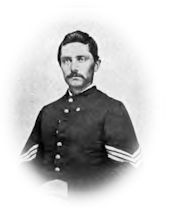
Wednesday, 5th—It was cold last night to lie in open bivouac. A cold northwest wind was blowing, and although we built fires to sleep by, yet the night was very uncomfortable, for while one was warm on the side next to the fire he was freezing on the other. We lay still all day to rest, but many of the boys slipped out in small squads for forage; they ran all over the country and fetched in fresh pork by the wholesale. I was in a squad of six with our corporal and we came in with our haversacks filled with sweet potatoes. On returning to camp, we passed too close to the colonel’s tent, and he happened to be standing outside taking a sun bath. He called the corporal to his side, asked him where he had been, where he belonged, and taking out his penknife, cut from the corporal’s blouse his chevrons and gave him an order to his captain, reducing him to the ranks.[1] The rest of us passed on to our tents. While we were out foraging, the colonel issued an order directing each orderly sergeant in the regiment to have his company fall in line every thirty minutes for roll call, and every man not answering to his name was either to be put in the guardhouse or on extra duty. I was caught, but being a pretty good friend of the orderly. I got off easy. He ordered me to carry a kettle of water to the company cook, telling me that since this was my first offense, he would let me off with that. None of the boys was punished very hard.
[1] This, it has always seemed to me, was a mean, contemptible thing for the colonel to do.—A. G. D.
Tuesday, 4th—We started rather early this morning and arrived at Grand Junction at 9 o’clock in the evening. The army has burned the fences along the road and set fire to many deserted houses.[1]
[1] Our march these two days was marred by the disgraceful spectacle of the waste and destruction of property. Some men set fire to the autumn leaves in the fence corners along the road. A high wind blowing soon spread the fire, which laid waste the timber and burned some farm buildings, together with their contents. Such destruction of property was the disgrace of our army—but it was at the seat of war.—A. G. D.
Monday, 3d—We started at 8 this morning, and marched eighteen miles. We cannot get much sleep at night because the army is so large; it is about 10 o’clock every night before we get into camp. But the weather is quite cool and the roads are good for marching. We went into bivouac for the night in a large vacant field. We passed through some rich farming country today, which the foraging parties had not found. The farms have good buildings and fences, and the crops are bountiful.
Sunday, 2d—We struck our tents, packed our knapsacks and sent them into Corinth for storage. The sick were all left in the hospital at Corinth. We started at 2 p. m. and marched fourteen miles, when we bivouacked for the night. The roads are very dusty and the weather is quite cool, but we are breaking the chill by building campfires.
Saturday, 1st—I was on guard today. The Sixth Division received orders to march in the morning.[1] We are to go in light equipment, leaving here our knapsacks and tents, which are to be put in storage.
[1] The Eleventh Iowa regiment was within fifty miles of Corinth for two hundred and thirty-four days, and in that time took active part in the two days’ battle at Pittsburg Landing, the siege of Corinth, two months of garrisoning and fortifying Corinth, forty-two days in fortifying and garrisoning Bolivar, the battle of Iuka and garrison duty there, the two days’ battle of Corinth and then the pursuit of the enemy and return to Corinth. During all this time Company E was with the regiment performing its full duty. The losses of our company were nine killed in battle and five dying of disease, making fourteen of the company whose bodies were laid away under the green sod.—A. G. D.
Friday, 31st—This was general muster day, and we were reviewed this afternoon by the commanding officer, General McArthur. The general says our division is hard to beat, declaring that it would be difficult to find a better-looking number of men armed for active service than the Sixth Division. After the review we were mustered for pay. The weather is very warm and the roads are dusty.
Thursday, 30th—The weather is quite warm again. We were at work getting ready for general inspection, cleaning camping ground, clothing and accouterments. Our camp is now in fine shape and the men are well rested. Some of the sick and wounded who have been absent for some weeks are returning to camp.
Wednesday, 29th—The Eleventh Iowa was detailed to clean up and smooth a tract of ground for inspection. We are to have general inspection of the army here at Corinth, and it is to be made by General Grant.
Tuesday, 28th—The regiment worked on the fortifications today for the third day in succession. I was not with my company though, being on other fatigue duty. The forts under construction are arranged so that if one fort should be captured, the guns of two other forts could be turned upon the enemy in that one. The floors of the forts and the rifle-pits are raised from four to ten feet by filling in earth, and then laid with the lumber from the houses which were pulled down to make room for the fortifications. The ramparts are faced on the outside with long woven baskets of hickory withes and filled with earth to keep them in shape. The forts are built with a view of standing some time, and should last for four or five years. We commenced drawing bread instead of crackers.
Monday, 27th—Our entire regiment was at work on the fortifications. Nathan Chase and William Cross of my company had a fight today, all over some trivial matter. It seems that it is enough to have to fight the rebels without the men fighting among themselves. They were put into the guardhouse.