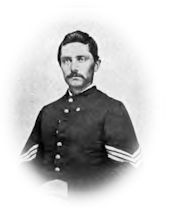
Wednesday, 27th—Companies G and B came out this morning to relieve us from picket duty at the big cut. We have had very little rest while on picket and patrol during the last forty-eight hours. Our regiment has begun building fortifications here at Bolivar; some negroes drifting into camp have been put to this work. The rebels to the south of us are getting bolder, and have driven in some of our outer pickets.
Diary of Alexander G. Downing; Company E, Eleventh Iowa Infantry
Tuesday, 26th—We remained on railroad guard all day again. Nothing of importance happened, but we had quite an exciting time for a while last night. When George Cush of Company E was on vedette, he thought he heard someone ahead of him in the brush, and gave the usual command to halt, but without response. Then as the noise continued he let fire, and although he hit nothing, yet that shot was enough to arouse the whole reserve post, and we remained in line the rest of the night, thinking that the rebels would make a charge on us before daylight. In the morning, upon investigation, we concluded that the noise must have been made by a hog or a calf, for there was not the least sign of the rebels. But the boys of the company began teasing George about his scare, and it is not likely that they will let him know the last of it for some time.
Monday, 25th—Companies E and K went out on railroad guard, to the deep cut about four miles east of our camp. We went to relieve Companies C and H and are to stay out two days. We have to patrol about five miles of the track to the east of our reserve post, making nine miles of track to guard. Our reserve stays in a schoolhouse located on a high piece of ground close by the railroad. We have to keep a strong picket line all night. Our drinking water here is excellent, and we have all the peaches and apples that we can eat. Some rain this evening.
Sunday, 24th—I went out on picket this morning to remain at the one post for twenty-four hours. I was on vedette for eight hours, two hours at a time. The vedette has to stand out in advance of the reserve post, one hundred yards or more. This post is about three miles east from Bolivar on the main road, having a high rail fence on either side. If the rebels should make a raid on the town, they would have to come in on this road.
Saturday, 23d—Some very hot weather today. It is my turn off duty today, but I dread the picket tomorrow on the main road going into Bolivar.
Friday, 22d—No news of importance. The rebels are not making any attacks on us, but they keep us busy watching them.
Thursday, 21st—There is one train a day over the railroad. It is a combination train, and comes in at 6 p. m. and departs at 8 o’clock in the morning. The train does not run at night for fear the track might be torn up, as the rebels are so near.
Some very hot weather now. We get all the fruit that we want here, and have plenty of other rations at this camp. We have fresh pork and sweet potatoes. The potatoes we either boil in kettles or bake in ashes.
Wednesday, 20th—Nothing of importance.
Tuesday, 19th—We received orders that two companies are to go out every three days about four miles east of the camp, to guard the railroad at the deep cut. On the third day they are to be relieved by two other companies from the regiment. It is a dangerous place to be on picket.
Monday, 18th—We are having some very hot weather. Since coming to Bolivar, each man is permitted to cook his rations in his own way, and so every man has a frying pan of some sort, and a tin peach can in which to boil his coffee. One man in our company, “Long John,” as the boys have nicknamed him, is a great coffee drinker. He carries a two-quart peach can strapped to his haversack, and every day buys up one or two rations of coffee from the boys who do not use much.


