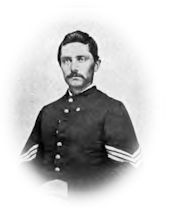
 Wednesday, 9th—Fifteen hundred more of our troops arrived. We are still burying the dead. It rained again today. The ground is so thoroughly soaked that it is difficult to dig the graves deep enough and keep out the water. We bury our dead by companies, all of one company in one grave, and if only one of a company is killed, the body is placed in a grave by itself. The bodies of the rebels’ dead are placed side by side in long graves. The carcasses of horses are removed by burning them.
Diary of Alexander G. Downing; Company E, Eleventh Iowa Infantry
Tuesday, 8th—We formed a line of battle early this morning and remained in line about two hours.[1] So many men throughout the camp were firing off their loaded rifles, preparing to clean them, that the officers thought a battle was in progress out in front. About 9 o’clock word came in from the front that there was no rebel in sight, and we were ordered back to our quarters. We spent the day in burying the dead, both our own and those of the rebels.
Our battle line had been at the south end of Jones’ Field, where a few days before we had cleared the timber for a review ground. This place was fought over so often by both armies and the dead lay so close that one could walk on dead bodies for some distance without touching the ground. There were over three thousand five hundred dead on the battlefield, and something like five hundred dead horses. Seven hundred bodies of the rebels were put into one grave. It is an awful sight to see the dead lying all about. It rained this forenoon, but cleared off this afternoon. The heavy rains have soaked the ground, making it very muddy. About five thousand of our forces arrived today.
[1] It has been said by some that from General Grant down to the commonest private in the ranks of the entire Army of the Tennessee, all the men cared for on Monday afternoon, the second day of the battle of Shiloh, was to get back to their camps. I cannot believe the statement, for on Tuesday, the 8th, when we were ordered into line of battle, on that gloomy, rainy morning, and a cold wind blowing from the northwest, I know by the sentiment of the boys in my own company, that they would have gone to the front then if ordered to do so. We felt that the loss in our company was too great not to follow up the victory.—A. G. D.
Monday, 7th—It rained all night. The battle was renewed this morning at 6 o’clock, by our forces under General Buell. The Eleventh Iowa formed and marched forward with parts of broken regiments, in support of the left center of Buell’s army, whenever needed. It was very trying for us thus to stand in line of battle, shells exploding over our heads and cutting off limbs of trees, spent minie balls flying all about us, yet not being able to get into action, because of the line of battle just in front of us. The rebels were fighting desperately, but falling back all the while with great slaughter of men. About 3 p. m. the rebels in front of us began to retreat, with Buell’s army after them, but we remained in line. About an hour later the report came that the rebels had left the field, and we were ordered back to our camp in Jones’ Field, arriving there about dark. We had not been in our tents since Sunday morning and they were still standing, but a great many had been hit and badly torn by shells and minie balls. We found the body of a rebel soldier lying in my tent; he had been wounded and apparently had gone in, crawled between our bunks and bled to death. We carried the body out to the parade ground and then got a shovel to clean away the blood from the place where the body had lain in the tent.
Sunday, 6th—The long roll sounded about half-past seven in the morning, and at once we formed a line of battle on the regimental parade ground. At about 8 o’clock we were ordered to the front, and marching out in battle line, about one-half mile, we met the rebels at Water Oaks Pond. Dresser’s battery was just in front of our regiment, we acting as a support to it. The rebels came up on our right, compelling us to fall back about eighty rods to our second position, where we remained until we were again flanked, when we fell back to within about one hundred yards of our parade ground, where we lay down on the brow of a hill awaiting the approach of the rebels in front. While in this position, Thomas Hains of Company E took off his hat, placed it upon his ramrod, and holding it up, shouted to the boys along the line to see what a close call he had had while out in front, for a minie ball had passed through the creased crown of his hat, making four holes. Before he could get his hat back on his head, a small shell burst over us and mortally wounded him.
By this time the rebels were marching right oblique, just in front of us, in double line of battle with their two stands of colors flying. By order we waited until we could look them in the eye and then rose up and fired a volley at close range into their ranks, throwing them into great confusion. We then made a bayonet charge, capturing one of their standards, and together with the Eleventh and the Twentieth Illinois Infantry we captured Cobb’s battery and retook General McClernand’s headquarters. In this charge Company E met its greatest loss of the day.
My musket became so dirty with the cartridge powder, that in loading it the ramrod stuck fast and I could neither get it up nor down, so I put a cap on, elevated the gun and fired it off. But now I had no ramrod, and throwing down my musket, I picked up a Belgian rifle lying at the side of a dead rebel, unstrapped the cartridge box from his body, and advanced to our company, taking my place with the boys. While in this position I witnessed a wonderful sight—thickly-flying musket balls. I have never seen hail falling thicker than the minie balls were flying in the air above us, though too high to do any harm. Our ammunition soon ran out and the entire regiment was ordered to the rear to replenish our cartridge boxes.
When leaving with my company for the rear to restock our ammunition supply, I passed a severely-wounded boy (a stranger to me) who begged me to help him to the rear and out of danger. I stooped down and let him put his arms around my neck, but finding that I could not rise up with him hanging on my neck, I assured him that he would be safe there among the logs, and explained that if I should stay with him, I would surely be taken a prisoner, so left the poor fellow to his fate.
After filling our cartridge boxes, we again formed in line of battle close by the cavalry field and right in the midst of heavy brush timber. Here we remained for about two hours, when we were ordered by General Grant (in person) to a position on the extreme left of the Army of the Tennessee, in support of Dresser’s battery, being placed in line by Webster of General Grant’s staff, just to the left of the siege guns. Here we were engaged for more than two hours. The Fifty-fifth Illinois and the Fifty-fourth Ohio were placed to our left in support of two batteries hard by the river. Here about 5 o’clock in the evening, three regiments of Buell’s army, just arriving, helped to repulse the fearful charge of the rebels.
The Eleventh Iowa was taken from its brigade early in the morning and remained separated all day. Now with the end of the day’s fight, and after dark, we retired a few rods distant from our last line of action and without food or shelter bivouacked for the night, lying down on the wet ground in the rain.
This was our first battle and our company was hard hit, our losses being as follows: Killed, Lieut. John F. Compton, Serg. Ezra McLoney, John R. Buckman, George Croak, Thomas M. Hains and Carlton Frink: mortally wounded. George W. Simmons and John W. Dwiggans; severely wounded, Elmore Chrisman and John T. Rice.[1] About ten other boys were slightly wounded.
[1] Rice finally died on April 19th, from the effects of the wound and typhoid fever.—A. G. D.
Saturday, 5th—We had company drill this morning as usual. Lieutenant Compton took the company out on the drill ground this afternoon for company drill, and he said: “Now, boys, we drill in earnest for an hour, then return to our quarters, put away our rifles, and then to the branch for bathing.” It was warm, but the men all went into it and after a hard drill we had a good wash-off in the branch.[1]
[1] This was the last time that Lieutenant Compton ever drilled our company, for the poor fellow was killed in the battle on the next day, Sunday, a little after noon. He was a fine drillmaster, and kind to his men, especially to those who tried to do their duty.—A. G. D.
Friday, 4th—It rained and hailed this afternoon, and by night it got very warm. We were ordered under arms at 6 p. m., and we formed a hollow square on the parade ground. We remained in line until 10 o’clock, when we were ordered back to our tents. It was reported out in front that the rebels were advancing in force from Corinth, but at 10 o’clock the word came that they had bivouacked for the night.
Thursday, 3d—We had drill as usual today and also general review, by General McClernand. We have no guard duty at this camp, but the troops of the front camps have to keep out a strong picket line.
Wednesday, 2d—It rained all day and we had no drill. The men remained in the tents, reading the Bible, magazines and papers, or writing letters home.
Tuesday, 1st—Our Division, the First, was reviewed this forenoon by General Grant and Maj. Gen. J. A. McClernand. While the review was in progress three men were seen on the roofs of two small log houses at the southern end of Jones’ Field, taking notes on our maneuvers, the number of men in line, etc. They were dressed in butternut suits although, it is said, they had claimed to be Union men; yet when the review was ended no trace of them could be found.
Monday, 31st—Our regular drills are: Company drill from 10 to 11 a. m., battalion drill from 3 to 5 p. m., and dress parade at 5 p. m. We have a splendid drill ground in a large field. Received orders to get ready for review by General Grant tomorrow morning at 10 o’clock.
The country around here is quite rough and the soil is very poor. There is a great deal of gravel and there are some rocks, but the soil works very easily. The timber here is mostly white oak.


