Thursday, 22d—Received orders this morning to get ready for review. At 1 o’clock in the afternoon we marched down into town and through the streets for a while and then back to camp. General Baker, Adjutant General of Iowa, is in charge of the camp. Our camp was named for General McClellan in the East.
Diary of Alexander G. Downing; Company E, Eleventh Iowa Infantry
Wednesday, 21st—We drew our army cooking utensils this morning and one day’s rations, and then cleaned up our camp. Besides a part of the Eighth Iowa Infantry, there is a part of the Second Iowa Cavalry in camp. The first day of camp life is past, and we had our first experience of a night in camp, sleeping on straw for a bed.
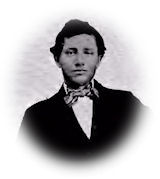
Tuesday, 20th—I went early this morning to Inland, where all who enlisted were to meet and go to Davenport.[1] Several of the friends came in to see us off. There were forty-five of us and at 9 o’clock we left in wagons for Davenport. After a hot, dusty ride we arrived at Davenport at 4 o’clock in the afternoon, and marched out to Camp McClellan, where they received us very kindly. We had very fine barracks to go into and the boys of the Eighth Iowa had a good supper for us. It was our first meal in the army and consisted of boiled potatoes, fried bacon and baked beans. We have lots of straw to sleep on at night. We were to meet a part of a company from Le Claire under command of Captain Foster and together form one company in the Eighth Iowa Infantry. But Captain Foster did not come, and since there are only eight Le Claire boys here we have not enough to make a company.
[1] When I bade father good-by, he said: “Well, Alec, as you have made up your mind to go into the army, I want you to promise me that you will not enter into any of the vices that you will come in contact with while in the army, but try to conduct yourself just as if you were at home.” Of course I was not an angel while in the army, but I always remembered father’s advice and to that I attribute what little success I have had in life—and this is my seventy-second year. Father was in his forty-sixth year, but he told me that if it were not for leaving the family alone, he would go with me. He was a strong Union man, and his father had served all through the War of the Revolution, in the command of General Wayne.—A. G. D.
Monday, 19th—I helped haul and stack hay this forenoon, and in the afternoon went to Inland with the other boys who enlisted yesterday, to see about going to Camp McClellan, at Davenport.
Sunday, 18th—This morning attended the Methodist church and Sunday school at Posten’s Grove. Several Methodist brethren were received into the church. In the afternoon Mr. Wharton, the minister, delivered a patriotic speech and spoke of the war. He then called for volunteers and I put my name down to go for three years or during the war. About fifty-five boys enlisted and we are to go in Company E of the Eighth Iowa.
Saturday, 17th—I mowed grass all forenoon and in the afternoon went to a Sunday school celebration down at Posten’s Grove. I made up my mind to enlist and go and fight our Southern brethren. In the evening I went to Mr. Willey’s to stay all night with Ward. Later in the evening we attended a peace meeting at Inland.
Friday, 16th—I, with Tom Toly, mowed grass all day. Swinging the scythe was hard work for me and I did not cut as wide a swath as Tom did. Father went to Tipton in the afternoon and upon his return told us the war news. I am thinking some of enlisting and going to war.
Thursday, 15th—We capped our grain stacks against rain and windstorms, and then commenced mowing wild grass for hay. This is my birthday; am nineteen years old.
During the months of July and August, 1861, the country was greatly aroused over the prospects of war. Excitement rose high when the news of the battle of Bull Run, July 21st, was flashed over the wires. I was then almost 19 and living at home on a farm near Inland, Cedar county, Iowa. Naturally I was deeply stirred over the question of war. Some of our neighbors and friends had earlier opposed the use of force in preventing secession, but I distinctly remember that my father and many neighbors and friends entertained no doubt as to the righteousness of such a course.
During these days we were at work in the harvest field. We had finished cutting our wheat and oats and during the first two weeks of August were engaged in stacking the grain. Everyone had some part in the work. Father did the stacking, while John was on the stack with him, placing the sheaves at his right hand. Albert and George drove the teams to and from the fields, while Paul and Andrew attended to watering the stock during the day.[1] Tom Toly, a strong Irishman, who had worked for us three or four summers, pitched the sheaves to father from the wagon, and Dave Cole pitched the sheaves from the shocks in the field to me on the wagon, while I arranged them on the load.
There had been some talk of raising a company of troops at Inland, but nothing had come of it. At Tipton, the county seat, a company of one hundred men was raised when the first call for volunteers was made. But as they were not then needed, they went out under the call of July 23, 1861, and became Company A of the Fifth Iowa Infantry.
I had been pondering in my mind the matter of going to join the army. On the evening of Saturday, August 10th, news came of the battle of Wilson’s Creek, and that General Lyon had been killed. The First Iowa Infantry was in that battle and made glorious history for itself and for Iowa. That fact, with the excitement over the battle itself, stirred us boys in the neighborhood, and I practically reached a decision as to what I should do.
The next day was Sunday, and everybody was talking about the battle of Wilson’s Creek. Ministers spoke of it in their sermons and prayers. It was the all-important topic of the day, and for the next three days—the 12th, 13th and 14th of August, it was the topic of conversation while we were finishing our work in the harvest field. On the next day, my birthday, I began my diary and shall now let it speak.
[1] The five boys, John, Albert, George, Paul and Andrew, are Mr. Downing’s half-brothers. They are all living at this time (March, 1916) and all reside in Iowa—Ed.


