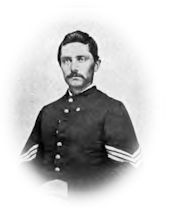
Monday, 9th—The weather is warm and pleasant and things are growing fine. The order of the day in camp is as follows: Reveille at 4 o’clock, roll call and breakfast call at 6, doctor’s call at 6:30, guard mount and company inspection from 8 till 9, company drill 9 to 10, dinner call and roll call at 12 noon; in the afternoon, company drill from 2 to 3 o’clock, dress parade and supper call at 6, tattoo and roll call at 8, taps at 8:30, when all lights must be out and every man not on duty must be in his bunk. This is the way the days pass with a soldier in camp, in time of war.
Diary of Alexander G. Downing; Company E, Eleventh Iowa Infantry
Sunday, 8th—All is quiet. We had dress parade this evening and an order was read to the effect that the troops should drill two hours a day in company or skirmish drill, and besides that, the recruits should drill four hours a day; also that there are to be four roll calls a day, and company inspection every morning at 8 o’clock. There are about five thousand men in camp under command of Brig. Gen. F. M. Force, and all are in fine spirits and well fitted for a fight. The general quartermaster has large quantities of rations and ammunition here, and there are some three or four thousand beef cattle for our meat supply. This camp puts us in mind of our camp at Pittsburg Landing, two years ago, but I do not think that we will have such a battle as we had then, although the rebels’ cavalry is quite active.
Saturday, 7th—Our new wedge tents were issued to us this morning by the quartermaster, and we worked all day pitching the tents and building bunks. I was on fatigue duty as corporal, in charge of a squad of men cleaning the grounds. We have a fine camp at this place with very good water. The health of the men is excellent and they are all in fine spirits. There was a flying report that the rebel general, Forrest, has been captured, but we don’t know as to the truth of it.
Friday, 6th—Our boats tied up for the night, but early this morning, at 4 o’clock, we continued our journey. The river is deep and narrow here, which with the high bluffs, makes it a dangerous place for bushwhackers, but we were not molested on the trip. We reached Clifton at 3 o’clock in the afternoon and disembarked, marched out about two miles and went into bivouac.
Thursday, 5th—Reveille sounded at 4 o’clock and by daylight we were on the boats. At 8 o’clock we started up the Tennessee river, our destination, we suppose, being Clifton, Tennessee. Our fleet consists of eleven transports and two gunboats, one of them in advance and the other taking the rear, so that if we should be attacked by light batteries from the bank, the gunboats would be ready for action and silence them. Then each transport has a squad of men with rifles in hand ready for action in case we should be fired upon by the guerrillas. The weather is pleasant and everything is working fine.
Wednesday, 4th—We lay here all day awaiting the boats. Nathan Chase, a veteran of our company, got into trouble with some men of the Fifty-third Indiana Regiment and one of them shot him twice, one ball going through his right arm and the other taking effect in his mouth, but neither wound is dangerous. The trouble was caused by drink. The health of the regiment is good, yet there are several sick, some with light attacks of the ague, and they are sent to the hospital here at Paducah. The transports arrived late this evening and we received orders to go aboard early in the morning.
Tuesday, 3d—We remained in bivouac all day. The transports did not return today as expected. The recruits of the Eleventh Iowa were formed into a battalion and drilled twice a day, by Captain Kelly of Company D. We had our first dress parade this evening, since returning from furlough, and the regiment looked well in their new uniforms, but it was very awkward in the manual of arms because of the new recruits. An order was read on dress parade making some promotions of noncommissioned officers in Companies A and H, since they went in as veterans. Paducah is a nice town and contained about seven thousand inhabitants just before the rebellion broke out.
Monday, 2d—We left Cairo at 1 o’clock in the night and arrived at Paducah, Kentucky, at 10 o’clock today. We were sent here to reinforce the troops at this place, as it was reported that the rebels, thought to be Forrest’s command, would make a raid into Paducah for the purpose of destroying our supplies. We went ashore while the transports with large details of men were sent back to Cairo for ammunition and provisions. I was detailed this morning for the first time as corporal of the guard. We have a force of about five thousand men at this place, with but one fort.
Sunday, 1st—The Eleventh Iowa signed the pay rolls this morning for two months’ pay. Six of the boys were robbed of $30.00 last night. Our regiment drew the new rifles and accouterments this afternoon. The Government is fitting out all of the veteran regiments with new equipments.
We received orders this afternoon to go on board the transports at 5 o’clock, and we struck our tents and turned them over to the post quartermaster. The Eleventh, the Fifteenth and part of the Thirteenth Iowa are on board the “John H. Dickey.” We were ordered to carry five days’ rations. Our destination is supposed to be Huntsville, Alabama.
Saturday, 30th—The Eleventh Iowa was mustered today for pay. The regiment numbers about six hundred men present for duty, and but few are absent on account of sickness. General McPherson is having his entire corps (the Seventeenth) armed with new Springfield rifles, and our regiment today turned over to the quartermaster the Enfield rifles and old accouterments to draw the new rifles and accouterments. Most of the men feel that the Enfield rifle is better suited to our use than the new one, for it has a bronze barrel, hence easier to keep clean, as the outside does not require extra polishing.
I took a walk this afternoon over Cairo to view the town. There is a great deal of building going on, even if it is one of the biggest mudholes in the State of Illinois. The town may be said to be on stilts, for the buildings rest on posts, ten or twelve feet from the ground, and of course the sidewalks are the same. There are only two or three really nice buildings in the town. But it is a very important place for our armies, as it is the mobilizing point for our army on the Mississippi and the Tennessee rivers.


