Wednesday, 13th—After an early breakfast we left bivouac at 6 o’clock and took up our march. By noon we reached the Mississippi river, where we took boat, and going down about two miles landed on the east bank at Grand Gulf or Hard Times Landing—where the town once was. The town was destroyed just a year ago by the Union fleet, and there is nothing left but the streets and sidewalks. We went into camp here to stay until relieved.
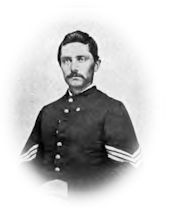
Diary of Alexander G. Downing; Company E, Eleventh Iowa Infantry
Tuesday, 12th—We took up our march at 5 o’clock this morning and marched sixteen miles over very fine roads. This is a very rich country, and before the war, was prosperous, but now looks quite desolate, the buildings and fences having been burned by our troops. At the approach of our army the people fled, leaving all behind them. At noon we halted for lunch, and since it was so fearfully hot, remained here during the heat of the day in the shade of evergreens. The Eleventh Iowa was situated just opposite the residence of General Bowie, said to be a descendant of the inventor of the bowie knife. The main Bowie residence was burned and household articles, among which is a grand piano, are strewn about the large lawn. The outbuildings, on a grand scale, were not molested. The lawn contains about forty acres and is planted in all kinds of tropical trees and shrubbery, with cisterns and fountains at different points. The plantation borders the west bank of Lake St. Joseph, the public highway being just between it and the lake. This plantation, containing several thousand acres, is all planted to corn, which is now in tassel and silk. Our march today was along the west bank of the lake with a continuous cornfield on our right. When night came we were still by the lake, where we went into bivouac.
Monday, 11th—We started this morning at 5 o’clock and marched about eight miles, when we stacked our arms until 3 p. m. We continued our march to Perkins’s Landing about forty-five miles below Vicksburg as the river runs, or twenty miles as the crow flies. Here we bivouacked for the night. The country here is very low and often overflows. The large plantations, such as Perkins’s, Holmes’s and Jeff Davis’s, are usually planted to cotton. The work is all done by slaves driven by overseers who live on the plantations, while the owners, planters, reside in more healthy localities.
Sunday, 10th—Our brigade received orders to march at 5 o’clock tomorrow morning. Regimental inspection at 8 o’clock this evening showed the regiment to be in fine order. Companies D and E went out on picket this evening.
Saturday, 9th—It is quite pleasant. Had battalion drill this forenoon. The boys are all in fine spirits, expecting at any moment to receive marching orders. Our division teams returned from the landing with provisions and went on down to Carthage, where they will load them on boats for Grand Gulf.
Friday, 8th—General Blair’s Division, composed of Ohio and Illinois troops, went by today on their way to Grand Gulf. All day teams were returning to the river landing for provisions for the army at Grand Gulf. We received orders to send all the sick back to the hospital at Memphis, and prepare to march. Our regiment has battalion drill twice a day now.
Thursday, 7th—One hundred and fifty prisoners captured at Grand Gulf were taken past here this morning; they all looked quite downhearted. A large train of provisions passed here for the army below. The roads are drying fast, which is making the hauling and marching better. The boys are all anxious to leave this place and move to the front. This is a low, unhealthy locality. An old negro here has picked up more than a thousand overcoats and blankets and is storing them away in his hut. These are thrown aside by the men marching out from the landing. On becoming warm and getting tired of their loads, they begin to unload about the first day’s march.
Wednesday, 6th—The Sixth Division trains all went to the landing this morning for ammunition. Wagon trains are passing back and forth all the time, hauling provisions and ammunition for the army at Grand Gulf. We had battalion drill this afternoon.
Tuesday, 5th—The Fourth Iowa Cavalry passed here this morning. It is a fine regiment of horse. Four hundred and forty-four rebel prisoners captured at Grand Gulf were taken by here this morning to be sent to our prisons in the North; they are a hard-looking set of men. News came today that our men have taken Grand Gulf with two thousand prisoners. If this is true it gives us a road to Vicksburg over high ground, which means the fall of Vicksburg.
Monday, 4th—The Eighth, Twelfth and Thirty-fifth Iowa Regiments passed here today on their way to the front. They are all fine-looking men. I feel in hopes that Vicksburg will soon be in our hands. Our division is in the rear, most of the other troops having gone on ahead of us. Our army is in strong force at this place, and there is no danger of the rebels’ cavalry making a raid on the base of our commissary supplies here.


